


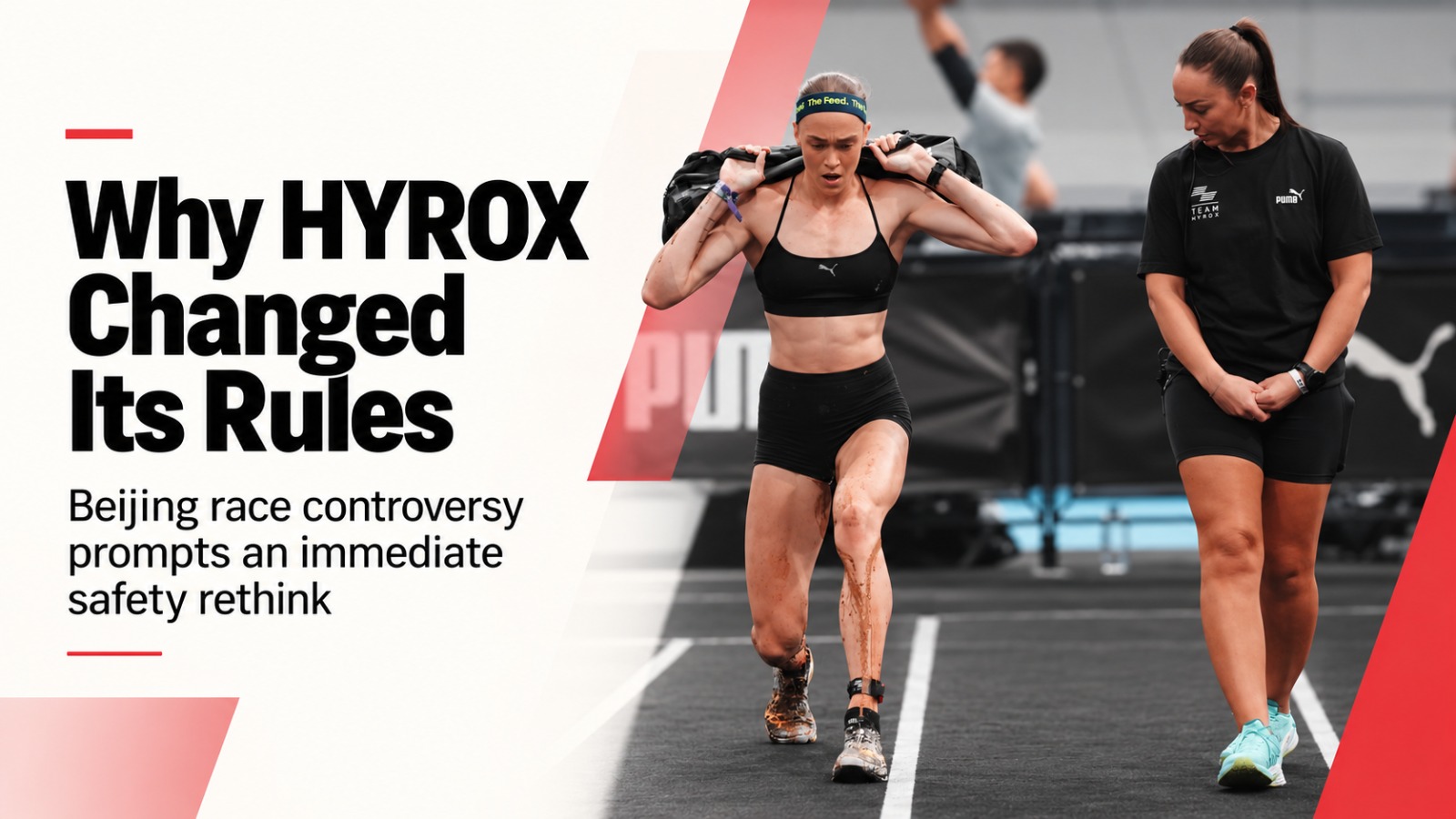
HYROX has changed its competition rules and procedures after acknowledging that officials failed to act quickly enough during a race in Beijing, where Australian athlete Joanna Wietrzyk was allowed to continue competing after soiling herself mid-event.
The incident became a major talking point because Wietrzyk continued through the race while using equipment and competition areas shared with other athletes. Footage circulated widely on social media, prompting questions about hygiene, athlete safety and how officials should respond when a biological contamination issue develops during a live competition.
Wietrzyk went on to win the event.
For HYROX, however, the controversy quickly became less about the result and more about a gap in its race-day procedures.
Why HYROX changed its rules
The central issue was that HYROX’s existing rulebook did not contain an immediate protocol specifically dealing with faecal contamination during competition.
Before the Beijing incident, athletes could already be penalised for offences such as littering, spitting or clearing their nose on the competition floor. But the rules did not provide officials with a comparable immediate procedure for dealing with faecal matter.
That became significant because a HYROX race is built around repeated movement between running sections and shared workout stations. Competitors use equipment including rowing machines, sleds, medicine balls and sandbags during the event.
Once the Beijing incident occurred, the absence of a clearly understood response became difficult for organisers to ignore.
HYROX co-founder Moritz Fürste later accepted responsibility for the way the situation was handled, saying the organisation had made a mistake by failing to react immediately during the race.
Fürste also confirmed that changes to the rulebook had been introduced immediately, with new rules and procedures intended to prevent a repeat of the situation.
What went wrong in Beijing?
The problem was not that HYROX had no health or medical procedures at all.
HYROX World said bio-contaminant and medical procedures were already in place. The difficulty, according to the organisation, was that procedures intended for elite competition and those designed for mass-participation events had become blurred.
That created uncertainty over how the rules should be interpreted and applied when the incident unfolded.
That distinction is important to understanding why HYROX responded with a rule change rather than treating the Beijing incident as an isolated athlete issue.
The organisation’s own explanation indicates that the failure occurred in how existing safety procedures translated into an immediate race-day decision.
In practical terms, officials did not stop the situation while the competition was still underway. HYROX later acknowledged that this response was not sufficient.
Shared equipment put health and safety at the centre of the debate
The incident attracted particular concern because HYROX competitions involve equipment and exercise areas used by multiple competitors.
After the race, HYROX China said the affected area and track were closed and isolated before comprehensive disinfection was carried out.
Contaminated equipment was removed, while affected lanes underwent deep cleaning. Venue carpet was also replaced overnight before competition resumed the following day.
Those measures showed that organisers treated the contamination seriously once the race had finished. The criticism, however, centred on why intervention had not happened earlier.
Other athletes and social media users questioned why Wietrzyk had been permitted to complete the event when fellow competitors could potentially come into contact with the same competition environment.
Competitor Joe Ho was among those who publicly criticised the response. He argued that participants had paid to compete in an event they expected to be professionally organised and safe. He also raised the possibility of physical and psychological consequences for people exposed to the situation.
HYROX admits officials should have acted sooner
The most significant part of HYROX’s response was its acknowledgement that the organisation itself had failed to react appropriately.
Fürste did not place the responsibility solely on the athlete. Instead, he said it was his responsibility to anticipate possible incidents and admitted that HYROX had not acted immediately when it should have.
That admission helps explain the speed of the subsequent rule change.
Rather than waiting for another event, HYROX said new procedures had already been put in place.
The available statement does not spell out every individual provision contained in the revised rules. What it does establish is that the organisation has moved to address the ambiguity exposed in Beijing and create procedures intended to prevent the same situation happening again.
What happened to Joanna Wietrzyk?
Wietrzyk, who is identified as the world record holder in the HYROX women’s solo event, had been invited to compete in Beijing.
After the event, she briefly posted a photograph to her Instagram story from what appeared to be a hospital bed. The post was later deleted.
The controversy then moved beyond criticism of the organisers, with online abuse directed at Wietrzyk after her identity became widely known.
HYROX responded by warning that people who sent abuse or threats of violence towards the athlete could be banned from future events.
That response drew a line between legitimate questions about competition safety and personal abuse directed at an individual athlete.
So, why exactly did HYROX change the rules?
HYROX changed its rules because the Beijing race exposed a specific weakness in how its safety procedures worked during live competition.
The organisation already had medical and bio-contamination procedures, but it acknowledged that the distinction between protocols for elite racing and mass-participation events had become unclear. Its rulebook also lacked an immediate protocol specifically covering faecal contamination.
When Joanna Wietrzyk was allowed to keep racing, that gap became visible in real time.
The resulting criticism was therefore not simply about an unusual incident during an endurance event. It was about whether organisers had a clear system for protecting every competitor when contamination affects shared equipment and competition areas.
HYROX has since admitted that it should have intervened sooner and says new rules and procedures are now in place.
The Beijing incident ultimately forced the organisation to answer a question that had not been clearly addressed before: when an athlete’s medical or bodily issue becomes a health and safety concern for others, who stops the race, and at what point?
HYROX’s immediate rulebook changes are its attempt to make that decision clearer the next time officials face such a situation.
Also Read: Netflix New Releases This Week: 15 Titles Arrive Sept. 14-20, With Five Landing on September 17