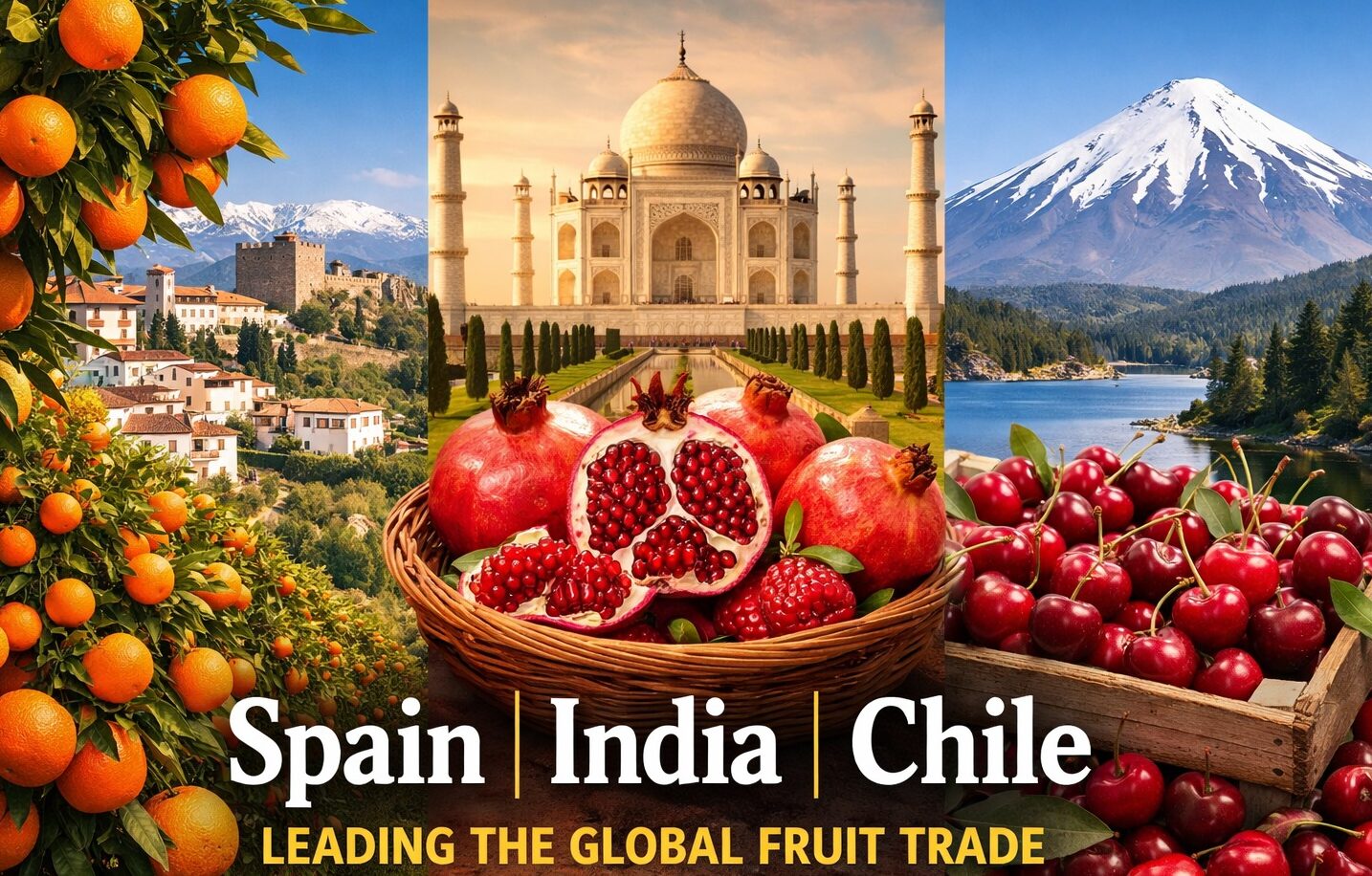
Three countries have emerged as dominant forces in the global fruit export market, each leading in a specific category through a combination of climate advantage, product quality, and strong logistics networks. Spain has established itself as the world’s top exporter of oranges, India leads in pomegranate shipments, and Chile holds a commanding position in cherry exports. Their success highlights how strategic planning and infrastructure can outweigh sheer production volume in international trade.
Stronghold in Key Fruit Export Segments
Spain continues to lead global orange exports, shipping between 1.5 and 1.8 million metric tonnes annually. It is followed by Egypt, South Africa, and the United States. Despite not always being the largest producer, Spain’s ability to consistently deliver high-quality fruit to nearby European markets gives it a strong competitive edge.
India dominates the global pomegranate export market, with annual shipments ranging from 90,000 to 100,000 tonnes. The country has built a reputation for producing varieties that meet international quality standards and travel well over long distances, making them highly suitable for export.
Chile, meanwhile, has become the undisputed leader in cherry exports. With shipments exceeding 428,000 tonnes, the country accounts for more than half of global cherry exports. Its scale and efficiency have made it a key supplier to international markets, particularly during peak demand periods.
Also Read: Shubman Gill’s Net Worth: Salary, Cars, and Lavish Lifestyle
The dominance of these countries underscores a broader trend in agricultural trade. Success is not determined solely by how much a country produces, but by how effectively it aligns its output with global demand and delivers it efficiently.
Spain’s advantage lies in its proximity to major European markets, which allows for faster delivery and fresher produce. Its well-developed logistics infrastructure ensures that oranges reach consumers quickly while maintaining quality.
India’s pomegranate industry benefits from a focused approach to cultivation. Farmers grow varieties that meet the preferences of international buyers, particularly in regions such as the Middle East and Europe. Combined with improving supply chains, this has strengthened India’s position in the global market.
Chile’s cherry exports are driven by timing as much as volume. Its harvest season falls during the Northern Hemisphere’s winter months, when demand is high and supply is limited. This counter-seasonal advantage, supported by advanced cold storage and transport systems, allows Chile to capture a significant share of the market.
Building Competitive Advantage Through Strategy
Each of these countries has leveraged its natural and structural strengths to build a sustainable export model. Spain’s Mediterranean climate supports consistent orange production, while its integration with European trade networks ensures steady demand.
India’s success in pomegranates is rooted in favourable growing conditions and long-standing trade relationships with key importing regions. The country has also adapted its production practices to meet export requirements, including durability and shelf life.
Chile has invested heavily in logistics, particularly cold chain infrastructure, to ensure that cherries remain fresh during long-distance transport. This has been critical in maintaining quality and expanding its reach to distant markets.
Future Outlook and Emerging Competition
The current leaders are well-positioned to maintain their dominance if existing conditions remain stable. However, the global fruit export landscape is not static. Emerging exporters are gradually increasing their presence in key markets.
Countries such as Uzbekistan in cherries and Egypt in pomegranates are expanding their production capacities and improving market access. While they have yet to match the scale of current leaders, their growth signals increasing competition in the years ahead.
At the same time, external factors could reshape the market. Climate change may affect growing conditions, while shifts in consumer preferences and trade policies could influence demand patterns. Exporting countries will need to adapt to these changes to retain their competitive edge.
A Clear Lesson from Global Trade Patterns
The success of Spain, India, and Chile illustrates a key principle in global agricultural trade. Strategic alignment between production, quality, and logistics can be more important than total output. By focusing on market needs and building efficient export systems, these countries have secured leading positions in their respective segments.
Their continued dominance will depend on how well they sustain these advantages while responding to evolving global conditions.
Also Read: Atlas Secures $6 Million Seed Funding to Expand AI Solutions for Accounting Firms