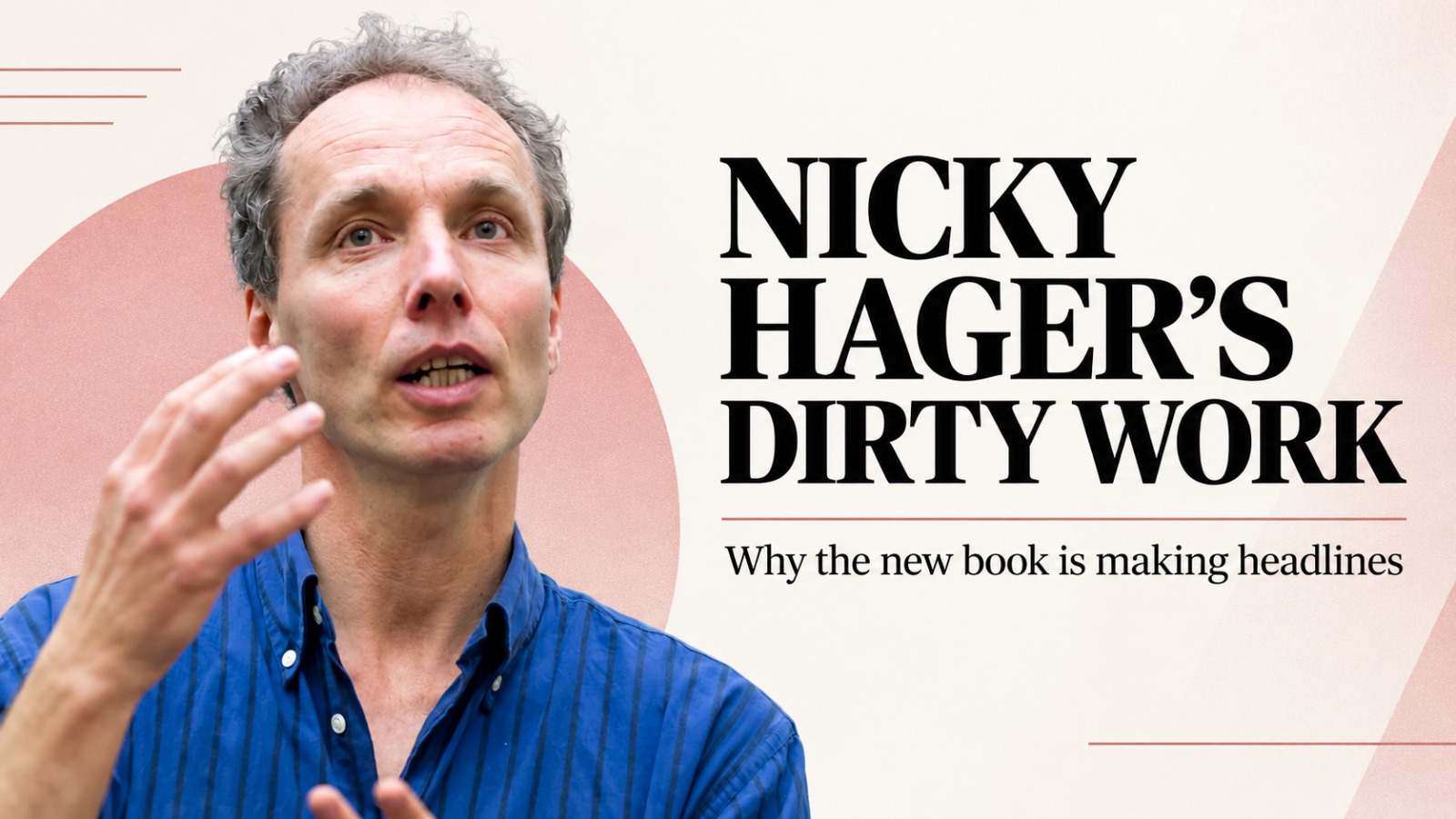
Nicky Hager’s latest investigation, Dirty Work, turns its attention to the New Zealand Taxpayers’ Union and what the investigative journalist describes as a wider network of political influence on the right. The title immediately recalls his 2014 book Dirty Politics, but this time Hager says much of the story comes from people who have worked inside the organisations and parties he is examining.
Nicky Hager has returned to New Zealand’s political debate with a title designed to invite an obvious question: what, exactly, is the “dirty work”?
The investigative journalist confirmed at the Wellington launch of his new book that it is called Dirty Work and that its central focus is the New Zealand Taxpayers’ Union. Hager described the organisation as part of what he called the “latest front for New Zealand’s hard right”.
That description is Hager’s, and the claims contained in the book remain his allegations. But his remarks at the launch offer the clearest explanation so far of what the title is intended to convey.
Rather than simply examining the public positions of a lobbying organisation, Hager says the book looks at the work taking place around political campaigns, attacks on opponents and relationships between lobby groups and political parties.
Crucially, he says much of the material came from insiders.
Hager told the launch audience that the book relied heavily on former Taxpayers’ Union staff and National Party members who were unhappy with what they saw happening in New Zealand politics.
That detail matters because it gives Dirty Work a somewhat different frame from the book with which it will inevitably be compared.
Why the title ‘Dirty Work’ matters
The name immediately brings Hager’s Dirty Politics back into the conversation.

Before the launch confirmed the title, The Post reported that booksellers had seen the new book invoiced as Dirty Work and noted that the name suggested a possible follow-up to Hager’s 2014 investigation.
There is, however, no statement in the available reporting in which Hager gives a literal explanation of why he chose those two words.
What he did do was describe the kind of activity the book investigates.
Among the stories Hager highlighted at the launch were the political evolution of Act leader David Seymour, whom Hager characterised as becoming “Mr anti-Treaty”, and what Hager called a “hit-job” targeting former 1News political editor Maiki Sherman, who resigned earlier in 2026.
Those are Hager’s characterisations, not independently established conclusions in the reporting available so far. Still, they help explain the book’s central idea. Dirty Work appears to be Hager’s description of political activity that he believes is carried out outside the most visible parts of party politics, but which can still shape political debate, public reputations and electoral narratives.
His larger argument appears to be about influence rather than a single incident.
Asked how the book demonstrated links between lobby groups and political parties, Hager claimed politicians across the main right-wing parties either tolerated or collaborated with the Taxpayers’ Union. He said he believed those relationships were politically damaging.
Again, that is Hager’s allegation. The material released in the two reports does not independently establish the extent of those relationships.
Why the Taxpayers’ Union is the focus
For Hager, the book is not being presented simply as a profile of the Taxpayers’ Union.
His launch comments suggest he sees the group as a case study in how political advocacy, campaigning and party politics can overlap.
He also argued that coalition ministers had benefited from work done by organisations such as the Taxpayers’ Union and said they should be accountable to the public for those connections.
The timing is deliberate too.
When Hager posed the question of why release the book before an election, he said elections were precisely the time when people should be thinking about politics, asking: “What better time?”
That places Dirty Work firmly inside the political argument surrounding New Zealand’s 2026 election, even though the full significance of its allegations will depend on the evidence presented in the book and how those named in it respond.
Jordan Williams pushes back
Taxpayers’ Union executive director Jordan Williams had addressed speculation about the book even before its launch.
Williams, who also appeared in Hager’s 2014 Dirty Politics, said he was “flattered” by the possibility that his organisation might again feature in a Hager investigation.
Speaking on Newstalk ZB before the launch, Williams said the speculation had “snowballed”. While acknowledging that the book could be about him or the Taxpayers’ Union, he argued that Hager had “a fixation on anyone who’s successful on the centre-right” and questioned whether there were more important subjects Hager could be pursuing.
His comments provide an early indication of how the book is likely to be contested. Hager is presenting his investigation as an examination of political influence and accountability. Williams is challenging the premise and Hager’s choice of target.
That disagreement will be central to how Dirty Work is received.
The shadow of ‘Dirty Politics’
Any new political book from Hager was already likely to attract attention. Calling it Dirty Work makes comparison with Dirty Politics unavoidable.
His 2014 book appeared during that year’s election campaign and examined alleged links between then Prime Minister John Key’s office and right-wing bloggers. The book was based on hacked emails and online conversations involving Whale Oil blogger Cameron Slater that had been supplied to Hager by a third party.
The aftermath extended well beyond the book itself.
Police searched Hager’s home in October 2014 while investigating the hacking that led to the material used in Dirty Politics. In 2018, police apologised and paid Hager substantial damages after the search was found to have breached his rights, including through the improper obtaining of 10 months of his banking information.
That history is relevant because Hager has built much of his career around information supplied by people inside political, government or institutional systems.
His previous books include The Hollow Men, which examined the Don Brash-era National Party, and Seeds of Distrust, which became part of the political controversy known as Corngate during the 2002 election campaign.
What makes ‘Dirty Work’ different so far
The most striking detail to emerge from Hager’s launch is not simply that another election-year investigation has appeared.
It is his claim about where the information came from.
Unlike Dirty Politics, whose origin became closely associated with hacked communications supplied by an anonymous source, Hager is publicly emphasising former Taxpayers’ Union staff and National Party members as important sources for Dirty Work.
That gives the new book a different starting point.
The argument Hager appears to be making is that the most revealing account of contemporary political campaigning can come from people who once participated in the machinery themselves.
Whether the evidence in Dirty Work sustains that argument will depend on the book itself, not simply its launch claims.
But the reason for the title is becoming clearer.
For Hager, the story is not merely about who publicly argues for lower taxes, smaller government or a particular political programme. It is about the methods, relationships and campaigns that he alleges operate behind those public positions, and about the question of who ultimately benefits from them.
That is the terrain Dirty Work has chosen to enter, just as New Zealand heads deeper into an election year.
Also Read: Paymob Raises $35m Pre-Series C After Adding 20,000 Clients Since January Last Year