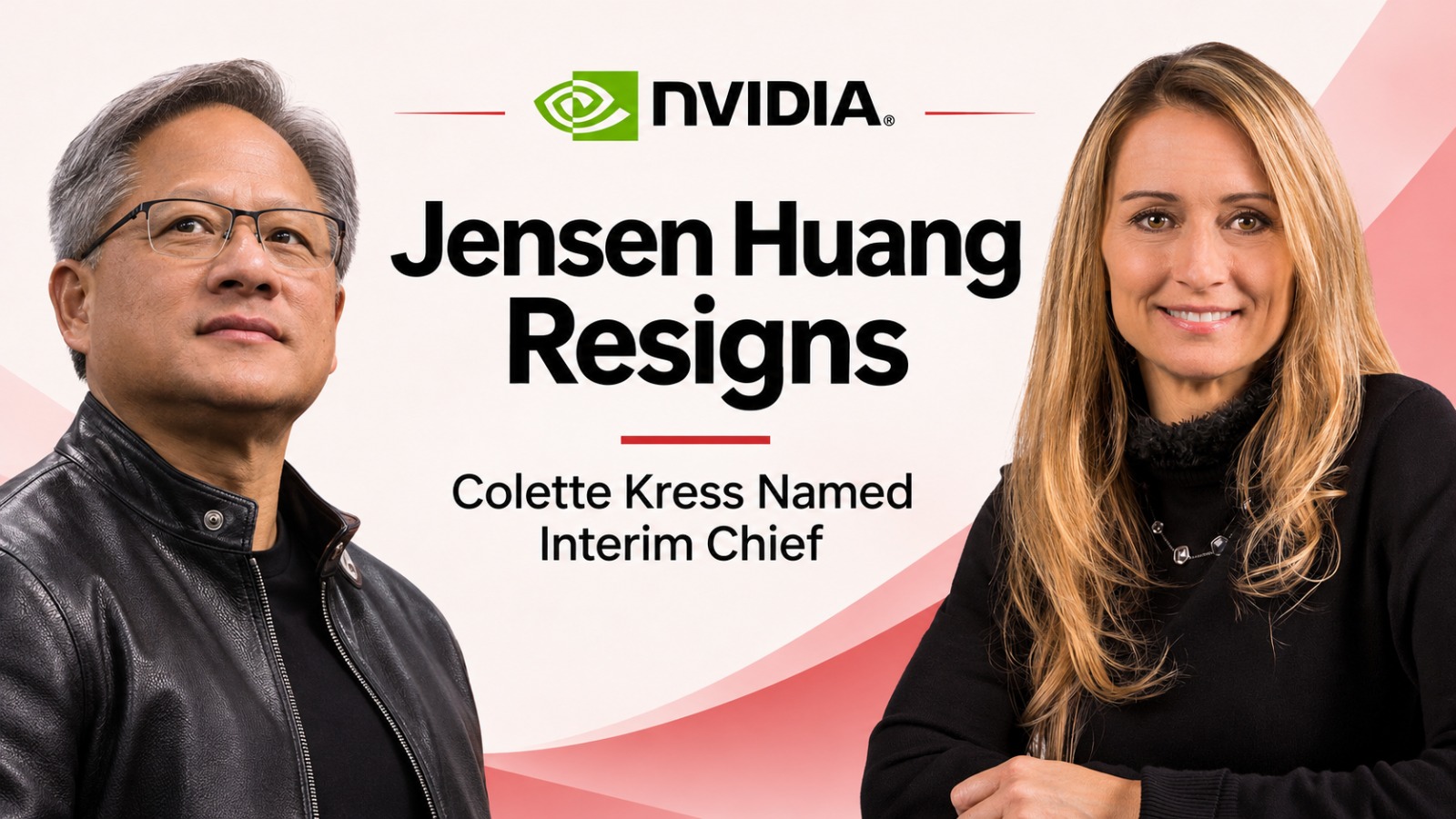
Nvidia CEO Jensen Huang has resigned with immediate effect after leading the artificial intelligence chipmaker for 33 years, marking a major leadership change at one of the world’s most influential technology companies. The company has appointed Chief Financial Officer Colette Kress as interim CEO while its board evaluates candidates for a permanent successor.
Nvidia announced the decision on November 12, confirming that Huang had stepped down as president, chief executive officer and a member of the board. The company has not disclosed the reason behind his departure or announced a timeline for appointing a permanent replacement.
Huang co-founded Nvidia in 1993 and oversaw its transformation into the world’s leading supplier of AI chips. His departure comes at a critical time for the company, whose market valuation has hovered near $4 trillion amid growing demand for artificial intelligence infrastructure.
Kress, who currently serves as Nvidia’s CFO, will oversee the company on an interim basis. The board is expected to consider both internal and external candidates as part of the succession process.
Nvidia Faces Leadership Uncertainty Amid Succession Questions
Huang’s immediate departure has brought attention to Nvidia’s succession planning, particularly given his central role in the company’s growth and strategic direction.
The company has not publicly established a detailed succession strategy, leaving questions about who could eventually take over its leadership. Kress is currently handling the interim role, while Ian Buck, who played a significant part in developing Nvidia’s CUDA software platform, has also emerged as a potential internal leadership candidate.
The search for a permanent CEO comes as Nvidia continues to operate in an increasingly competitive semiconductor industry, where its AI chips and software ecosystem have become important components of the global technology market.
US Senators Raise Questions Over Nvidia’s China Chip Exports
The leadership announcement also comes amid heightened scrutiny of Nvidia’s business activities involving China and concerns about national security.
US Democratic senators Elizabeth Warren and Chris Coons have urged the Trump administration to preserve records and communications concerning Nvidia’s exports of advanced chips to China. They have also questioned whether federal agencies took appropriate counterintelligence measures to address a suspected intelligence operation and whether earlier warnings were overlooked.
In a letter addressed to Commerce Secretary Howard Lutnick, Secretary of State Marco Rubio and White House Chief of Staff Stephen Miller, the lawmakers raised concerns about the government’s ability to enforce restrictions on sensitive technology exports.
The senators also sought a congressional briefing to examine the potential national security implications of the alleged intelligence operation. Reports indicated that Rubio had previously briefed US President Donald Trump about the matter.
Washington has restricted exports of some of Nvidia’s most advanced chips to China as part of efforts to protect America’s position in strategically important semiconductor and artificial intelligence technologies.
These concerns have placed additional attention on Nvidia’s relationship with the US government and the regulatory environment surrounding its international business.
Nvidia’s Leadership Change Comes at a Critical Time for AI Industry
Huang’s departure introduces a significant transition for Nvidia as the company navigates growing demand for AI computing, competition across the semiconductor sector and increasing government scrutiny of advanced chip exports.
The company’s decision to appoint Kress on an interim basis provides temporary leadership while the board considers its next steps. However, the absence of a permanent successor leaves an important question about Nvidia’s long-term leadership unresolved.
Nvidia has not provided further details about the circumstances surrounding Huang’s resignation.