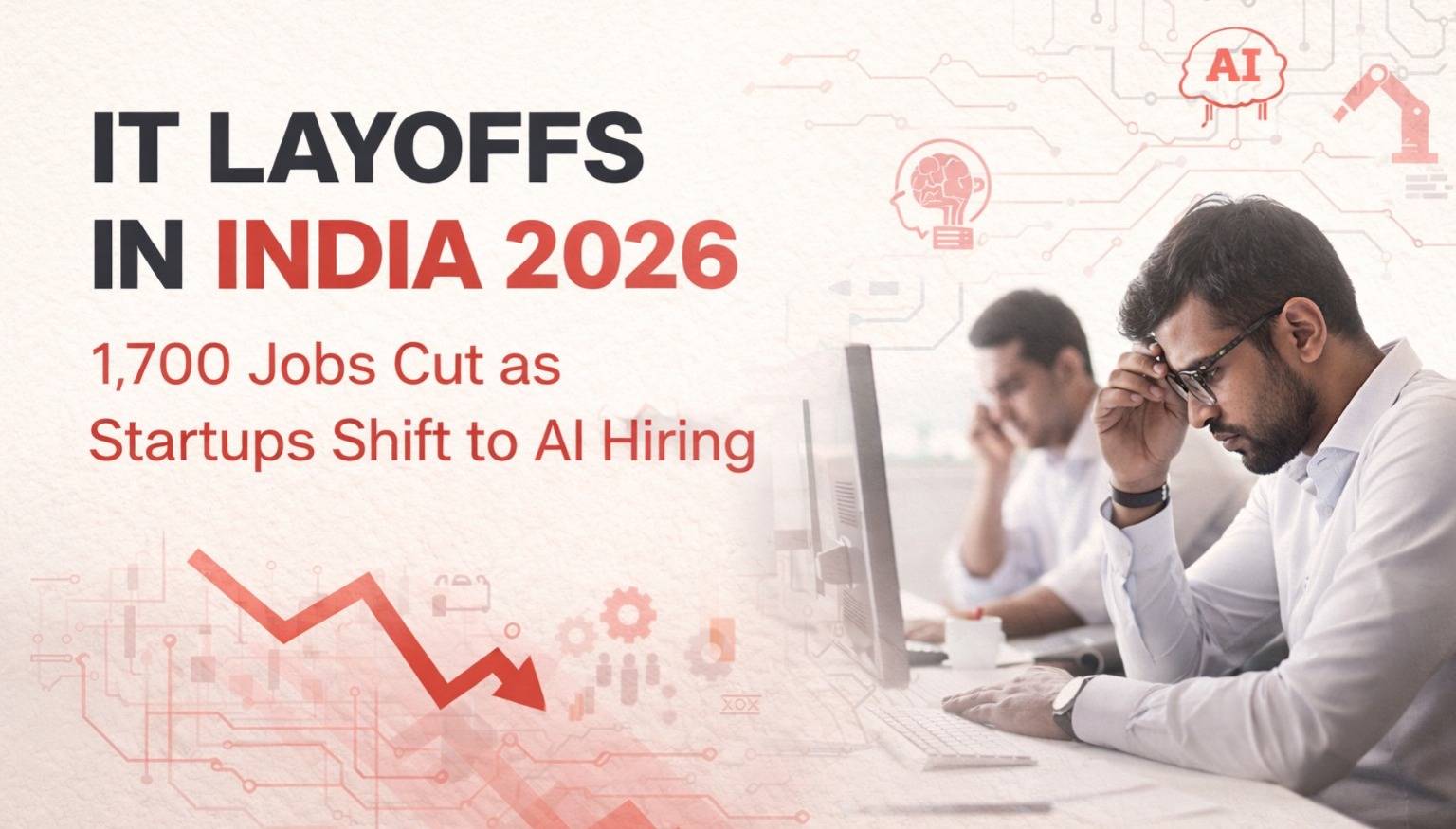
IT layoffs are back at the centre of India’s startup conversation, but the mood this time is different. This is not just a funding winter story or a delayed correction to reckless expansion. It is increasingly a story about how artificial intelligence is beginning to alter the structure of work itself. Startups are cutting roles even as they continue to invest in growth, because many now believe leaner teams supported by AI can deliver more than larger teams built for an earlier phase of expansion.
The latest quarter shows that shift clearly. A fresh report by FE found that around 1,700 employees were laid off across three Indian startups in the first quarter of 2026, compared with 1,102 employees across three companies in the same period last year. What makes the trend striking is that the number of companies resorting to layoffs has not widened dramatically. Instead, the cuts have been deeper within a small set of firms, pointing to a more concentrated but more intense phase of restructuring.
The layoffs were led by Livspace, Flipkart and Zupee. Livspace accounted for the largest share, with nearly 1,000 employees laid off, or roughly 12% of its workforce. The company described the move as part of an internal reorganisation aimed at becoming an AI-native organisation. That language is telling. Companies are no longer presenting layoffs only as distress signals. They are increasingly framing them as part of a redesign around automation, efficiency and productivity.
Livspace’s numbers also show the kind of balancing act many startups are now attempting. Even as it works to improve efficiency, the company is also trying to reduce losses while sustaining revenue growth. Its losses narrowed to Rs 242 crore in FY25 from Rs 416 crore a year earlier, while revenue rose 23% to Rs 1,460 crore. But the pace of growth has clearly moderated from the breakneck surge of earlier years, reinforcing the pressure on management teams to deliver better economics rather than growth at any cost.
Flipkart cut around 500 jobs as part of its annual performance review process, continuing a pattern it has followed in the past. Zupee cut about 200 jobs as it reorganised its business after regulatory disruption in real-money gaming. Taken together, the three cases point to a broader truth about India’s startup ecosystem in 2026: the pressure is no longer only about raising capital, but about proving that each employee and each vertical can justify itself in a more disciplined operating environment.
That is why these layoffs feel different from earlier cycles. In previous years, job cuts were often explained by slowing demand, shrinking investor appetite or poor cash discipline. Those factors still matter, but AI has added a new layer to the story. Startups are now actively rethinking team size because they believe software, automation and AI-led workflows can replace or compress parts of human labour. In that sense, the layoffs are not only reactive. They are also strategic.
The Indian picture mirrors a larger global churn in technology jobs. Across the world, tech companies have continued to cut staff as they adapt to a more uncertain economy and redirect spending toward automation. Fewer companies may be announcing layoffs than before, but the scale of job losses at those that do has grown substantially. The global backdrop matters because Indian startups do not operate in isolation. They absorb the same investor signals, productivity expectations and technology trends that shape the world’s biggest tech firms.
Back home, the funding environment remains selective rather than frozen. Capital is still available, but it is flowing through fewer deals and with greater caution. That changes founder behaviour. When fundraising becomes more discriminating, companies focus less on headcount-led expansion and more on output, margins and survival through efficiency. In such an environment, AI becomes attractive not only as a product opportunity, but as an internal management tool.
The startup era that celebrated blitzscaling, oversized teams and perpetual expansion is steadily giving way to a more restrained model. Founders now want smaller teams, tighter execution and systems that can do more with less. The workforce consequences of that transition are already visible.
For startups, however, the challenge is much bigger than just trimming payroll. They will have to show that AI-led restructuring actually improves business performance, speeds up delivery and creates durable value. Otherwise, job cuts dressed up as transformation will not solve deeper strategic problems.
India’s startup economy is still alive with ambition, capital and innovation. But the first quarter of 2026 suggests that growth is being pursued on new terms. The companies that once scaled through people-heavy expansion are now trying to scale through technology-heavy efficiency. That change is likely to shape not only hiring plans, but also the very meaning of startup work in the months ahead.
Also Read: Perplexity Announces $1 Million Challenge to Build a Billion-Dollar AI Startup