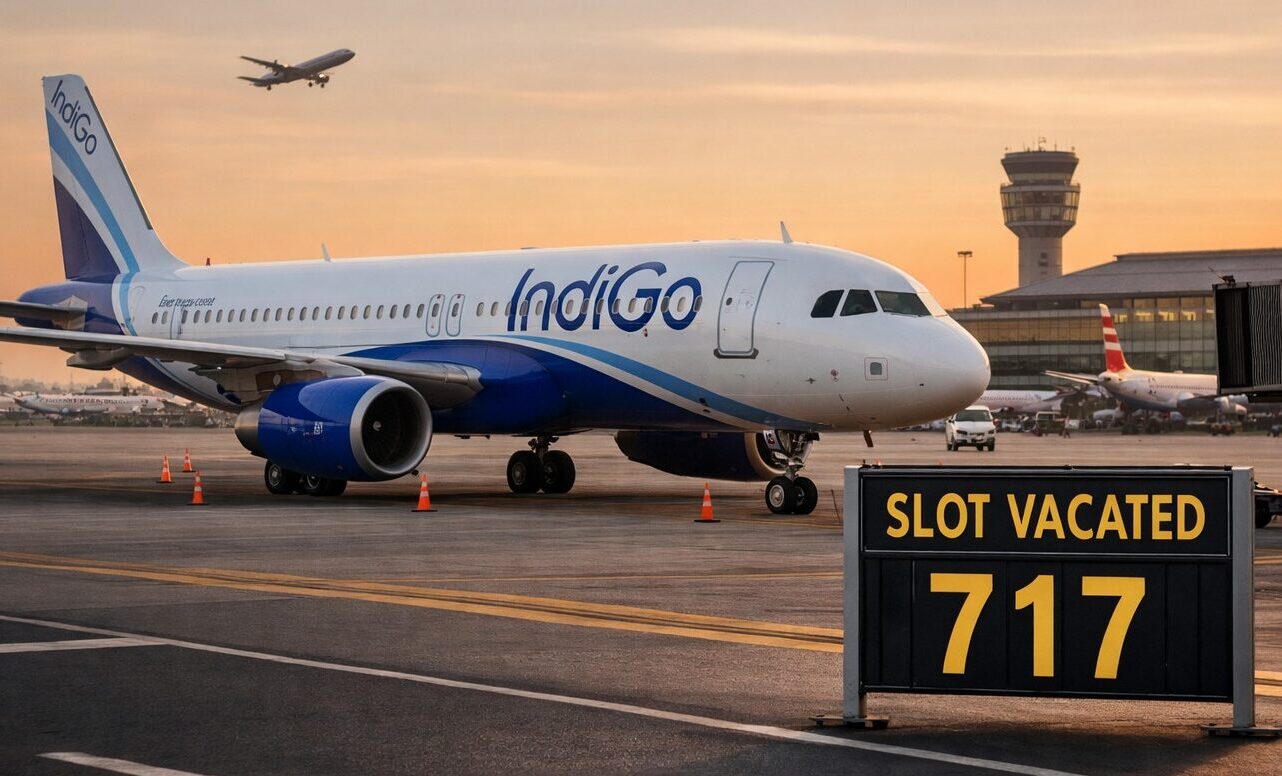
India’s largest airline, IndiGo, has vacated 717 domestic airport slots after the Directorate General of Civil Aviation mandated a 10 percent reduction in its winter flight schedule. The regulatory action followed a series of major operational disruptions in early December that affected thousands of passengers and raised concerns over flight reliability and system preparedness.
Airport slots are fixed time windows allocated to airlines for aircraft take-offs and landings at specific airports. These slots are critical at busy hubs, where runway capacity is tightly managed to avoid congestion and delays.
Metro Airports See the Sharpest Reduction
Out of the total 717 slots relinquished, 364 slots are from six major metro airports: Delhi, Mumbai, Chennai, Kolkata, Bengaluru and Hyderabad. These airports form the backbone of India’s domestic aviation network, handling the highest passenger volumes and flight frequencies.
The remaining slots are distributed across other domestic airports, indicating that the schedule reduction has impacted IndiGo’s network nationwide rather than being limited to a few locations.
Slot Surrender Spread Across Three Months
The vacated slots are spread across the January to March winter period. IndiGo gave up 361 slots in January, 43 slots in February, and 361 slots in March. The pattern reflects a uniform reduction at the beginning and end of the season, with fewer changes in February.
Under its original winter schedule for 2025-26, IndiGo was approved to operate 15,014 flights per week, or around 2,144 flights per day. Following the DGCA’s directive, the airline’s daily domestic operations were reduced to approximately 1,930 flights.
Also Read: On-Device AI Positions India for a More Inclusive AI Future
Disruptions That Triggered Regulatory Action
The DGCA’s intervention came after widespread service disruptions between December 3 and December 5. During this three-day period, IndiGo cancelled 2,507 flights and delayed 1,852 flights, impacting more than three lakh passengers across the country.
The disruptions exposed gaps in crew availability, operational planning, management oversight and system support. In response, the regulator moved to cap the airline’s operations to a level that could be managed more reliably, with the aim of reducing last-minute cancellations and delays.
Government Opens Vacated Slots to Other Airlines
Following IndiGo’s slot surrender, the Ministry of Civil Aviation invited other domestic airlines to submit requests to operate flights using the vacated slots. The objective is to ensure that airport capacity remains utilised and that passenger connectivity is maintained despite IndiGo’s temporary reduction in services.
Airlines seeking these slots are required to demonstrate adequate operational readiness, including the availability of aircraft, flight crew and ground handling support. Authorities have also made it clear that carriers should not cancel existing routes solely to redeploy aircraft to the newly available slots.
Limited Interest Expected From Rivals
Despite the government’s invitation, industry executives have indicated that interest in the vacated slots may remain limited. One key reason is the short duration of availability. The slots are valid only until the end of March, after which they are expected to revert to IndiGo.
Airlines typically finalise their schedules months in advance, making it difficult to redesign networks or launch new routes for such a brief window. In addition, a significant number of the vacated slots fall during late-night and early-morning hours, commonly known as red-eye operations, which usually attract lower passenger demand and weaker commercial returns.
Financial Penalties and Compliance Measures
In addition to the schedule cut, the DGCA has taken enforcement action against IndiGo over the December disruptions. On January 17, the regulator imposed fines totalling Rs 22.20 crore and issued warnings to Chief Executive Officer Pieter Elbers and two senior executives for operational lapses.
The regulator has also directed the airline to furnish a Rs 50 crore bank guarantee to ensure long-term systemic corrections and sustained compliance with operational norms.
In its assessment, the DGCA stated that the December disruptions were caused by shortcomings in flight crew management, weaknesses in the management structure and inadequate system software support.
Focus on Stability Going Forward
The winter schedule reduction and slot surrender mark one of the most significant regulatory interventions in India’s aviation sector in recent years. The measures underline the regulator’s emphasis on operational reliability over aggressive capacity expansion.
As IndiGo works to stabilise operations under the revised schedule, the coming months will be closely watched by passengers, competitors and regulators alike, with on-time performance and service consistency now firmly under scrutiny.
Also Read: Deep33: Betting on the Hidden Engines of the AI Race