In the mid-1990s, a simple cybercafe could give a student access to the world for the cost of a short hourly rental. You did not need to own a computer to explore the internet. You only needed access. Nearly three decades later, that same idea is being pushed far beyond Earth by two Hyderabad-based startups that want to change who gets to use space.
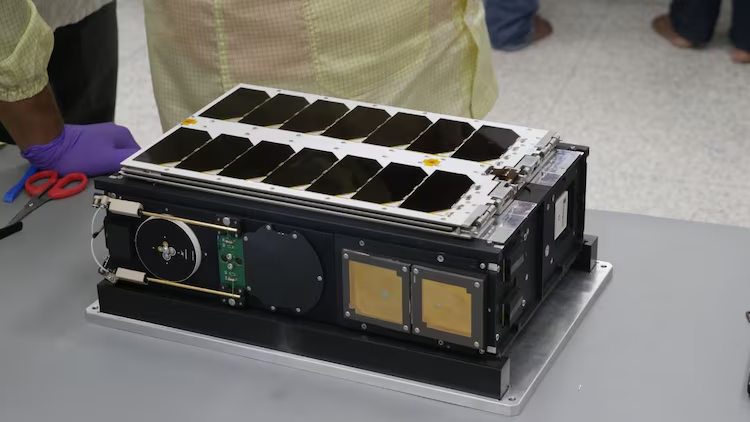
As the Indian Space Research Organisation prepares for the PSLV-C62 launch, much of the spotlight rests on the Defence Research and Development Organisation’s Anvesha satellite. Quietly sharing the ride is a much smaller payload with a disruptive ambition. MOI-1, a 14-kilogram satellite, is designed to function as the world’s first pay-as-you-go orbital laboratory.
Breaking the Cost Barrier to Orbit
MOI-1 has been developed by TakeMe2Space, a Hyderabad-based startup founded by Ronak Samantray. Their core idea is simple but radical. Instead of forcing researchers and startups to own expensive satellites, MOI-1 allows them to rent computing power directly in orbit.
Samantray explained that space research has traditionally remained the domain of governments and well-funded corporations because of prohibitive costs. With MOI-1, developers can upload and run their own software in space without investing in multi-crore infrastructure. The satellite is positioned as a shared experimental platform, where access replaces ownership.
Turning Satellites Into Thinking Machines
Most Earth-observation satellites operate as passive observers. They capture images and transmit everything back to ground stations, regardless of whether the data is useful. A large portion of this data is wasted, especially when cloud cover blocks the view.
TakeMe2Space is challenging this model by enabling real-time data processing in orbit. MOI-1 offers access to its onboard graphics processing unit at a rental rate of two dollars per minute. This GPU allows artificial intelligence algorithms to analyse data while the satellite is still in space.
Instead of downloading large image files, users receive refined results. A researcher monitoring vegetation does not need a massive image file, only a health assessment. Someone tracking ships or oil spills needs precise coordinates, not gigabytes of raw pixels. By filtering data in orbit, MOI-1 reduces bandwidth use and delivers answers in seconds rather than days.
This approach cuts data transmission costs by eight times by identifying cloud cover in space and ignoring it altogether.
Also Read: US Markets Touch New Peaks on Signs of Labour Market Stability
A Telescope Built as a Single Piece
At the heart of MOI-1’s imaging system is the MIRA space telescope, developed by Eon Space Labs. MIRA stands out because it is India’s first monolithic space telescope. Instead of multiple lenses mounted within mechanical frames, the entire optical system is carved from a single block of pure silica glass.
Sanjay Kumar explained that traditional telescopes are vulnerable to misalignment caused by the intense vibrations and forces of rocket launches. MIRA avoids this risk entirely. With no separate lenses or air gaps, light travels through a single, uninterrupted optical path.
The result is a rugged and precise imaging system that remains stable throughout launch and operation. Weighing just 502 grams, MIRA is among the lightest high-resolution space telescopes of its kind, proving that simplicity can outperform complexity in harsh environments.
Building a Satellite on a Startup Budget
One of MOI-1’s most striking achievements is its cost. The entire mission was built for Rs 2.5 crore. Instead of relying on expensive space-hardened electronics, the team used commercially available, military-grade components similar to those found in advanced drones.
To protect these components from radiation, the startup developed a proprietary shielding coating that prevents data errors caused by cosmic rays. This material-based solution eliminates the need for specialised silicon while maintaining reliability in orbit.
By combining affordable hardware with innovative material science, the team reduced overall mission costs by 70 percent, demonstrating that modern terrestrial technology can survive space with the right protection.
Laying the Foundation for a Space Cloud
The January 12 launch marks only the beginning. Samantray outlined a roadmap to scale this concept into a six-kilowatt orbital computing and power grid by 2027. The long-term vision is to create a shared infrastructure in space, similar to cloud computing platforms on Earth.
This future network would consist of six satellites capable of sharing processing power among themselves. A satellite facing heavy computational demand could request support from a neighbour. Smaller satellites with limited batteries could offload complex tasks through radio links.
Such a system would allow missions to operate more efficiently and could position India as a central computing hub for space-based data processing.
Making Space a Shared Workspace
MOI-1 is more than a technical experiment. It represents a shift in how space can be accessed and used. By lowering costs and offering shared resources, it opens the door for students, researchers, and small companies to test ideas in orbit.
Much like cybercafes once democratized internet access, this orbital laboratory signals a future where space innovation is no longer limited to those with deep pockets. For Indian innovators with strong ideas and modest budgets, the sky is no longer the limit. It is becoming a place to work.
Also Read: Digi Yatra Set to Reach 41 Airports as Nationwide Rollout Accelerates