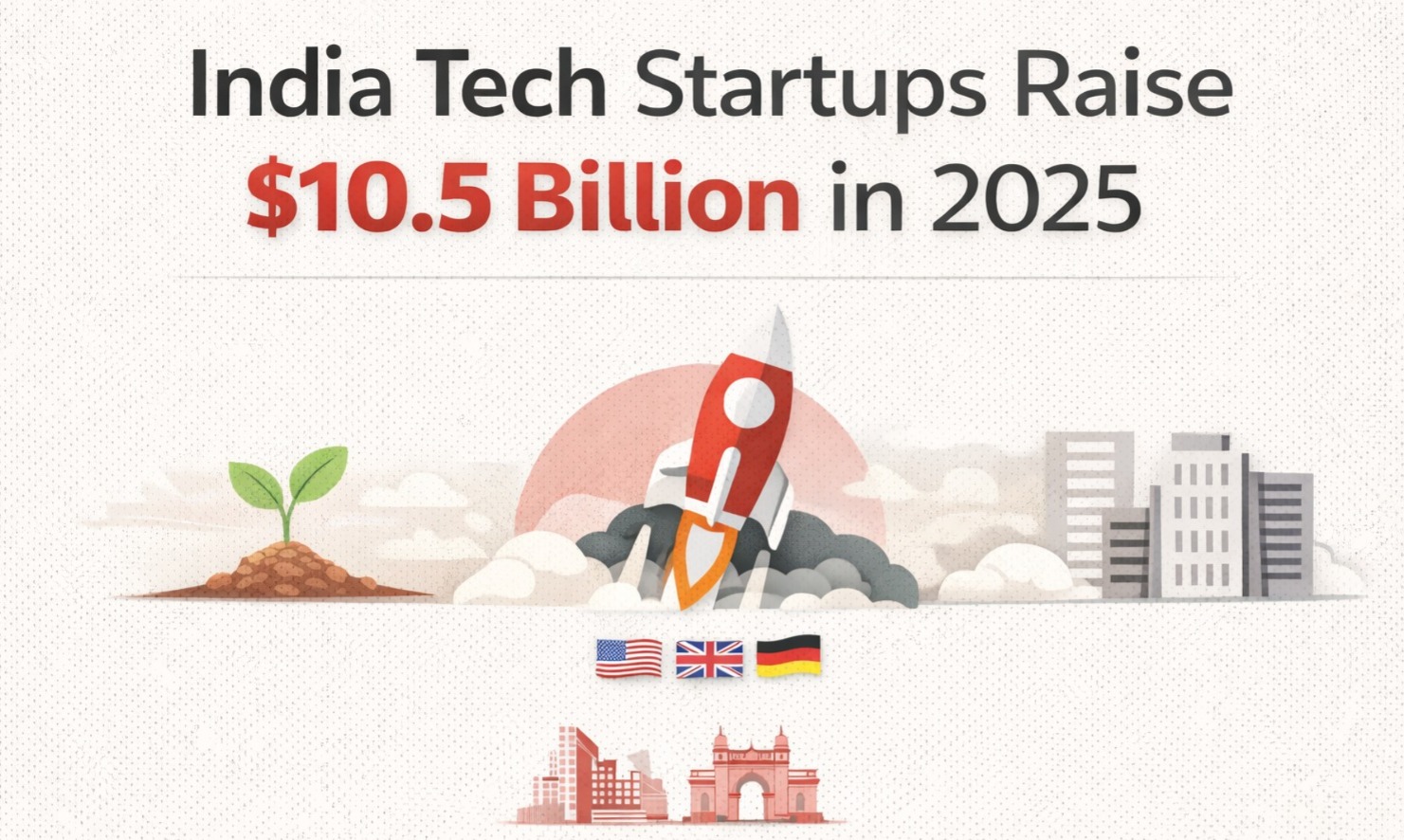
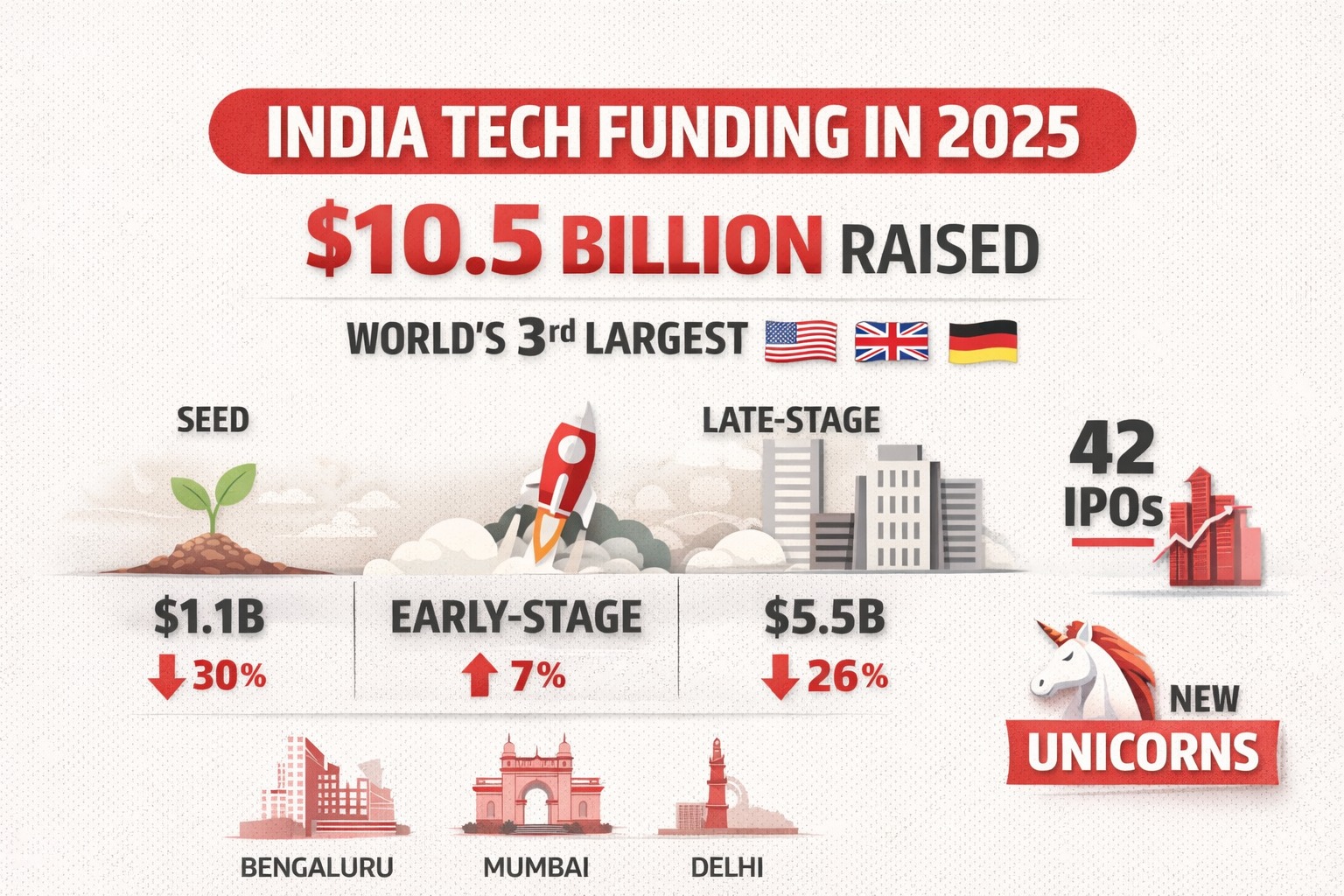
India’s technology startups raised $10.5 billion in equity funding during 2025 (January 1-December 15), retaining their position as the third most funded startup ecosystem globally, behind the United States and the United Kingdom, and ahead of China and Germany, according to Tracxn’s India Tech Annual Funding Report 2025.
A year of restraint, not retreat
The headline figures, however, belie a significant change in investor sentiment. The total amount raised in 2025 declined by 17% from 2024, at $12.7 billion, and also corresponded to lower amounts in 2023, at $11.0 billion. However, relative to global positions, India’s position did not deteriorate, and therefore, the contraction in capital can be considered a universal phenomenon and not a country-specific trend.
What changed materially was how money was deployed.
Stage-wise funding: the middle holds firm
A closer look at the funding pipeline shows a market recalibrating risk.
| Funding Stage | 2023 | 2024 | 2025 | Trend |
|---|---|---|---|---|
| Seed | $1.4B | $1.5B | $1.1B | Sharp decline |
| Early-stage | $3.5B | $3.7B | $3.9B | Moderate growth |
| Late-stage | $6.0B | $7.5B | $5.5B | Significant pullback |
Seed funding experienced the most correction in terms of investment, which symbolizes that the filters on new innovation have become stricter. Early-stage investment, on the contrary, increased by $3.9 billion, which shows that entrepreneurs receiving validation investment were still supported. Late-stage investment dropped significantly, symbolizing investor vigilance with respect to large checks.
Fewer mega rounds, higher scrutiny
India recorded 14 funding rounds above $100 million in 2025, down from 19 such rounds in 2024. The reduction signals a shift away from aggressive late-stage expansion funding.
That said, large deals did materialise, particularly in sectors tied to infrastructure, mobility, and sustainability:
- Erisha E Mobility raised $1.0 billion (Series D)
- Zepto secured $300 million (Series H)
- GreenLine closed a $275 million (Series A) round
Transportation and logistics technology, environment-focused ventures, and auto-tech emerged as preferred destinations for large institutional capital.
Sectoral picture: familiar leaders, lower totals
Funding concentration remained consistent with previous years, even as absolute numbers dipped.
| Sector | Funding in 2025 | Change vs 2024 |
|---|---|---|
| Enterprise Applications | $2.6B | ↓ from $3.2B |
| Retail Tech | $2.4B | ↓ from $2.9B |
| FinTech | $2.2B | Slight decline |
Enterprise software remained the biggest absorber of capital investment, driven by the sustainable demand for digitisation. Retail and fintech sectors followed as the closest competitors in the investment outcome.
Exits signal ecosystem maturity
While fundraising slowed, exit activity improved, suggesting a gradual normalisation of the startup lifecycle.
- 42 IPOs were recorded in 2025, up from 36 in 2024 and 26 in 2023
- 136 acquisitions took place, compared with 127 the previous year
- Five new unicorns emerged, matching 2024 levels
The rise in IPOs points to more companies testing public markets, even as private funding remains selective.
Women co-founded startups: steady participation
Women co-founded startups raised $1.0 billion in 2025. Notable deals included:
- GIVA’s $62 million Series C
- AMNEX’s $52 million Series A
Bengaluru, Mumbai, and Delhi continued to be the primary hubs for women-led tech ventures.
Geography of funding: concentration persists
Funding remained heavily clustered in established startup hubs:
- Bengaluru accounted for 32% of total funding
- Mumbai followed with 18%
This concentration underscores the continued dominance of a few urban centres in attracting venture capital.
Snapshot 2025
India’s startup ecosystem in 2025 did not expand, it consolidated. Investors showed willingness to fund execution-ready companies, reduced exposure to speculative bets, and prioritised exits and capital efficiency over growth-at-any-cost narratives.
The result is a market that looks quieter on the surface but structurally stronger underneath—less exuberant, more selective, and still globally relevant.
Also Read: Turno Plans ₹50 Crore Pre-Series B to Scale EV Financing