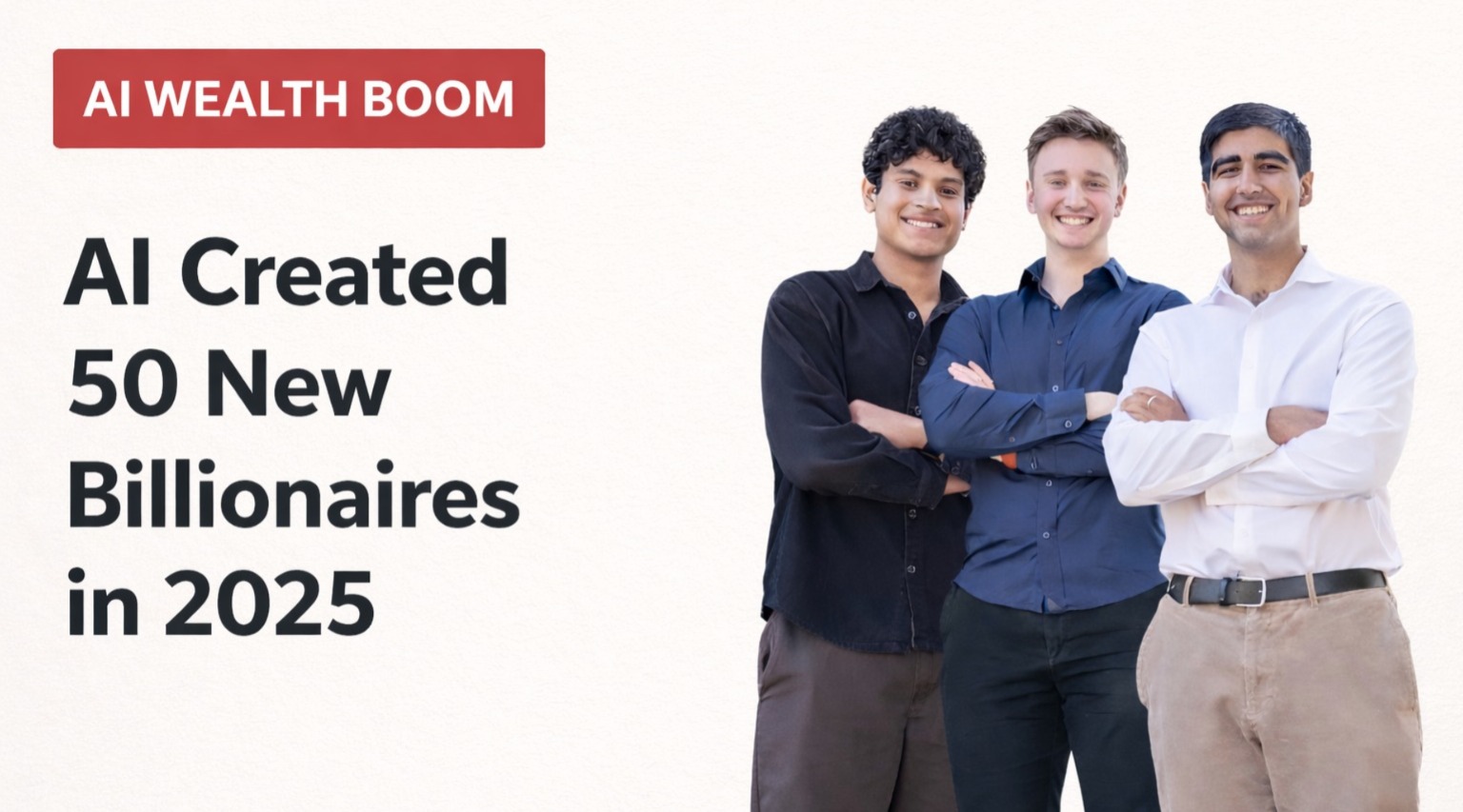
AI Billionaires 2025: Artificial intelligence crossed a rare economic threshold in 2025. Beyond reshaping software, chips, and workflows, AI became one of the most powerful engines of personal wealth creation seen in the technology sector in recent decades.
In a single year, artificial intelligence led to the creation of more than 50 new billionaires globally, a development closely tied to an unprecedented surge in capital flowing into AI-driven businesses. Over the same period, AI startups attracted $202.3 billion in total investment, underscoring how aggressively global investors repositioned themselves around the sector.
The numbers point to a structural shift, not a speculative spike.
Who Became AI Billionaires And Why AI Was Central?
The new billionaire cohort emerging in 2025 is largely composed of AI startup founders and senior executives, particularly those operating in software-as-a-service platforms, foundation model companies, and AI systems designed to automate or replace human tasks.
This marks a departure from earlier tech wealth cycles dominated by social media, e-commerce, or consumer internet platforms. The AI-driven wealth surge is more tightly linked to enterprise adoption, cost reduction, and operational replacement, making these companies immediately valuable to large corporations and investors.
Among the notable names entering billionaire ranks are former senior executives from established technology firms who have built new AI-first companies. Their rise reflects how experience, scale, and capital access now play a decisive role in determining who benefits most from the AI transition.
The Funding Wave That Made It Possible
The creation of new AI billionaires did not happen in isolation. It was enabled by one of the largest funding waves the technology industry has ever seen.
AI startup investment climbed from $114 billion in 2024 to $202.3 billion in 2025, a sharp year-on-year increase that consolidated AI’s position as the dominant investment theme in global technology markets.
A substantial portion of this capital flowed into foundation model developers, which raised $80 billion during the year, accounting for around 40% of global AI investment. At the very top of the market, OpenAI and Anthropic together captured 14% of all global venture investment in AI, highlighting the degree of capital concentration shaping the sector.
Young Billionaires and the Speed of AI Wealth Creation
One of the most striking aspects of the 2025 AI wealth cycle is how quickly fortunes were created.
The three youngest new billionaires linked to artificial intelligence, Brendan Foody, Adarsh Hiremath, and Surya Midha, founders of recruiting firm Mercor, underscore how rapidly AI-enabled companies can scale when positioned at the intersection of automation and enterprise demand.
Their emergence illustrates a broader trend: AI businesses no longer require decades to mature into wealth-generating giants. With sufficient capital and adoption, valuation leaps can happen within a few funding cycles.
Existing Tech Titans Became Even Richer
While AI created dozens of new billionaires, it also dramatically expanded the wealth of those already at the top of the technology hierarchy.
The AI-driven stock market rally in 2025 added more than $500 billion to the combined wealth of America’s richest technology leaders. Key beneficiaries included Elon Musk, Larry Page, Jeff Bezos, and Nvidia CEO Jensen Huang, whose fortunes rose alongside the growing demand for AI platforms, infrastructure, and computing power.
Nvidia’s rise was particularly notable, as the company’s valuation crossed $5 trillion, driven by surging demand for AI accelerators used in data centres worldwide.
What the 50 New Billionaires Reveal About AI’s Future
The creation of more than 50 AI billionaires in 2025 sends a clear message about where the technology economy is headed.
AI wealth is being generated not primarily through consumer-facing innovation, but through control of models, infrastructure, automation tools, and enterprise-scale systems. Capital is concentrating around companies that can scale rapidly, replace costs, and embed themselves deeply into business operations.
As AI continues to expand, the key question is no longer whether it will create wealth, but how concentrated that wealth will become, and who will be positioned to access it.
For 2025, the answer is already visible: artificial intelligence has moved from promise to power, and in doing so, it has quietly rewritten the billionaire map of the global tech economy.
Also Read: BlindPay: From Bootstrapped Idea to Global Fintech Player