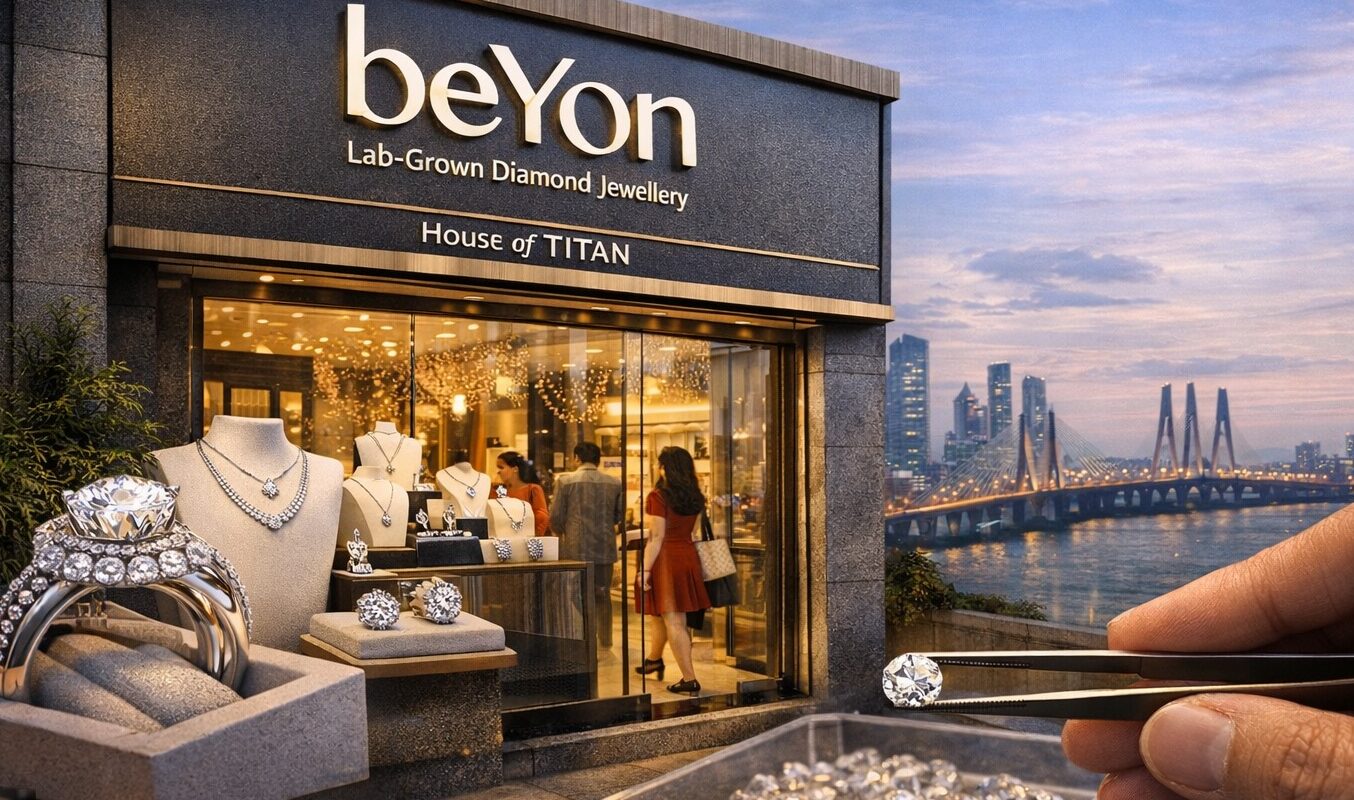
Titan Company, India’s largest jewellery retailer, is entering the fast-growing yet still niche lab-grown diamond jewellery segment, marking a notable expansion beyond its long-standing focus on natural diamonds. The Tata Group company has announced the launch of a new brand called beYon, introduced under the banner of the House of Titan.
The first exclusive beYon store is scheduled to open in Mumbai on December 29, signalling Titan’s formal entry into a category that has been gaining attention among younger and more value-conscious consumers.
A Strategic Addition to Titan’s Portfolio
In an exchange filing on Friday, Titan said the beYon brand will feature a curated selection of lab-grown diamond jewellery. The move aligns with the company’s broader strategy to address the evolving adornment needs of women, extending beyond its established offerings such as watches, perfumes, sarees and handbags.
Titan also indicated that it plans to open a couple of additional beYon stores in Mumbai and Delhi in the near term, suggesting a measured and focused rollout rather than an aggressive nationwide expansion in the initial phase.
Second Tata Group Entry Into the LGD Space
With this launch, Titan becomes the second Tata Group company to enter the lab-grown diamond segment. Trent, another Tata Group firm, introduced its own lab-grown diamond brand, Pome, last year. The growing interest from large corporate players reflects increasing confidence in the long-term potential of lab-grown diamonds, even as the category remains relatively small within the broader jewellery market.
Also Read: Ola Electric Secures Rs 366.78 Crore Incentive Under PLI-Auto Scheme
A Small but Rapidly Expanding Market
Lab-grown diamonds currently account for a limited share of India’s overall diamond market, which is valued at Rs 53,512 crore. The lab-grown diamond segment itself is estimated to be worth around Rs 3,452 crore in FY25 and is projected to grow to Rs 5,179 crore by FY28. This represents an expected compound annual growth rate of approximately 14 percent.
India plays a significant role in global lab-grown diamond production, manufacturing an estimated 25 lakh to 30 lakh stones each year. This accounts for roughly 15 percent of global output. However, only about 10 percent of this production is consumed domestically, indicating that the local market remains underdeveloped compared to export volumes.
Changing Consumer Preferences Drive Demand
Titan’s decision to enter the segment reflects shifting consumer preferences, particularly among Gen Z and millennial buyers. These consumers are increasingly drawn to lab-grown diamonds for everyday jewellery due to their relatively lower prices and perceptions of ethical and sustainable sourcing. As affordability becomes a key factor in purchase decisions, lab-grown diamonds are emerging as an accessible alternative for a wider audience.
Price Pressures and Competitive Intensity
During Titan’s Q1FY26 earnings call, Ajoy Chawla, CEO of Titan’s jewellery division, highlighted the rapid pace of price correction in the lab-grown diamond market. He noted that wholesale prices have declined quickly, while retail prices in India are currently ranging between Rs 30,000 and Rs 50,000 per carat. About a year ago, prices were significantly higher, but new entrants continue to launch products at lower price points.
Chawla also pointed to the low entry barriers in the segment and the limited scope for differentiation. He said the market already includes around 50 players, more than 100 physical stores and several online-only brands. Despite this crowded landscape, Titan estimates that lab-grown diamonds still account for less than 2 percent of the overall diamond-studded jewellery market in India.
Risks of Commoditisation
According to Chawla, the rapid influx of players raises the risk of the category becoming highly commoditised. He cautioned that without strong intellectual property and brand-led differentiation, competition could increasingly revolve around offering larger stones or more diamonds at lower prices. This dynamic, he suggested, could compress margins and make it harder for brands to sustain long-term value.
Strong Core Jewellery Performance Continues
Titan’s entry into lab-grown diamonds comes at a time when its core jewellery business remains a key growth driver. In the September quarter, total income from jewellery operations, excluding bullion and Digi-Gold, rose 21 percent year on year to Rs 14,092 crore.
The domestic jewellery business, which includes Tanishq, Mia and Zoya, recorded an 18 percent increase in income to Rs 12,460 crore. CaratLane, Titan’s digital-first jewellery brand, delivered even stronger growth, reporting a 32 percent rise in income to Rs 1,072 crore.
As Titan experiments with lab-grown diamonds through beYon, the company appears to be balancing innovation with caution, entering the segment while remaining mindful of its challenges and competitive pressures.
Also Read: Turno Plans ₹50 Crore Pre-Series B to Scale EV Financing