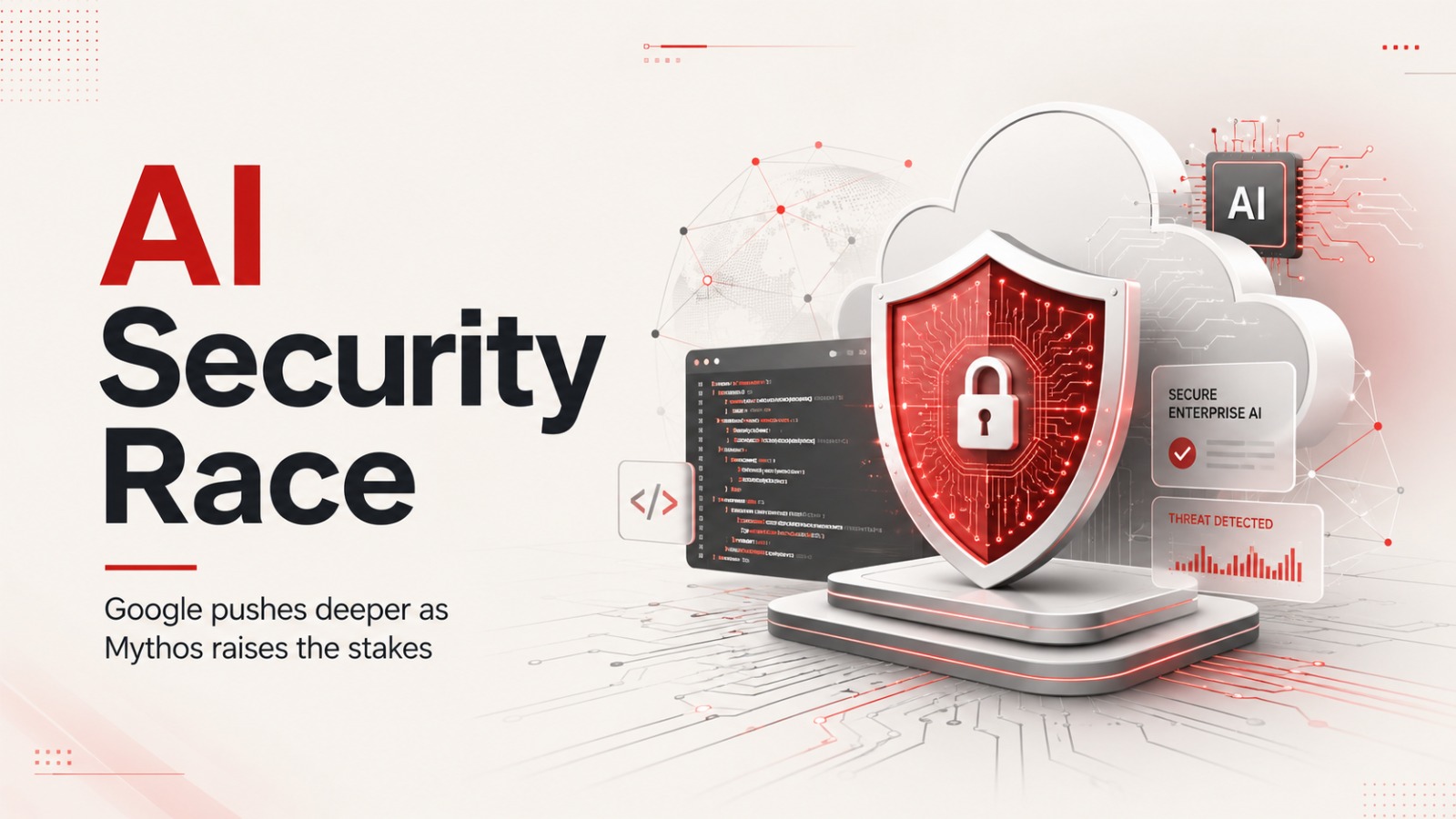
Google AI is moving deeper into AI-powered cybersecurity at a time when the sector is no longer debating whether artificial intelligence will reshape digital defence. That shift is already underway.
At I/O 2026, Google placed security inside its larger enterprise AI story. The company is not only talking about faster models or smarter assistants. It is trying to show that AI can become part of a full cybersecurity stack, combining model reasoning, threat intelligence, cloud infrastructure, automated vulnerability research and code repair inside systems that large companies already use.
The timing matters because Anthropic’s Claude Mythos Preview has changed the conversation around AI security. Anthropic announced Mythos on April 7, 2026, but chose not to release it publicly because of its advanced cybersecurity capabilities. Instead, the model was placed inside Project Glasswing, a controlled defensive programme involving major technology, security and financial partners.
That decision gave Mythos an unusual position in the market. It was not introduced as another AI coding tool. It was presented as a model strong enough to assist with serious vulnerability research under controlled conditions. For enterprise buyers, that is a different category altogether.
Google now has to respond on two fronts. On one side, it is connected to Project Glasswing, and Mythos has been described as available in private preview to select Google Cloud customers through Vertex AI. On the other side, Google is building its own defensive AI stack around Gemini, Big Sleep, CodeMender and its existing threat intelligence business.
That makes Google both a partner in the Mythos ecosystem and a direct contender in the race to define AI security for enterprises.
Google AI’s Security Push
The strongest part of Google’s pitch is convenience. Large companies already run parts of their cloud, developer workflows and security operations through major platforms. If Google can place AI-driven threat detection, vulnerability discovery, code remediation and model governance inside that existing environment, it becomes harder for buyers to justify adding another standalone product.
This is where the pressure on cybersecurity startups will increase.
A startup selling a broad AI security layer may struggle if Google can bundle similar capabilities into products that enterprises already trust. In corporate buying, the easiest product to approve often wins. A bundled tool does not need to be perfect. It only needs to be reliable enough, integrated enough and easier to clear through procurement.
That does not mean startups are finished. It means generic AI security products will face a tougher market.
The companies with a real chance will be the ones solving narrow, high-trust problems. Regulated industries, sensitive codebases, software supply chains and security operations workflows still leave room for specialist vendors. But those vendors will need more than a smart interface. They will need proprietary data, measurable outcomes and proof that their tools reduce actual risk.
Mythos raised the bar
Anthropic’s decision to keep Mythos out of public release was a signal to the market. It suggested that AI-assisted cybersecurity had moved beyond ordinary automation and into a more sensitive phase.
Mythos gained attention because it was associated with advanced computer security tasks and controlled work on real codebases. Its positioning made restraint part of the product story. Anthropic effectively told the market that some AI cyber capabilities are powerful enough to require limited access, careful governance and defensive use first.
That puts pressure on every major AI company. Google cannot afford to be seen only as a distributor of another company’s security model if AI security becomes central to enterprise adoption.
Big Sleep gives Google a research-led story around finding unknown software flaws. CodeMender gives it a remediation story by using Gemini reasoning to help repair critical vulnerabilities. Together, they allow Google to argue that it is not just detecting threats. It is trying to shorten the distance between finding a weakness and fixing it.
That is exactly what security teams want. Vulnerability backlogs are not just technical lists. They are business risks waiting for engineering time, budget and prioritisation. Any system that can help move faster from discovery to repair will get attention.
The threat environment is already changing
AI security is no longer a future-facing concern. Criminal and state-linked groups are already using commercial AI models to scale attacks, improve malware work and experiment with vulnerability exploitation, based on Google’s May 11 threat-intelligence findings cited in coverage by The Guardian.
That makes Google’s push easier to explain to enterprise clients. This is not just about preparing for a distant wave of AI-led cyberattacks. The early signs are already visible.
For companies, the concern is practical. If attackers can use AI to move faster, defenders need tools that can keep pace. Human analysts remain critical, but the speed and scale of modern threats make AI-assisted defence increasingly difficult to ignore.
A harder market for “AI wrapper” startups
The most exposed companies are those selling broad AI security tools without deep differentiation. If a product only adds a conversational layer over existing security workflows, it may become difficult to defend once platforms offer similar capabilities.
Enterprise buyers will ask a simple question: what does this separate tool do that Google, Microsoft, Amazon, Anthropic or another core vendor cannot provide inside the existing stack?
That question does not kill innovation. It forces sharper innovation.
Startups will need to choose their battles carefully. The stronger opportunities may come from areas where large platforms move slowly, such as highly specific compliance needs, industry-specific threat models, complex software supply-chain risks or deeply customised security operations.
The market is moving away from excitement around AI alone. Buyers will want evidence, controls and accountability.
The bigger fight is over trust
Google’s deeper move into AI security is not only a product expansion. It is a trust play.
Enterprise AI adoption depends on security. Companies will not place sensitive data, code and workflows into AI systems unless they believe those systems can be governed, monitored and protected. That gives cybersecurity a central role in the next phase of AI competition.
With the help of Mythos, Anthropic has generated urgency. Google is responding by using platform power. This means the competition is going to become more serious. This is because the winner won’t be the one with the best model. Instead, it would be the firm with the capability to create safer systems with advanced AI reasoning.
For cybersecurity startups, the signal is clear. The market is still open, but it is becoming less forgiving. Broad promises will not be enough. The next phase will reward companies that can prove exactly where they fit, why they matter and what risk they actually reduce.
Also Read: Vaibhav Suryavanshi’s Rise Is Bigger Than a Net-Worth Number