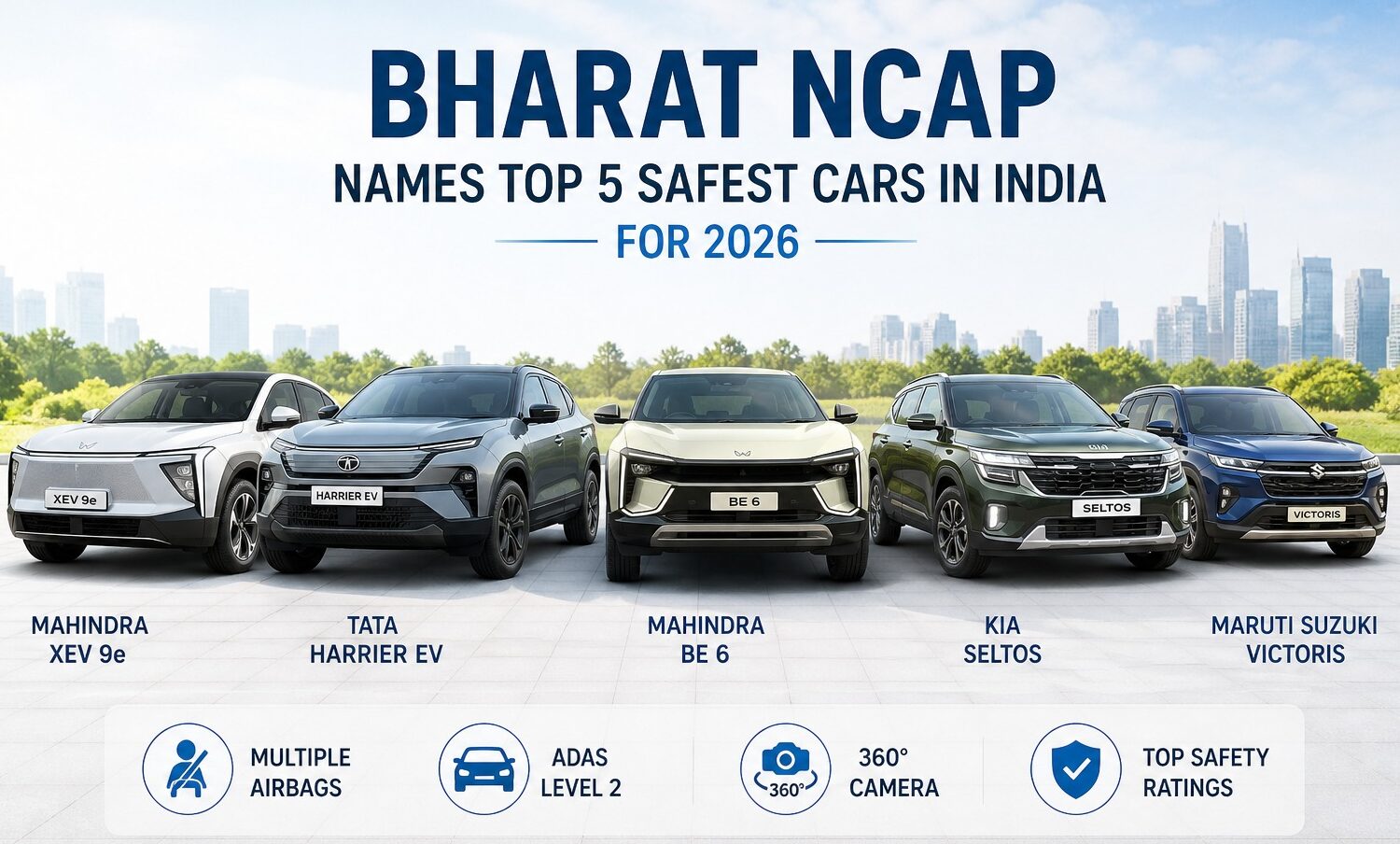
India’s official car safety assessment program, Bharat NCAP, has released its list of the top five safest cars for 2026 after testing more than 30 models across manufacturers. Leading the rankings are the Mahindra XEV 9e from Mahindra & Mahindra and the Tata Harrier EV from Tata Motors. Both vehicles achieved a perfect score of 32 out of 32 in Adult Occupant Protection and 45 out of 49 in Child Occupant Protection, placing them at the top of the safety rankings.
Close behind are the Mahindra BE 6, Kia Seltos from Kia, and the Maruti Suzuki Victoris from Maruti Suzuki. These models also posted strong safety scores, supported by features such as multiple airbags, Advanced Driver Assistance Systems at Level 2, and 360-degree camera systems. The results reflect a growing focus on integrating both active and passive safety technologies across vehicle categories.
Why Safety Ratings Matter More Than Ever
With rising concerns about road safety in India, structured and transparent crash test ratings are becoming increasingly important for buyers. The Bharat NCAP scoring system provides a clear and standardized way to evaluate how well vehicles protect occupants during accidents. This helps consumers make informed decisions based on verified safety performance rather than marketing claims.
The inclusion of both electric and internal combustion engine vehicles in the rankings ensures that buyers across different price segments have access to reliable safety comparisons. For families in particular, high scores in both adult and child occupant protection offer reassurance. As more consumers prioritize safety alongside price, design, and performance, such ratings are likely to play a decisive role in purchase decisions.
Also Read: FinStackk Expands US Business Support Playbook With Launch of FinStackk Legal
A Wide Spectrum of Safe SUV Choices
While the top rankings highlight models with the highest safety scores, the broader SUV market in India offers a wide range of options catering to different budgets and preferences. Premium vehicles such as the Mercedes-Benz GLA from Mercedes-Benz, the Tesla Model Y from Tesla, and the Volvo XC60 from Volvo combine advanced safety systems with high-end comfort and technology features.
At the same time, more affordable options like the Tata Nexon and the Nissan Magnite from Nissan demonstrate that strong safety performance is no longer limited to premium segments. These vehicles balance cost, efficiency, and essential safety features, making them accessible to a wider range of buyers. The diversity of choices highlights how safety is becoming a standard expectation rather than a luxury feature.
SUV Demand Drives Focus on Safety Standards
The rapid growth in SUV sales across India has significantly influenced how manufacturers approach vehicle design and engineering. As more buyers shift toward SUVs, safety ratings have become a key factor in evaluating new models. Bharat NCAP’s standardized crash testing, tailored to Indian road conditions, ensures that safety claims are backed by measurable and comparable data.
This competitive environment is encouraging automakers to invest more in structural integrity, safety technologies, and occupant protection systems. The push for higher ratings is expected to lead to continuous improvements in vehicle safety across the industry. As a result, Indian consumers are likely to benefit from better-equipped vehicles that prioritize protection without compromising on performance or affordability.
The 2026 rankings underline a clear trend. Safety is no longer an optional feature but a central consideration in India’s evolving automobile market.