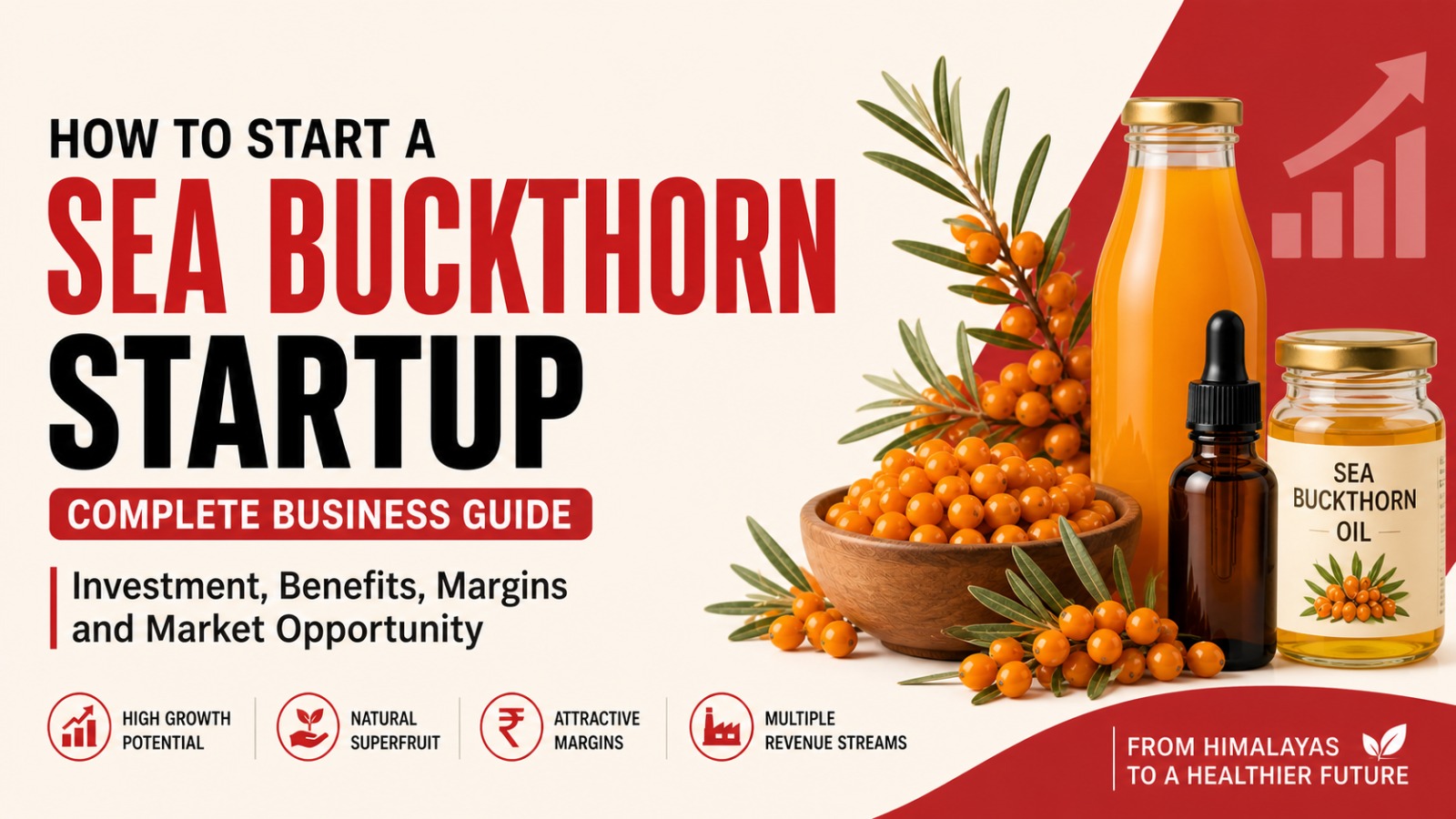
Sea Buckthorn Startup: Sea buckthorn is not a regular berry business. It sits at the intersection of food, wellness, cosmetics, climate resilience, mountain livelihoods, and India’s growing demand for natural functional products.
For a founder, the opportunity is simple:
India has sea buckthorn growing naturally in cold desert regions such as Ladakh and parts of Himachal Pradesh, Uttarakhand, Sikkim and Arunachal Pradesh. The fruit is nutritionally dense, difficult to harvest, highly perishable, and still under-commercialised. That creates a classic startup gap: abundant natural potential, weak processing infrastructure, low farmer value capture, and a rising market for premium health products.
A sea buckthorn startup can be built around:
- Juice and ready-to-drink wellness beverages
- Pulp and concentrate supply to food brands
- Seed oil and berry oil for nutraceuticals and cosmetics
- Freeze-dried powder for supplements
- Herbal tea, gummies, capsules and functional foods
- B2B ingredient supply to skincare, nutraceutical and beverage companies
The strongest model is not just selling juice. The smarter play is a full-value utilisation model: pulp, peel, seed, oil, powder and residue.
What Is Sea Buckthorn?
Sea buckthorn is a hardy shrub from the genus Hippophae. It grows in cold, dry and high-altitude regions. The plant is known for its bright orange berries, thorny branches and ability to survive in difficult terrain.
Its commercial value comes from three parts:
| Part | Business Use |
|---|---|
| Berry pulp | Juice, concentrate, puree, jam, syrup, beverages |
| Seeds | Seed oil, nutraceutical oil, cosmetic oil |
| Peel and pomace | Powder, extracts, animal feed, compost, functional ingredients |
| Leaves | Tea, extracts, animal feed research applications |
Sea buckthorn is often called a “superfruit”, but that term should be used carefully. Its value is not magic. Its value comes from its documented nutritional profile: vitamin C, carotenoids, tocopherols, flavonoids, fatty acids and other bioactive compounds.
A Short History of Sea Buckthorn?
Sea buckthorn has been known across Eurasia for centuries. Traditional medicine systems in Tibet, Mongolia, Russia and China used the berry, oil and leaves for nutrition and healing applications.
Its name has an interesting historical link. The genus name Hippophae is commonly interpreted from Greek roots connected to horses and shining appearance. Historical accounts suggest that horses fed with sea buckthorn leaves and berries developed glossier coats. This is often repeated in botanical literature, though founders should avoid making exaggerated claims from it.
Modern scientific interest grew in the twentieth century, especially in Russia, China and parts of Europe. China became one of the largest centres of sea buckthorn cultivation, research and ecological plantation because the plant can help control soil erosion and survive in harsh regions. In India, Ladakh became the most visible sea buckthorn region because of its naturally growing wild shrubs and local livelihood potential.
For India, the story is still young. Sea buckthorn is not yet a mainstream packaged food category like amla, aloe vera or turmeric. That is exactly why the startup opportunity exists.
Also Read: How to Start a Profitable Makhana (Fox Nut) Business in India!
Why Sea Buckthorn Is Trending?
Sea buckthorn is gaining attention because several consumer and business trends are meeting at the same point.
India’s wellness market is moving beyond basic health drinks
Consumers are increasingly looking for products with functional value. A drink is no longer just a drink. It is expected to support immunity, energy, gut comfort, skin health or clean nutrition. Sea buckthorn fits this trend because it has a strong nutritional story.
Consumers want natural and regional ingredients
There is growing interest in Himalayan, indigenous and local-origin ingredients. Sea buckthorn has a powerful origin story: cold desert, high altitude, difficult harvest, bright orange berries, and mountain communities.
That gives the brand a natural storytelling advantage.
Skincare brands are moving toward botanical oils
Sea buckthorn seed oil and berry oil are used in cosmetic formulations because of fatty acids, carotenoids and antioxidants. This opens a B2B ingredient opportunity beyond food.
The plant is climate-resilient
Sea buckthorn grows in harsh conditions and helps in soil conservation. For investors and development agencies, this creates a climate-linked livelihood story.
India still imports many premium wellness ingredients
A domestic sea buckthorn value chain can reduce dependence on imported wellness ingredients, provided quality, standardisation and compliance are handled properly.
Benefits of Sea Buckthorn
This section should be written responsibly. Sea buckthorn has promising nutritional and cosmetic value, but it should not be marketed as a cure for disease.
Nutritional benefits
Sea buckthorn berries are documented to contain:
- Vitamin C
- Carotenoids
- Tocopherols
- Flavonoids
- Organic acids
- Minerals
- Fatty acids in seed and pulp oil
The exact composition changes by species, altitude, climate, harvest season and processing method.
Skin and cosmetic value
Sea buckthorn oil is used in skincare formulations because it contains fatty acids and antioxidant compounds. Cosmetic brands use it in face oils, creams, lip balms and repair products.
Allowed marketing language should be cautious:
Good claim: “Contains sea buckthorn oil, known for its fatty acid and carotenoid profile.”
Avoid: “Cures skin disease” or “heals wounds” unless supported by approved regulatory claims.
Food and beverage value
The berry has a sharp, acidic taste. That makes it useful in blends with apple, honey, ginger, lemon, mint or other fruit bases. Pure sea buckthorn juice may be too sour for mass consumers, so blended beverages are commercially more practical.
Farmer and livelihood value
The plant grows in regions where agricultural options are limited. A structured procurement model can give mountain communities additional income, especially if collection, grading and primary processing are organised locally.
The Best Startup Model
A sea buckthorn startup should not begin as a single-product juice company. That is risky because juice margins can be damaged by cold-chain cost, spoilage, seasonality and low consumer awareness.
A stronger model is:
Phase 1: Source and process pulp
Make pulp, concentrate and juice base. Sell B2B and D2C.
Phase 2: Launch consumer products
Start with 2 to 3 products:
- Sea buckthorn wellness shot
- Sea buckthorn juice blend
- Sea buckthorn honey syrup or concentrate
Phase 3: Extract oil
Use seeds for premium oil. This improves margins because oil has higher value than juice.
Phase 4: Build a zero-waste ingredient business
Convert pomace into powder, tea blends, extracts or animal nutrition inputs where legally permitted.
Product Strategy
Product 1: Sea Buckthorn Wellness Shot
Format: 30 ml to 60 ml
Positioning: daily functional shot
Target customer: urban wellness consumer
Best channels: D2C, Amazon, premium grocery, gyms, yoga studios, cafes
Sample formula:
| Ingredient | Share |
|---|---|
| Sea buckthorn pulp | 20 percent |
| Apple or orange base | 55 percent |
| Honey or natural sweetener | 10 percent |
| Ginger, lemon, spices | 5 percent |
| Water and stabilisation base | 10 percent |
Product 2: Sea Buckthorn Juice Blend
Format: 200 ml bottle
Positioning: Himalayan functional drink
Target customer: everyday health beverage buyer
A pure sea buckthorn drink may be too acidic. A blended beverage is more commercially viable.
Product 3: Sea Buckthorn Oil
Format: 15 ml, 30 ml bottles
Positioning: cosmetic oil or nutraceutical oil, depending on compliance
Target customer: skincare users, clean beauty brands, nutraceutical buyers
This is where margins improve sharply.
Product 4: Freeze-Dried Powder
Format: 50 g, 100 g
Positioning: smoothie, supplement, tea and food ingredient
Target customer: premium wellness buyer, B2B ingredient buyer
This requires higher investment but gives better shelf life and export potential.
Investment Breakup
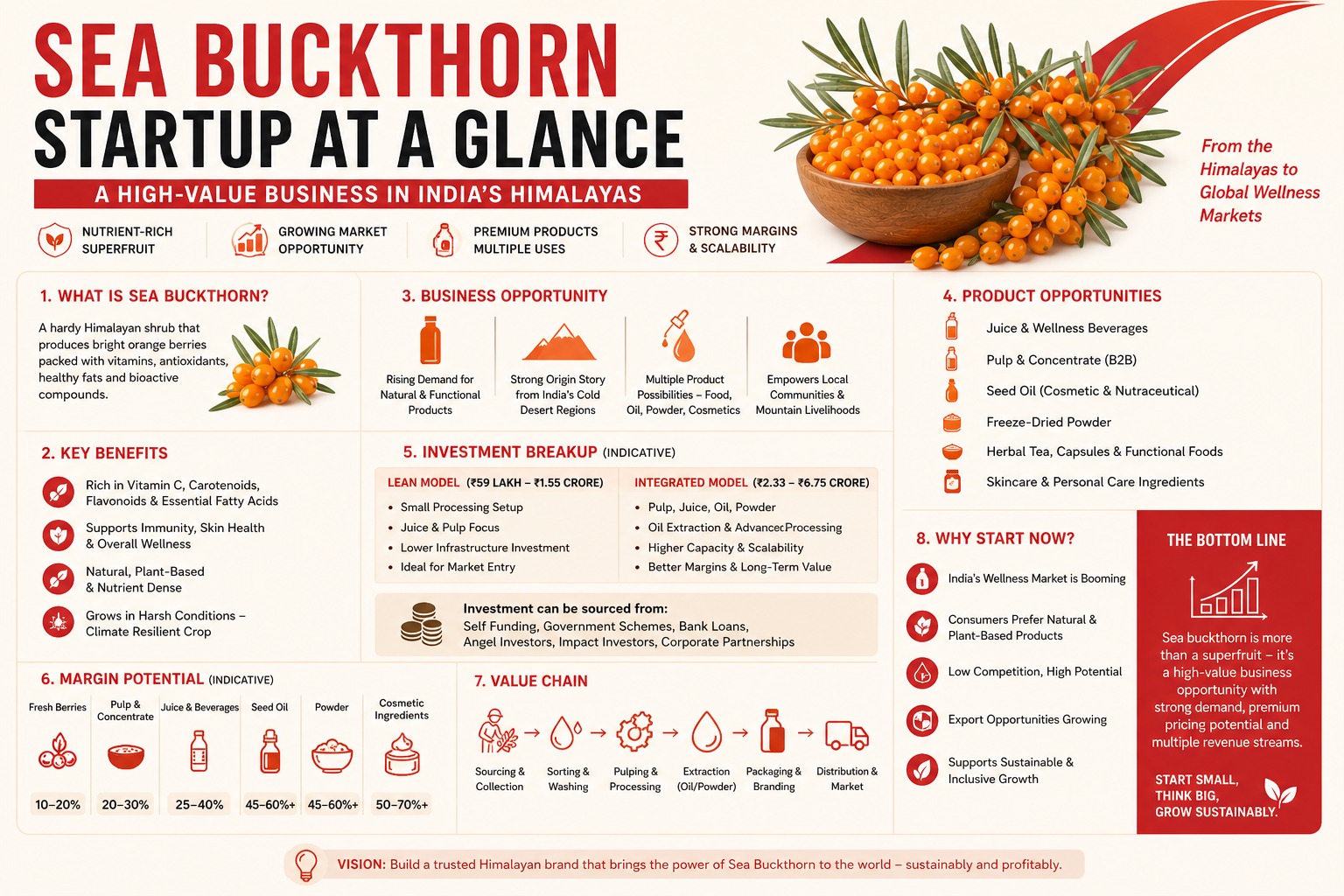
Below is a practical small-scale startup model. These numbers are indicative estimates and must be validated with local vendors, FSSAI consultants, machinery suppliers and state-level subsidy offices.
Model A: Lean Processing and D2C Launch
Capacity assumption: 500 kg berries handled per day during season
Business type: outsourced cold storage, small processing unit, own brand launch
| Cost Head | Estimated Investment |
|---|---|
| Company registration, FSSAI, legal, basic compliance | ₹1 lakh to ₹3 lakh |
| Small processing space setup | ₹5 lakh to ₹10 lakh |
| Washing, sorting and pulping equipment | ₹8 lakh to ₹18 lakh |
| Pasteurisation and filling setup | ₹10 lakh to ₹25 lakh |
| Small cold storage or refrigerated holding | ₹8 lakh to ₹20 lakh |
| Packaging material and bottle inventory | ₹3 lakh to ₹8 lakh |
| Branding, label design, website, photography | ₹3 lakh to ₹8 lakh |
| Initial raw material procurement | ₹5 lakh to ₹15 lakh |
| Testing and lab analysis | ₹1 lakh to ₹3 lakh |
| Working capital for 3 months | ₹10 lakh to ₹25 lakh |
| Marketing launch budget | ₹5 lakh to ₹20 lakh |
Total estimated investment
₹59 lakh to ₹1.55 crore
This model is suitable for a founder who wants to test the market without building a heavy extraction facility from day one.
Model B: Integrated Processing With Oil Extraction
Capacity assumption: 1 to 2 tonnes berries per day during season
Business type: pulp, juice, oil, powder, B2B ingredient supply
| Cost Head | Estimated Investment |
|---|---|
| Land or long lease setup | ₹10 lakh to ₹40 lakh |
| Building and processing infrastructure | ₹25 lakh to ₹75 lakh |
| Washing, grading, pulping line | ₹20 lakh to ₹50 lakh |
| Pasteuriser, evaporator, filling machines | ₹30 lakh to ₹80 lakh |
| Cold storage and freezer system | ₹25 lakh to ₹75 lakh |
| Seed separation and drying system | ₹10 lakh to ₹30 lakh |
| Oil extraction unit | ₹25 lakh to ₹70 lakh |
| Laboratory and quality control | ₹8 lakh to ₹25 lakh |
| Packaging line | ₹15 lakh to ₹40 lakh |
| Certifications and compliance | ₹5 lakh to ₹15 lakh |
| Working capital | ₹40 lakh to ₹1 crore |
| Brand and distribution launch | ₹20 lakh to ₹75 lakh |
Total estimated investment
₹2.33 crore to ₹6.75 crore
This model is stronger for long-term value creation but should be attempted only after procurement and market demand are proven.
Raw Material Economics
Let us take a conservative example.
Assumption:
1,000 kg fresh berries purchased during season
Indicative breakup after processing:
| Output | Approximate Quantity |
|---|---|
| Pulp and juiceable fraction | 650 kg to 750 kg |
| Seeds | 40 kg to 80 kg |
| Pomace and peel | 150 kg to 250 kg |
| Losses | 50 kg to 100 kg |
The exact yield depends on berry variety, ripeness, moisture, equipment and processing method.
Example Cost Calculation
Assume fresh berry procurement cost: ₹120 per kg
Quantity: 1,000 kg
Raw material cost = 1,000 × ₹120 = ₹1,20,000
Add:
| Cost | Amount |
|---|---|
| Transport and handling | ₹15,000 |
| Sorting loss and labour | ₹12,000 |
| Processing cost | ₹35,000 |
| Packaging and storage | ₹40,000 |
| Testing and compliance allocation | ₹8,000 |
Total batch cost = ₹2,30,000
If 700 kg pulp is recovered:
Effective pulp cost per kg = ₹2,30,000 ÷ 700 = ₹328.57 per kg
Now suppose this pulp is used to make a blended beverage where sea buckthorn pulp is 20 percent of the formulation.
1 kg pulp can support approximately 5 litres of finished drink.
So 700 kg pulp can produce:
700 × 5 = 3,500 litres
If packed in 200 ml bottles:
3,500 litres ÷ 0.2 = 17,500 bottles
If total additional bottling, flavouring, packaging, logistics and marketing cost is ₹22 per bottle, and pulp cost allocation is:
₹2,30,000 ÷ 17,500 = ₹13.14 per bottle
Total cost per bottle = ₹13.14 + ₹22 = ₹35.14
If wholesale selling price is ₹55:
Gross margin = ₹55 – ₹35.14 = ₹19.86
Gross margin percentage = ₹19.86 ÷ ₹55 × 100 = 36.1 percent
If D2C selling price is ₹90:
Gross margin = ₹90 – ₹35.14 = ₹54.86
Gross margin percentage = 60.9 percent
But D2C also has delivery, discounts, returns, ads and platform fees. Real net contribution may fall sharply if customer acquisition cost is high.
Margin Analysis
Product-wise margin potential
| Product | Margin Potential | Reason |
|---|---|---|
| Fresh berries | Low to medium | Perishable, seasonal, logistics heavy |
| Pulp | Medium | Useful B2B product, lower brand cost |
| Juice blend | Medium | Good volume, but packaging and marketing heavy |
| Wellness shots | Medium to high | Premium pricing possible |
| Seed oil | High | Small quantity, high value |
| Freeze-dried powder | High | Shelf-stable premium product |
| Cosmetics ingredient | High | B2B premium positioning |
The best business is not built on one SKU. It is built on margin stacking.
Example:
From the same 1,000 kg berries:
- Pulp becomes beverage
- Seeds become oil
- Pomace becomes powder or extract input
- Leaves can become tea or research-backed ingredient
This reduces waste and improves total revenue per kg.
Where Investment Can Be Sourced
Founder capital
Best for the first stage. Use it for research, pilot batches, travel, product testing and early branding.
Government schemes
Potentially relevant schemes may include:
- PM Formalisation of Micro Food Processing Enterprises Scheme
- Ministry of Food Processing Industries support schemes
- Startup India recognition
- State industrial policies in Himalayan states
- National Horticulture Board schemes
- MSME loans
- NABARD-linked support in rural and agri-value chains
- Stand-Up India or Mudra loans, depending on eligibility
Founders should verify scheme availability, subsidy amount and eligibility at the time of application.
Bank loans
Suitable for machinery, working capital and processing units. Banks usually ask for:
- Project report
- Promoter contribution
- Collateral or credit guarantee coverage
- Quotations from machinery suppliers
- FSSAI and business registration
- Cash-flow projections
Angel investors
A sea buckthorn startup can attract angels if it has:
- Strong sourcing moat
- Clean brand story
- Tested product-market fit
- Repeat purchases
- Gross margin proof
- Clear D2C and B2B strategy
Impact investors
This category is especially relevant because sea buckthorn can connect to:
- Mountain livelihoods
- Women-led collection groups
- Farmer producer organisations
- Climate-resilient crops
- Local processing
- Waste reduction
Corporate partnerships
Cosmetic, nutraceutical and beverage companies may support the venture through advance purchase agreements or ingredient sourcing contracts.
Sourcing Strategy
The biggest operational risk is not branding. It is raw material security.
Sea buckthorn is seasonal, thorny, highly perishable and often collected from difficult terrain. A founder should not depend only on spot-market buying.
Best sourcing model
- Identify growing clusters
- Work with local cooperatives, FPOs or self-help groups
- Train collectors on harvesting, grading and handling
- Set up collection centres near growing areas
- Use crates instead of sacks to reduce fruit damage
- Process or freeze quickly after harvest
- Pay quality-linked prices
Why local primary processing matters?
Transporting fresh berries over long distances can increase losses. It is better to create a local primary processing point for:
- Washing
- Sorting
- Pulping
- Freezing
- Seed separation
The final consumer product can be manufactured closer to a larger market, but the first stage should happen near the source.
Compliance Checklist
For India, the founder should plan for:
- FSSAI licence
- GST registration
- Legal metrology compliance for packaged products
- Labelling rules
- Nutritional testing
- Shelf-life testing
- Microbiological testing
- Food-grade packaging compliance
- Factory licence, where applicable
- Pollution control consent, where applicable
- Trademark registration
- Cosmetic licence, if manufacturing skincare products
- AYUSH or nutraceutical compliance only if making regulated health claims
The most important rule: do not make disease-cure claims. Sell nutrition, taste, origin and clean formulation.
Go-To-Market Plan
Stage 1: Build credibility
Start with three proof points:
- Nutritional lab report
- Clean sourcing story
- Taste-tested product
Without taste, even the best superfruit fails.
Stage 2: Sell in controlled channels
Start with:
- Premium grocery stores
- Wellness cafes
- Yoga studios
- Direct website
- Amazon
- Corporate wellness gifting
- Nutritionists and dieticians, with compliant messaging
Stage 3: Build a founder-led story
Sea buckthorn has a natural narrative. The brand should not sound like a supplement company. It should sound like a mountain-origin food company solving a real value-chain problem.
Suggested brand angle:
“From India’s cold desert to the urban breakfast table.”
Stage 4: Use education-led content
Google-ranking content ideas:
- What is sea buckthorn?
- Sea buckthorn vs amla
- Why Ladakh’s orange berry is becoming a wellness ingredient
- Sea buckthorn oil for skincare
- How sea buckthorn is harvested
- Is sea buckthorn juice worth trying?
- Sea buckthorn business opportunity in India
Financial Projection Example
Assume a small startup sells 50,000 bottles per month of a 200 ml blended drink.
Selling price to distributor: ₹55
Cost per bottle: ₹35
Gross profit per bottle: ₹20
Monthly revenue = 50,000 × ₹55 = ₹27,50,000
Monthly gross profit = 50,000 × ₹20 = ₹10,00,000
Now subtract monthly fixed costs:
| Cost | Monthly Estimate |
|---|---|
| Salaries | ₹3,00,000 |
| Rent and utilities | ₹1,00,000 |
| Marketing | ₹2,50,000 |
| Admin and compliance | ₹50,000 |
| Logistics overhead | ₹1,00,000 |
Total fixed cost = ₹8,00,000
Operating profit before tax and depreciation:
₹10,00,000 – ₹8,00,000 = ₹2,00,000 per month
This means the business becomes attractive only when volume rises or premium products like oil and powder are added.
Now add oil.
Suppose seed oil contributes ₹4,00,000 gross profit per month.
New gross profit = ₹14,00,000
Fixed cost = ₹8,00,000
Operating profit = ₹6,00,000 per month
This is why a full-value model matters.
Risks
Raw material risk
Poor harvest, climate variation and collection inefficiency can disrupt supply.
Taste risk
The berry is acidic. Bad formulation can kill repeat purchases.
Claim risk
Wrong health claims can create regulatory trouble.
Logistics risk
Fresh berries spoil quickly. Processing delay means margin loss.
Awareness risk
Sea buckthorn is still unfamiliar to many Indian consumers. Education cost will be high.
Imitation risk
Once the category grows, larger brands can enter. The startup needs sourcing relationships and brand trust.
The Practical Roadmap
First 90 days
- Study growing regions
- Meet suppliers, FPOs and local processors
- Get berry samples
- Conduct lab testing
- Develop 3 prototype products
- Test taste with 100 to 300 consumers
- Estimate shelf life
- Register company and brand name
Month 4 to Month 9
- Lock sourcing agreements
- Launch small-batch production
- Sell through D2C and premium offline channels
- Track repeat purchase
- Improve formulation
- Build content and founder story
- Approach B2B buyers for pulp and oil
Month 10 to Month 18
- Expand processing capacity
- Add seed oil or powder
- Apply for relevant subsidies
- Build partnerships with skincare or nutraceutical brands
- Strengthen quality control
- Explore export only after domestic systems are stable
The Founder’s Edge
Sea buckthorn is not a “quick money” business. It is a patient founder’s business.
The real opportunity is not in buying berries and selling juice. Anyone can do that. The real opportunity is in building a trusted Himalayan ingredient company with:
- Verified sourcing
- Scientific testing
- Clean formulation
- Farmer-linked procurement
- Zero-waste processing
- Premium storytelling
- Multiple revenue streams
India already has famous natural ingredients: turmeric, amla, moringa, ashwagandha and aloe vera. Sea buckthorn could become part of that list, but only if founders build the category responsibly.
A good sea buckthorn startup should not overpromise. It should not sell fear. It should not pretend the berry cures everything. The stronger story is more honest: a difficult mountain fruit, rich in useful compounds, waiting for a serious value chain.
That is where the startup opportunity lies.
“India’s Himalayan orange berry, bottled with science, sourced with dignity, and built for modern wellness.
Also Read: Kartik Sharma Net Worth: The Story Behind CSK’s ₹14.2 Crore Young Star