

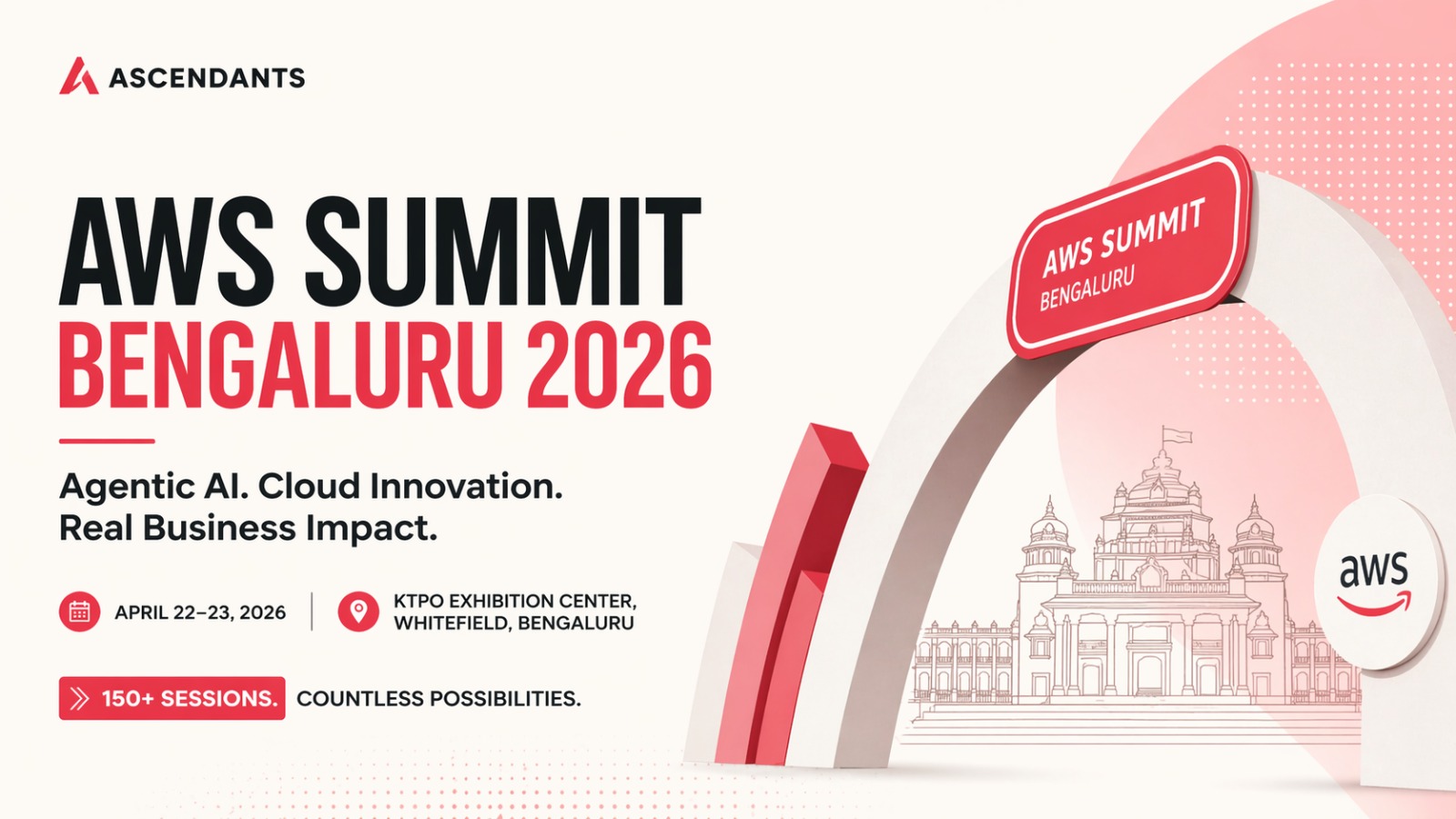
Amazon Web Services has brought back its flagship Bengaluru summit on April 22 and 23, 2026, with this year’s edition sharply focused on agentic AI, enterprise modernisation and cloud-native infrastructure. The event is being held at the KTPO Exhibition Center in Whitefield and continues the two-part format introduced last year, splitting the programme into an Innovators Edition on day one and a Technical Edition on day two.
On one side are boardroom conversations around AI adoption, secure deployment and business transformation. On the other are the engineers, architects and developers who now have to turn those ambitions into working systems. AWS Summit Bengaluru 2026 appears designed to sit exactly at that intersection.
The summit features more than 150 sessions, along with hands-on workshops, startup demos, customer showcases and networking opportunities for business leaders, developers and cloud practitioners. AWS is positioning the gathering as a practical, hands-on showcase of the latest cloud innovation, stretching from AI agents to serverless computing.
What stands out most this year is the prominence of agentic AI. Unlike the earlier phase of generative AI, which was largely dominated by experimentation and proof-of-concept excitement, the new emphasis is on systems that can reason, plan and execute tasks with greater autonomy.
That shift is visible in AWS’s keynote messaging and in the product stack expected to be highlighted at the summit. Amazon Bedrock, AWS’s managed platform for building generative AI applications with foundation models, is expected to take centre stage, along with Bedrock Guardrails and Bedrock AgentCore, which is positioned around orchestrating AI agents in enterprise workflows.
For the developer community, the technical agenda appears equally pointed. AWS is expected to spotlight Amazon Nova, its multimodal AI model family, Kiro IDE as an agentic development environment, and the next-generation Amazon SageMaker as a more unified platform that brings together data, analytics and AI workflows. That matters because enterprise AI adoption is no longer just about accessing a model.
Increasingly, the real challenge is managing the full chain: data, tooling, governance, deployment and iteration.
At the same time, the summit is not abandoning AWS’s traditional strengths. Sessions are also expected across the company’s core cloud stack, including Amazon EC2, AWS Lambda, Amazon Redshift, Amazon Elastic Kubernetes Service and CloudWatch. In effect, AWS seems to be making a broader case: that the future of AI inside enterprises will not be built in isolation, but on top of the same compute, storage, observability and orchestration layers that already run modern digital businesses.
The first day’s Innovators Edition is aimed at CXOs, CIOs, CTOs, enterprise architects and digital transformation leaders. Its focus is on strategy, secure AI deployment and transformation stories from Indian enterprises and startups. The announced keynote speakers for that day include Srinivasaa HG of Wipro, Madhusudhan Rao of Swiggy, Prasad Kalyanaraman of AWS, and Sandeep Dutta, president for India and South Asia at AWS.
Day two shifts the lens to builders. The Technical Edition is tailored for software engineers, machine learning engineers, DevOps leaders, cloud architects and security specialists, with deep-dive workshops, live coding demonstrations and labs. Its keynote lineup includes Rishi Bal of Bharat Gen, Murali Swaminathan of Freshworks, Satinder Singh of AWS India, Olivier Klein of AWS, and Mudit Agrawal of Amazon Robotics.
Beyond the sessions, AWS is also leaning into experience-led engagement. The summit includes the AWS Village, AWS for Industries Zone, Developers Zone, Startup Zone and an “8-bit Agents Activation,” where attendees can watch AI agents solve challenges in real time. That may sound theatrical, but it also reflects a serious point: AI events are no longer just about slides and product announcements. They are becoming demonstration grounds where companies try to prove that their tools can move from concept to action.
Taken together, AWS Summit Bengaluru 2026 looks less like a routine ecosystem event and more like a temperature check on the next phase of enterprise technology. The big story is not merely that AI remains central. It is that the conversation has matured.
The sector is also raising more difficult questions about how to implement AI safely, integrate it into enterprise workflows, govern it, and ensure its relevance beyond a mere demonstration. With an agenda that addresses these issues, it seems likely that Bengaluru will again provide a platform where cloud infrastructure and enterprise AI are no longer two separate dialogues but one and the same.
Also Read: Who Owns Your Team Now? IPL’s Latest Ownership Breakdown