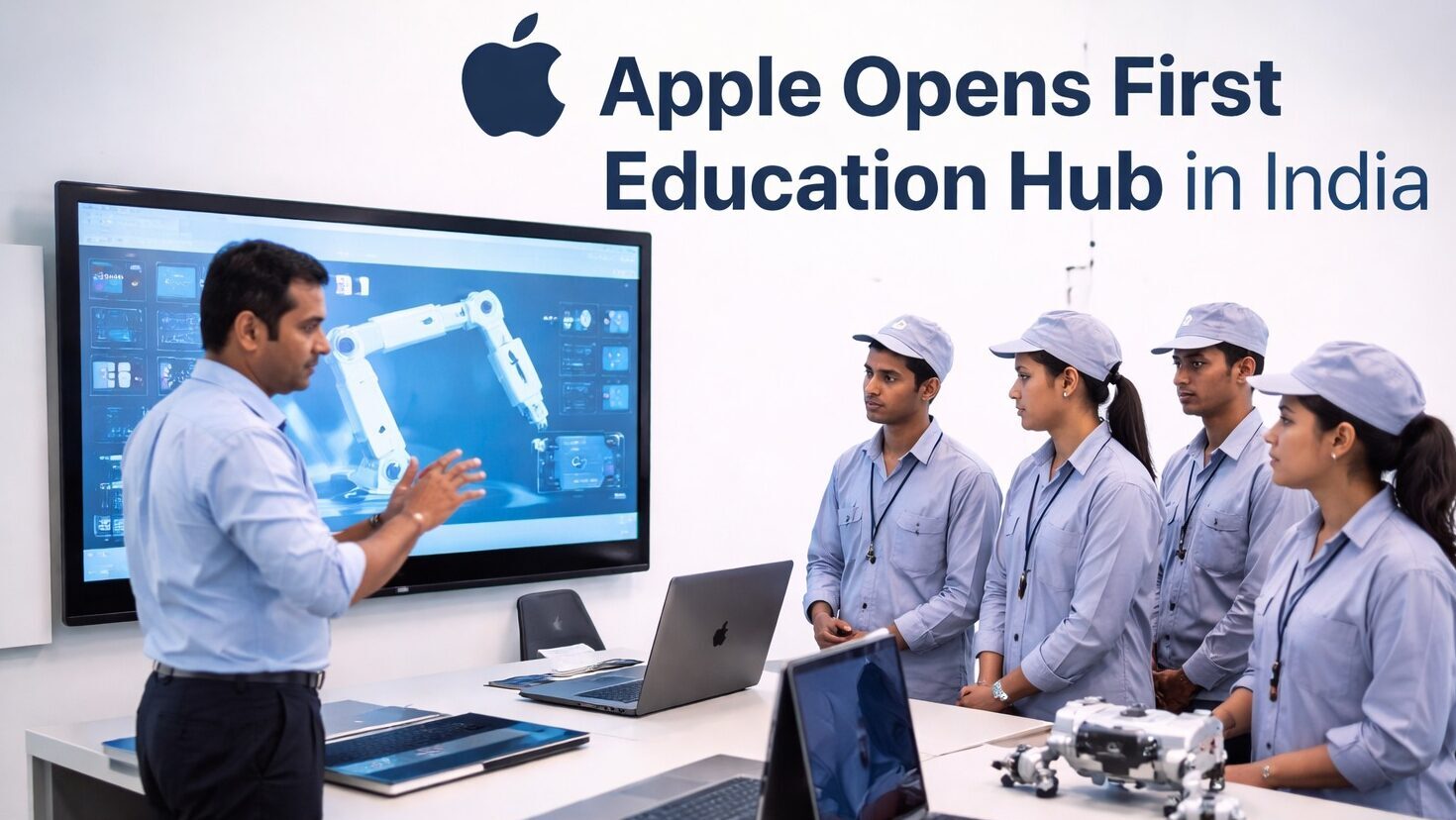
Apple has opened its first education hub in India, marking a significant step in expanding skills development across its local manufacturing ecosystem. The new hub is located in Bengaluru and has been launched in partnership with the Manipal Academy of Higher Education (MAHE). The initiative reflects Apple’s growing focus on India as a key part of its global supply chain and manufacturing strategy.
The Bengaluru hub will begin operations in March and is designed to provide structured, industry-relevant training to employees working at Apple supplier facilities across the country. The programmes aim to enhance technical capabilities while supporting long-term workforce development within India’s electronics manufacturing sector.
Focus on Digital and Advanced Manufacturing Skills
The education hub will offer courses in digital literacy, Swift coding, robotics, automation, and smart manufacturing. These programmes are targeted at employees working in more than 25 Apple supplier facilities in India. Training will begin with Tata Electronics, one of Apple’s major manufacturing partners in the country.
By focusing on both foundational digital skills and advanced manufacturing technologies, Apple aims to improve productivity, innovation, and operational quality across its supplier network. The curriculum is aligned with evolving manufacturing requirements as production processes become increasingly automated and technology-driven.
Train-the-Trainer Model to Reach More Workers
A key feature of the Bengaluru hub is its train-the-trainer approach. Under this model, faculty members from MAHE will first train educators employed by Apple’s suppliers. These trained educators will then conduct customised training sessions for workers at their respective manufacturing facilities.
This structure allows Apple to scale learning efficiently without requiring all employees to travel to a central location. The approach has already been used successfully in Apple’s education hubs in other countries and enables rapid expansion of training programmes across multiple sites.
The Bengaluru hub also builds on Apple’s earlier robotics training initiatives in India, strengthening a framework that blends academic expertise with on-ground industrial needs.
Also Read: Deepinder Goyal’s message to ex-Zomato staff: “I want you back”
Expansion of Course Offerings by 2026
Apple currently offers more than 75 courses to supplier employees in India through its development programmes. The company plans to increase this number to over 100 courses by the end of 2026. These courses are part of Apple’s global Supplier Employee Development Fund, which has a total commitment of $50 million.
Worldwide, the fund has already supported skill development for more than 18,000 supplier employees. The expansion in India signals Apple’s intention to deepen its investment in human capital as manufacturing volumes and complexity continue to rise in the country.
Sarah Chandler, Apple’s vice president responsible for supplier responsibility, said that skill development in India has the potential to be transformative and aligns with the company’s belief in investing in the people who manufacture its products.
India’s Growing Role in Apple’s Global Network
Apple already operates similar education hubs in the United States, Vietnam, and China. The launch of the India hub highlights the country’s increasing importance within Apple’s global manufacturing and supply framework.
India has emerged as a major production base for Apple devices, particularly iPhones, as the company diversifies its manufacturing footprint. The focus on structured training is expected to support higher quality standards and enable suppliers to adopt advanced production techniques more quickly.
Tax Policy Change Eases Equipment Funding
The launch of the education hub comes alongside a significant policy development that supports Apple’s manufacturing expansion in India. A new five-year tax exemption now allows Apple to supply manufacturing equipment directly to Indian contract manufacturers without creating a taxable presence in the country.
Earlier, Apple avoided funding high-end machinery directly due to potential tax liabilities, which meant suppliers such as Foxconn and Tata had to bear these costs themselves. The exemption removes a long-standing hurdle and makes it easier for Apple to invest in advanced equipment for its partners.
Boost for iPhone Production and Exports
The policy change is expected to accelerate iPhone production in India. The country already accounts for around 25 percent of global iPhone shipments, and increased investment in equipment and skills is likely to strengthen export capacity, particularly for markets such as the United States.
Together, the education hub and the revised tax framework underline Apple’s long-term commitment to India. By combining workforce training with operational support, the company is reinforcing India’s position as a central pillar of its global manufacturing strategy.
Also Read: Silver and Gold Prices Rebound in Delhi After Sharp Fall