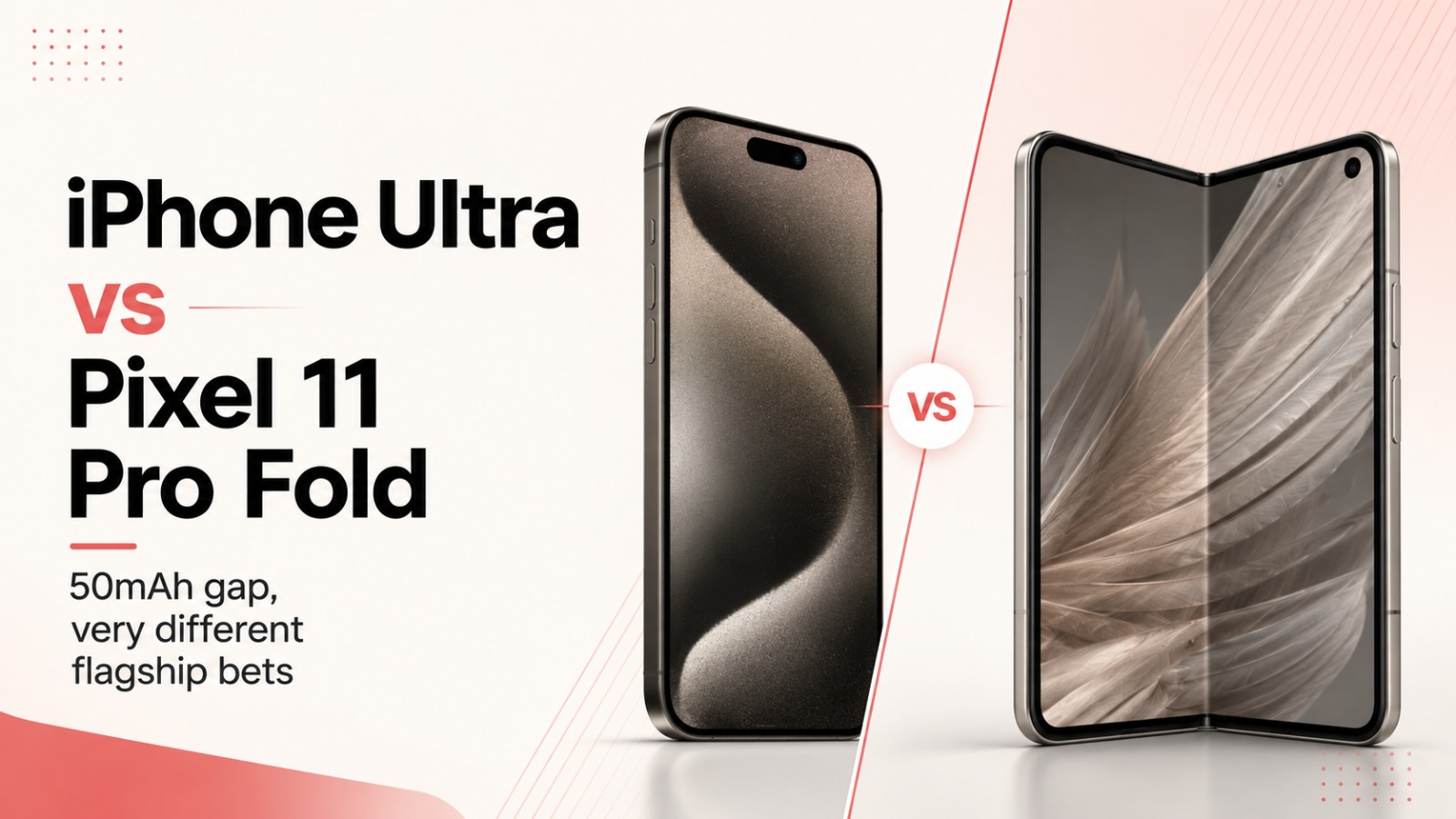
The forthcoming Apple iPhone Ultra and Google Pixel 11 Pro Fold have much to offer as two distinct versions of the top-end smartphone. Although the batteries of both the phones have similar specifications in terms of capacity, which differ by only 50mAh, there is little else that the duo have in common.
There is also an important distinction before comparing the specifications. Google has officially announced the Pixel 11 Pro Fold, while the iPhone Ultra is listed as an expected September 2026 device. That means the Apple specifications discussed here should be treated as expected rather than as a confirmed final configuration.
Bigger screens, but not the same approach
The most obvious difference comes from the displays.
The iPhone Ultra is listed with a 7.8-inch OLED screen carrying a 120Hz refresh rate and 2460×2180 resolution, along with Super Retina XDR and Dolby Vision support. A 5.5-inch cover display is listed at 2380×1080 resolution.
Apple’s expected device is also described with a glass back, titanium frame and 3D face unlock.
Google’s Pixel 11 Pro Fold, by comparison, uses an 8-inch OLED inner display with a 120Hz refresh rate, HDR support and brightness of up to 3,600 nits. Its outer display measures 6.5 inches and also refreshes at 120Hz.
The Pixel uses Gorilla Glass Victus 2 and an aluminium frame, while IP68 water resistance and fingerprint authentication are also listed among its features.
The numbers make the difference fairly clear. Google’s phone offers the larger inner and outer screens, while the listed iPhone Ultra specifications put greater emphasis on Apple’s display technologies and a titanium construction.
Tensor G6 versus A20 Pro
The divide continues under the hood.
The iPhone Ultra is listed with Apple’s A20 Pro processor built on a 2nm process, paired with 12GB RAM and 256GB of storage.
Google has equipped the Pixel 11 Pro Fold with its Tensor G6 2nm chip and 16GB RAM. Buyers get a choice between 256GB and 512GB storage variants.
Neither device offers expandable storage.
That leaves the Pixel with 4GB more listed RAM and an additional 512GB storage option, while Apple’s expected model is currently listed only in a 256GB configuration.
Only 50mAh separates the batteries, but charging is another story
Battery capacity is one of the closest parts of the comparison.
The iPhone Ultra is listed with a 4,700mAh battery, while the Pixel 11 Pro Fold has a 4,750mAh unit. The gap is just 50mAh.
Charging specifications, however, show a wider difference.
Apple’s expected model is listed with 20W wired charging. The Pixel 11 Pro Fold supports 30W wired charging and 25W wireless charging, along with Qi wireless charging.
Capacity alone therefore does not tell the full battery story. The two phones are closely matched by the headline battery figure, but Google’s officially announced model carries the stronger charging specifications in the comparison.
Apple goes dual-camera, Google adds a 5x telephoto
Camera hardware is another area where the two devices take noticeably different routes.
The iPhone Ultra is listed with two rear cameras: a 48MP main sensor and a 12MP ultrawide. A 12MP camera sits at the front.
Its listed video capabilities include 8K recording at 30 frames per second and 4K recording at 60fps.
The Pixel 11 Pro Fold uses a three-camera rear setup consisting of a 48MP main camera, a 10.5MP ultrawide and a 10.8MP telephoto camera offering 5x zoom. It also carries a 10MP front camera and supports 4K video recording at 60fps.
On the listed specifications alone, Google’s phone brings the additional flexibility of a dedicated 5x telephoto camera, while the expected iPhone Ultra configuration lists the higher 8K video recording option.
Pixel 11 Pro Fold starts at ₹1,86,999
Google’s Pixel 11 Pro Fold will be offered in 256GB and 512GB storage configurations, with pricing beginning at ₹1,86,999.
The iPhone Ultra, meanwhile, is anticipated to debut in September 2026. No iPhone Ultra price is stated in the information available here, so a direct price comparison cannot yet be made.
That difference in availability also matters when reading the specification sheet. The Pixel 11 Pro Fold is an announced product with a stated starting price, while the iPhone Ultra remains an expected device.
Which phone stands out on the current specifications?
For buyers looking at the specifications alone, the Pixel 11 Pro Fold makes its case with an 8-inch inner display, a larger 6.5-inch outer screen, 16GB RAM, a 512GB storage option, a dedicated 5x telephoto camera and faster listed wired and wireless charging.
The expected iPhone Ultra takes a different route. Its listed configuration includes a titanium frame, A20 Pro chip, Super Retina XDR and Dolby Vision display technologies, 3D face unlock and 8K video recording at 30fps.
The ultimate choice will most likely come down to platform choice and form factor. The Google device offers a folding Android smartphone featuring a large interior display, whereas the expected Apple device will offer the iOS platform and a wholly different set of hardware specifications.
What makes the comparison particularly interesting is that the closest number on the specification sheet, the 50mAh battery difference, turns out to be one of the least important distinctions. Displays, charging speeds, camera layouts, memory and software platforms create a far wider separation between the two premium devices.
Also Read: iPhone 18 Pro vs 15 Pro, 16 Pro & 17 Pro: Is It Worth Upgrading?