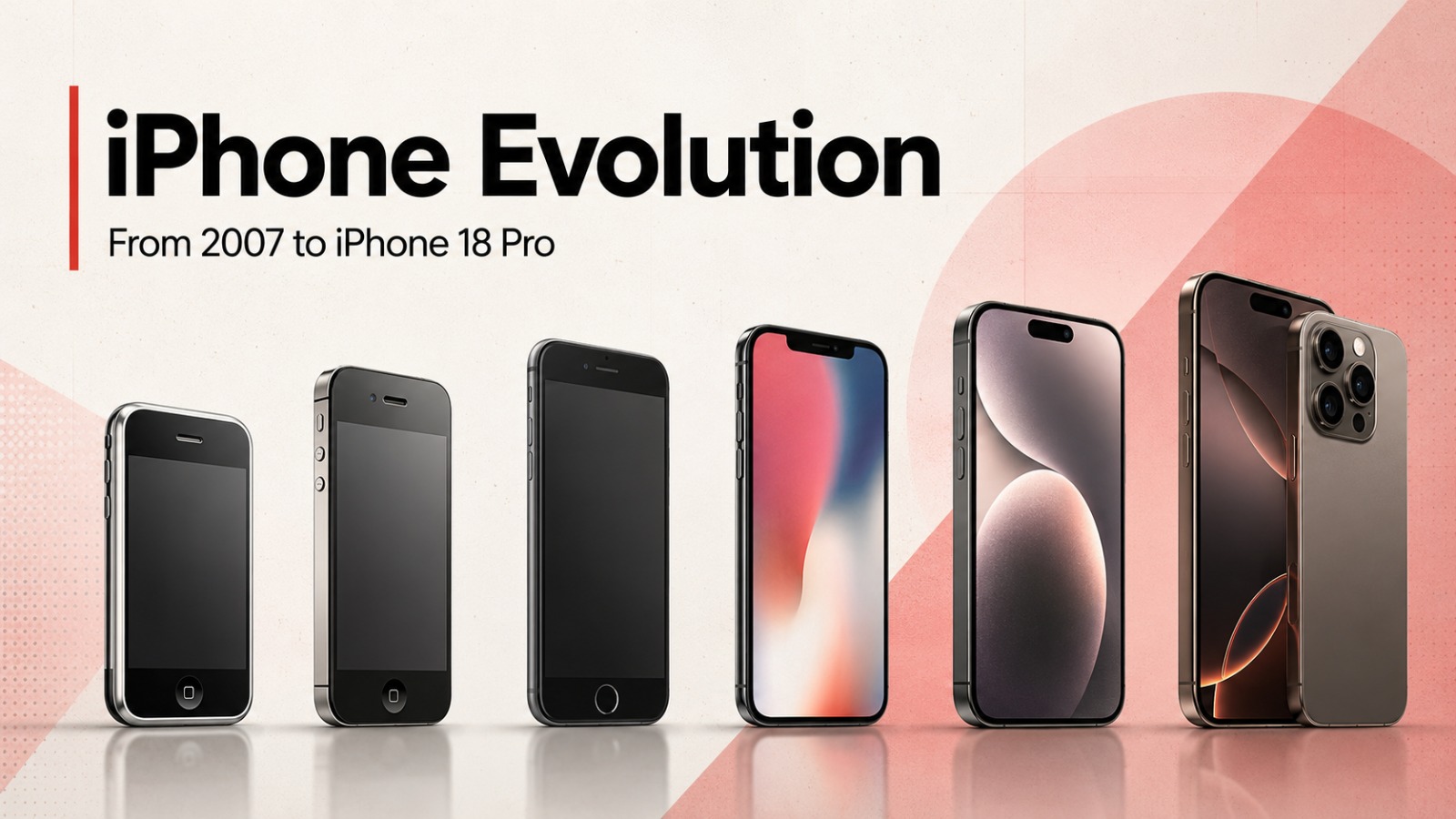
Evolution of Apple: From 2007 iPhone to iPhone 18 pro
When Steve Jobs walked onto the Macworld stage in San Francisco on January 9, 2007, he did not introduce the iPhone as another mobile phone.
He framed it as three products.
A widescreen iPod with touch controls. A revolutionary mobile phone. A breakthrough internet communicator.
Then came the reveal: they were the same device.
Almost two decades later, that presentation still explains something fundamental about the iPhone. Apple has rarely built its most important products around a single spectacular specification. Its bigger skill has been deciding which technologies are ready to be combined, which conventions are ready to be abandoned, and which parts of the experience it needs to control itself.
That philosophy took the iPhone from a 3.5-inch device with a 2-megapixel camera and no App Store to phones capable of satellite communication, sophisticated computational photography, console-class graphics ambitions and 4K video recording at frame rates that would have sounded absurd in 2007.
The road toward iPhone 18 Pro is therefore not simply a story about faster processors and better cameras. It is a story about decisions.
Apple killed the physical keyboard. It created its own mobile processors. It moved from passwords toward fingerprints and then faces. It abandoned the headphone jack. It replaced the Home button with gestures. It took the iPhone through three physical connector eras, from 30-pin to Lightning to USB-C. It turned cameras into software-defined imaging systems. And eventually it began designing the phone around artificial intelligence workloads as much as conventional smartphone computing.
Some of those decisions were immediately celebrated. Others were mocked before competitors adopted similar ideas.
Together, they explain how the iPhone became what it is.
The iPhone journey at a glance
| Year | Major iPhone generation | What changed |
|---|---|---|
| 2007 | Original iPhone | Multi-Touch interface, full web browser, visual voicemail |
| 2008 | iPhone 3G | 3G connectivity, GPS, App Store era |
| 2009 | iPhone 3GS | Faster performance, video recording, Voice Control |
| 2010 | iPhone 4 | Retina display, A4 chip, FaceTime, front camera |
| 2011 | iPhone 4S | Siri, A5 chip, major camera improvement |
| 2012 | iPhone 5 | 4-inch display, LTE, Lightning connector |
| 2013 | iPhone 5s and 5c | Touch ID, 64-bit A7 chip, product segmentation |
| 2014 | iPhone 6 and 6 Plus | Larger screens, Apple Pay, NFC |
| 2015 | iPhone 6s series | 3D Touch, Live Photos, 4K video |
| 2016 | iPhone SE, iPhone 7 series | Headphone jack removed, water resistance, dual-camera system |
| 2017 | iPhone 8 series, iPhone X | OLED, Face ID, gesture navigation, wireless charging |
| 2018 | iPhone XS, XS Max, XR | Broader premium lineup, Smart HDR, eSIM support |
| 2019 | iPhone 11 series | Night mode, ultra-wide camera, Pro branding |
| 2020 | iPhone 12 series | 5G, MagSafe, OLED across main lineup, LiDAR on Pro models |
| 2021 | iPhone 13 series | ProMotion on Pro, Cinematic mode, major battery and camera refinements |
| 2022 | iPhone 14 series | Dynamic Island on Pro, Emergency SOS via satellite, 48MP Pro camera |
| 2023 | iPhone 15 series | USB-C, titanium Pro design, Action button, A17 Pro |
| 2024 | iPhone 16 series | Camera Control, A18 family, Apple Intelligence-focused hardware direction |
But the specifications tell only half the story.
The more interesting part is why Apple kept changing the definition of what an iPhone was supposed to be.
2007: Apple decides the keyboard is the problem
Smartphones existed before the iPhone.
Touchscreens existed before the iPhone.
Mobile email existed. Web browsing existed. Cameras existed.
What Apple challenged was the assumption that a serious smartphone needed a permanent physical keyboard and a collection of fixed buttons.
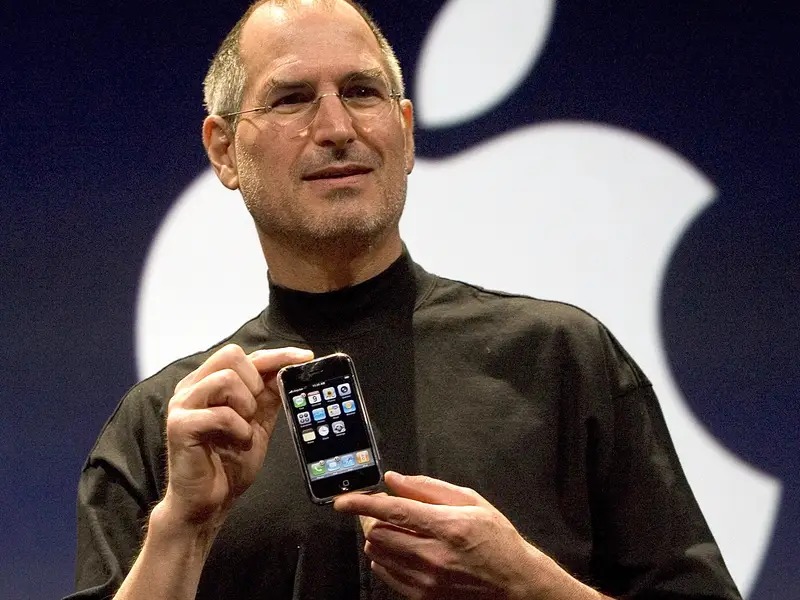
Jobs argued that buttons were a problem because they could not change when software changed.
Apple’s answer was a large Multi-Touch display whose controls could be created by software.
That sounds ordinary today because the bet worked so completely.
In 2007 it was radical.
The original iPhone had a 3.5-inch display, a 2-megapixel rear camera and storage configurations that seem microscopic by modern standards. There was no 3G. There was no front-facing camera. There was no App Store when the phone first went on sale.
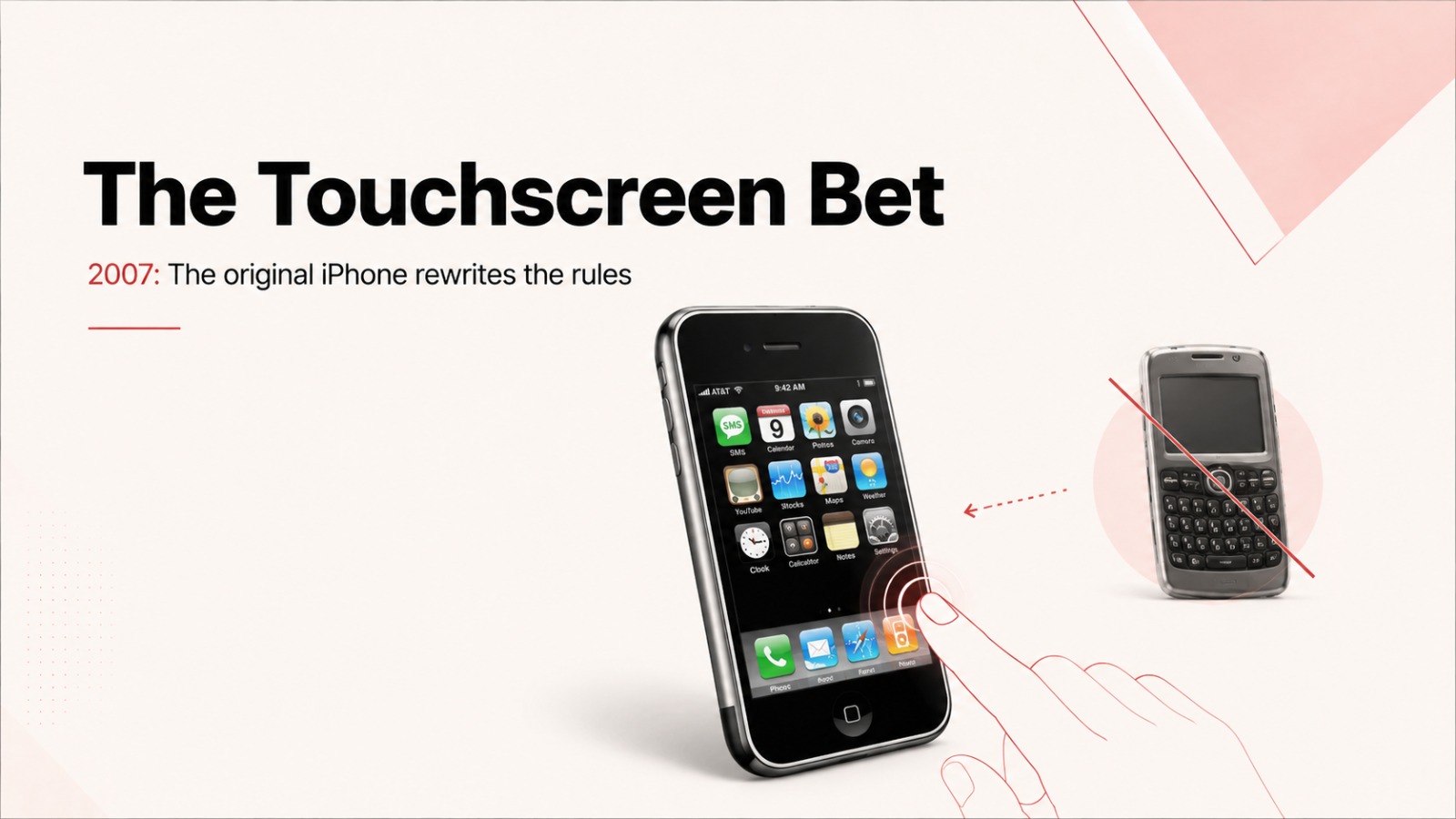
Yet the architecture of the modern smartphone was already visible.
Finger-driven scrolling. Pinch-to-zoom. A software keyboard. Full-screen applications. A desktop-class approach to web browsing. Sensors that changed screen orientation.
The key innovation was not one component.
It was the interface.
Apple had made the screen itself the primary control surface.
That decision would shape practically every smartphone that followed.
2008: The App Store turns a product into a platform
The original iPhone was intentionally restricted in ways that now seem astonishing.
Third-party developers could not initially install native applications through an official consumer marketplace.
That changed in 2008.
The iPhone 3G arrived with faster cellular connectivity and GPS, but the transformational development was software distribution.
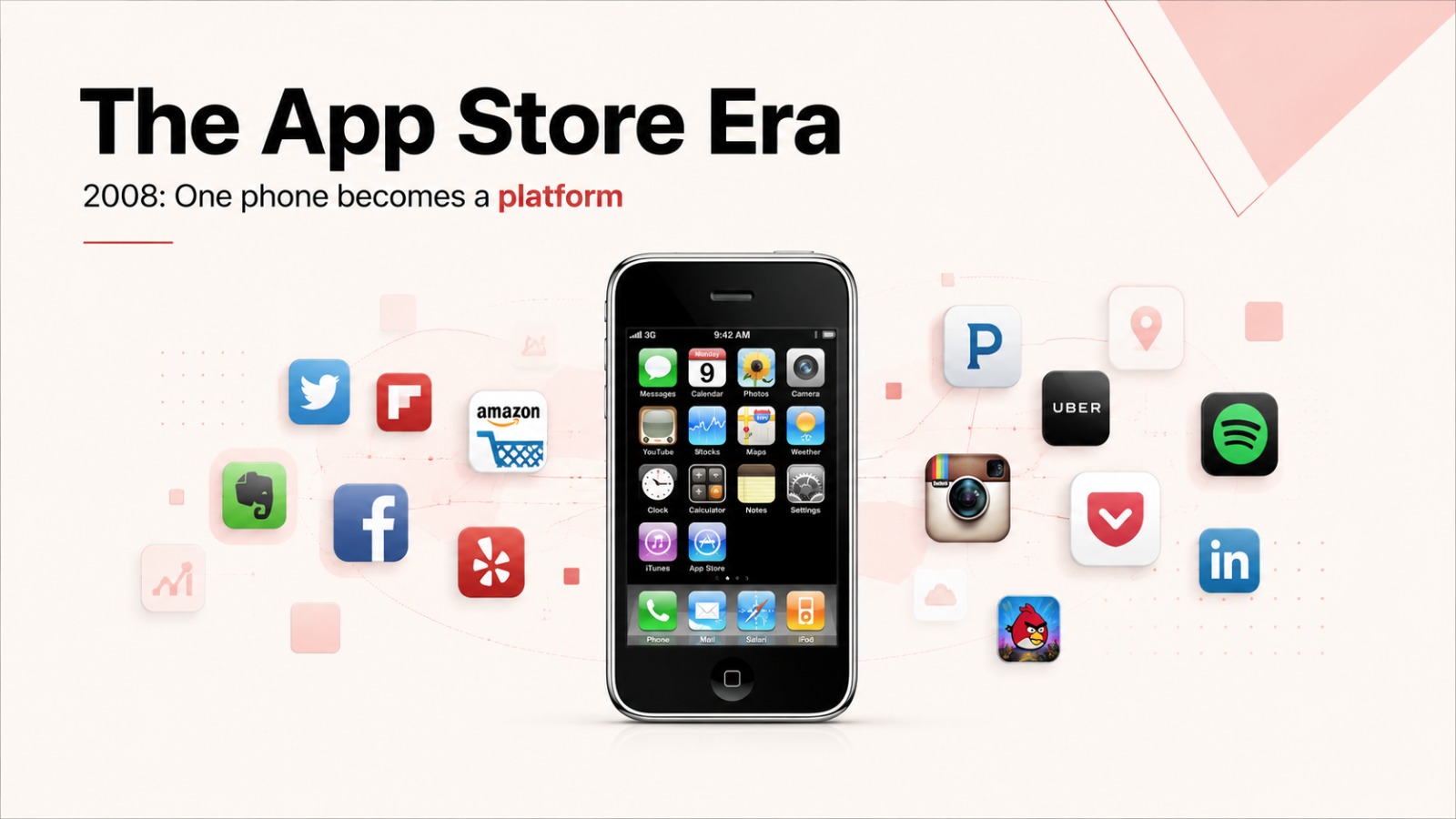
The App Store launched with more than 500 applications.
That changed the economics of the iPhone.
Before the App Store, Apple primarily determined what the phone could do.
After the App Store, hundreds and eventually millions of developers could expand its usefulness.
Banking, social networking, games, transportation, photography, streaming, food delivery, productivity and entire categories of businesses moved onto smartphones.
Apple had turned the iPhone from a finished electronic product into a platform that could become more useful after someone bought it.
That may have been the most consequential business decision in iPhone history.
2009: The iPhone starts becoming a camera
The iPhone 3GS was less visually dramatic.
That was itself important.
Apple had begun establishing a rhythm the industry would become familiar with: major redesigns followed by generations focused on internal improvements.
The “S” generation brought substantially faster performance, video recording, a digital compass and Voice Control.
The camera was still modest by today’s standards, but video recording hinted at a change that would eventually transform both the iPhone and the internet.
A phone was no longer merely something that could take an occasional photograph.
It was becoming a device for creating media.
2010: Apple starts building the heart of the iPhone itself
The iPhone 4 remains one of the most consequential generations Apple has produced.
The industrial design changed dramatically, with glass surfaces and a stainless-steel frame.
The screen changed too.
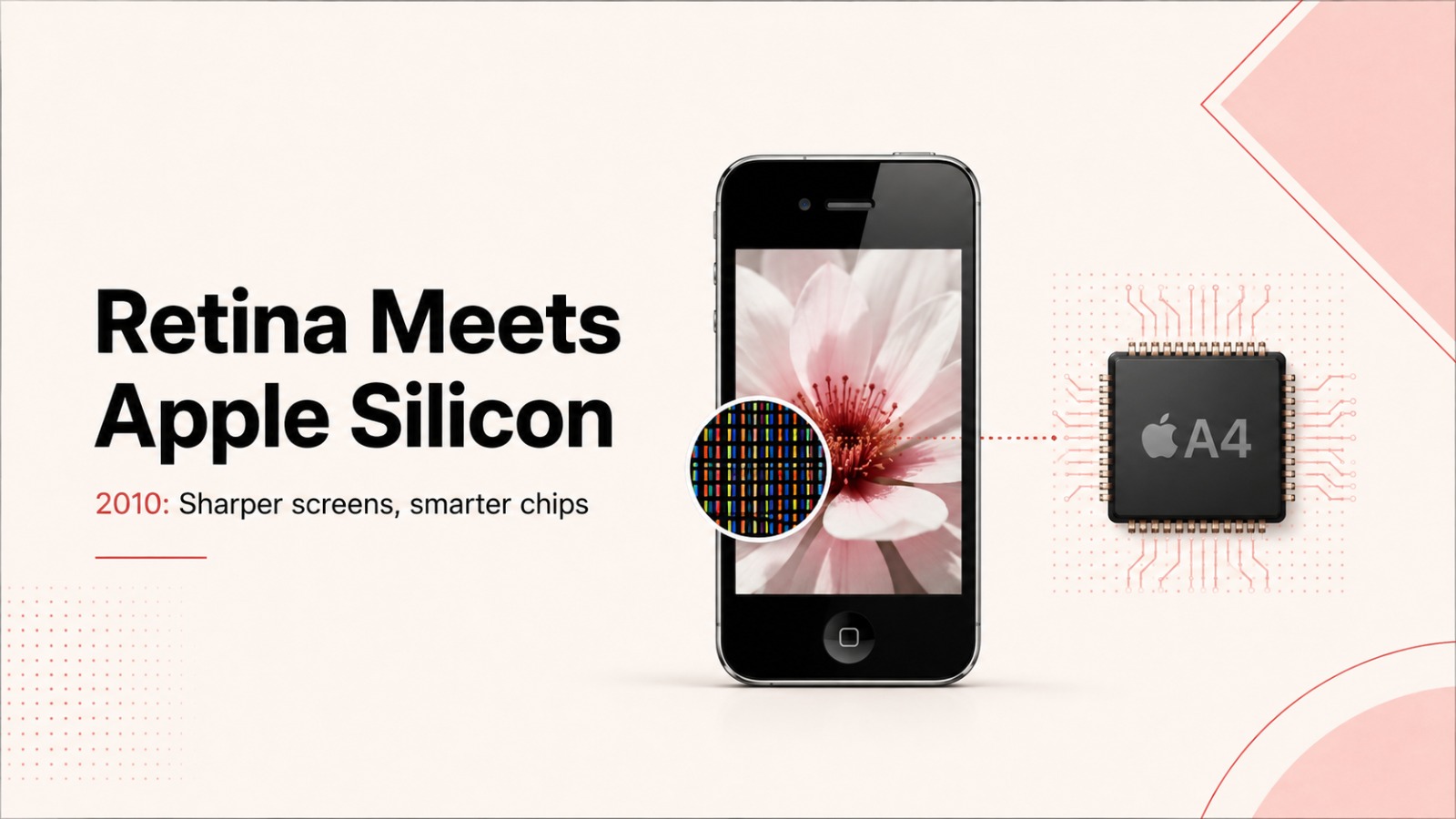
Apple introduced what it called the Retina display, dramatically increasing pixel density and making individual pixels far harder to distinguish at normal viewing distance.
A front-facing camera arrived.
So did FaceTime.
But one change was even more important for Apple’s long-term strategy.
The iPhone 4 used Apple’s A4 processor.
Apple was moving toward controlling the silicon at the centre of its mobile products.
That decision became a competitive weapon.
Instead of designing software for generic processors available to multiple manufacturers, Apple could increasingly coordinate hardware, operating system, machine-learning features, camera processing, security and power efficiency around its own chips.
Much of what modern iPhones can do begins with that decision.
2011: Siri gives the phone a voice
The iPhone 4S looked similar to the iPhone 4, but introduced one of Apple’s most recognisable software features.
Siri.
Voice interaction had existed in various forms before Siri, but Apple placed a conversational assistant directly into the mainstream smartphone experience.
The 4S also brought the A5 chip and an 8-megapixel camera capable of 1080p video.
Photography was becoming central to how Apple sold the iPhone.
That trend would accelerate.
2012: Bigger screen, faster network, smaller connector
The iPhone 5 represented another architectural shift.
Its display grew from 3.5 inches to 4 inches.
LTE arrived.
Apple also retired the large 30-pin dock connector that had been associated with iPods and early iPhones.
Its replacement was Lightning.
The reaction is worth remembering.
Changing a connector inconveniences people. Existing cables, docks and accessories suddenly need adapters or replacement.
Apple accepted that pain in exchange for a much smaller, reversible connector better suited to increasingly thin devices.
It would keep Lightning for more than a decade.
The episode established another recurring feature of Apple’s product strategy: the company was willing to remove established hardware standards before many customers wanted them removed.
It would do it again.
2013: Touch ID and the 64-bit gamble
The iPhone 5s did not look revolutionary from across a room.
Inside, it contained two developments that would influence smartphones for years.
The first was Touch ID.
Apple built a fingerprint sensor into the Home button, allowing users to unlock their phones by touching the button rather than repeatedly entering a passcode.
Biometric authentication became convenient enough for ordinary daily use.
The second was the A7.
Apple described it as the first 64-bit chip in a smartphone.
At the time, critics questioned what a phone needed 64-bit computing for.
The answer became clearer over the following years as mobile applications grew more complex and Apple’s chips pushed into performance territory once associated with conventional computers.
The iPhone 5c also appeared that year, placing iPhone 5-class technology in a colourful polycarbonate body.
It was an early sign that Apple was willing to broaden the iPhone family rather than depend on a single flagship model.
2014: Apple finally accepts that people want big phones
For years, Apple had resisted the industry’s race toward larger displays.
Then came the iPhone 6 and iPhone 6 Plus.
The screens jumped to 4.7 inches and 5.5 inches.
The decision was commercially important because large-screen Android phones had proved that consumers were comfortable carrying significantly bigger devices.
Apple adapted.
The Plus model also established a pattern that remains important today: screen size itself could become a reason to move further up the product range.
The same generation introduced Apple Pay and brought NFC into the iPhone’s consumer experience.
The iPhone was becoming more than a communications device.
It was becoming a wallet.
2015: Apple experiments with pressure as an interface
The iPhone 6s generation introduced 3D Touch.
The display could detect different levels of pressure, allowing software to expose shortcuts and previews based on how firmly users pressed.
It was technically ambitious.
It also became a useful lesson.
Not every interaction Apple introduces becomes permanent.
3D Touch eventually disappeared from the iPhone lineup.
Its legacy matters because it demonstrates something often forgotten when people reconstruct Apple’s history after the fact.
Apple does not know with certainty which interface experiments will become universal.
Some succeed spectacularly.
Some are replaced.
The 6s also introduced Live Photos, a 12-megapixel rear camera and 4K video recording, strengthening the iPhone’s position as a serious everyday camera.
2016: Apple removes the headphone jack
Few iPhone decisions generated as much immediate argument as the iPhone 7’s missing 3.5mm headphone jack.
Apple pushed users toward Lightning headphones, adapters and wireless audio.
The timing mattered.
AirPods were introduced at the same event.
Removing the jack created frustration, but it also pushed the iPhone ecosystem rapidly toward wireless audio.
The iPhone 7 generation brought another major change on the Plus model: two rear cameras.
The additional telephoto camera enabled optical zoom options and supported Portrait mode, which used computational techniques to create a shallow depth-of-field effect.
This was an early glimpse of the future of smartphone photography.
The camera was no longer simply capturing what passed through one lens.
Software was beginning to construct the final image using information from multiple sensors and algorithms.
2017: The Home button disappears
Ten years after the original iPhone, Apple made its most dramatic interface change since Multi-Touch.
The iPhone X removed the Home button.
That meant Touch ID disappeared from Apple’s flagship design.
Face ID took its place.
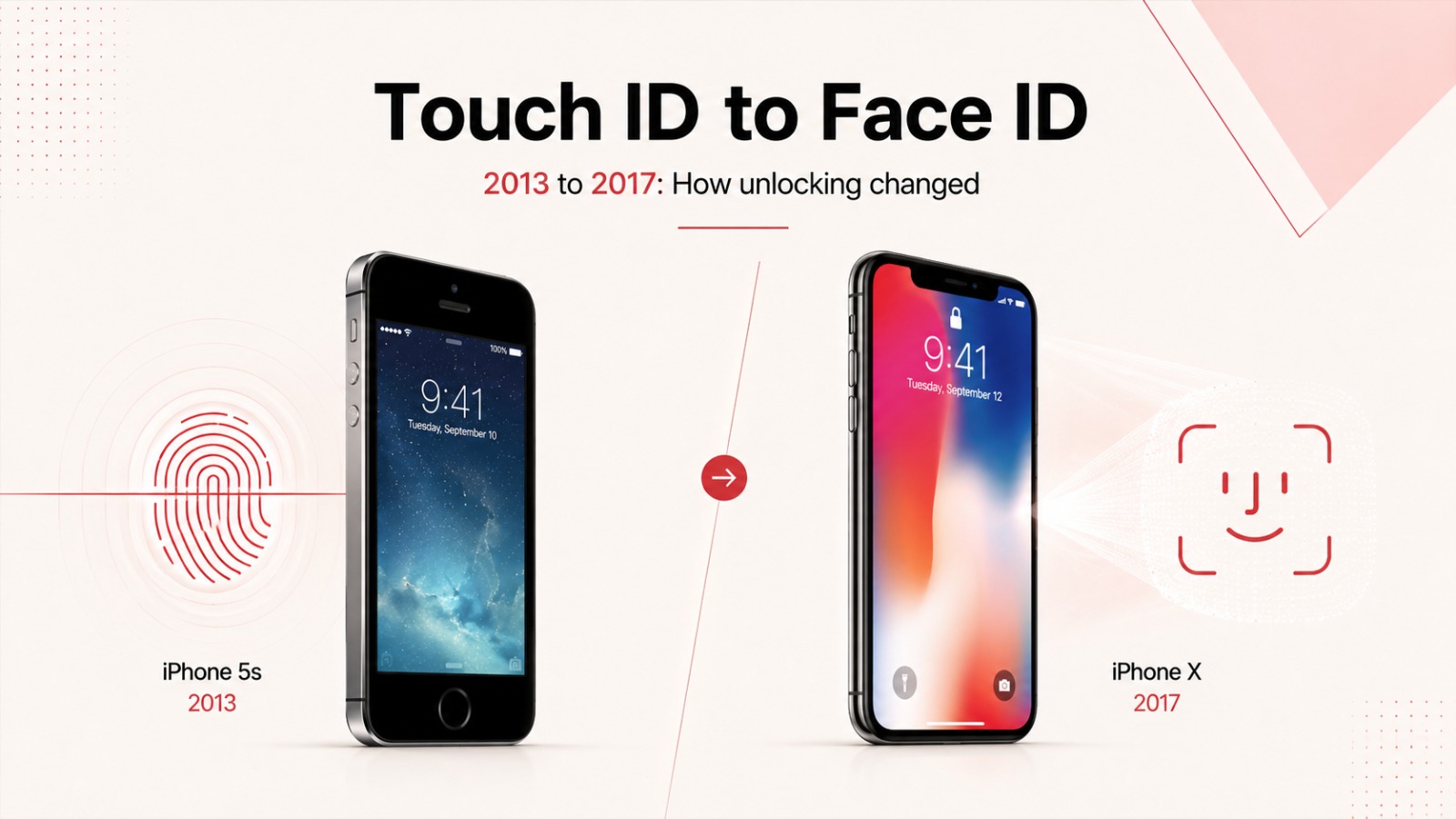
Apple’s TrueDepth camera system projected and analysed depth information to authenticate a user’s face.
Navigation also changed.
Instead of pressing Home, users swiped.
Once again, Apple was asking hundreds of millions of people to relearn something basic.
The iPhone X also brought OLED to the iPhone and pushed the display closer to the edges of the device.
Meanwhile, the iPhone 8 and 8 Plus added glass backs and wireless charging.
By the end of 2017, the basic visual grammar of the modern premium iPhone had arrived: Face ID, gestures, a near-full-screen front and increasingly sophisticated computational photography.
2018: One flagship becomes a family
With the iPhone XS, XS Max and XR, Apple’s segmentation strategy became clearer.
The company no longer needed every new iPhone to occupy the same price or screen category.
The XR offered many of the central experiences of Apple’s new generation while making compromises in areas such as the display and camera system.
That model helped establish a formula Apple would reuse repeatedly.
Customers could enter the current generation without buying the most expensive phone, while Pro-level buyers could be given increasingly specialised hardware.
The iPhone was turning into a portfolio rather than a product.
2019: The word “Pro” comes to iPhone
The iPhone 11 Pro and 11 Pro Max introduced Apple’s Pro naming to the iPhone family.
More important was the camera system.
The Pro models used wide, ultra-wide and telephoto cameras.
Night mode significantly improved low-light photography through computational processing.
This was the point at which smartphone photography began to become difficult to explain using camera specifications alone.
Megapixels mattered.
Lens aperture mattered.
Sensor size mattered.
But so did the processor, image signal processing, machine learning and the software pipeline combining multiple exposures.
The photograph was increasingly the product of a computing system.
Apple also introduced the U1 chip with Ultra Wideband technology in the iPhone 11 generation, adding precise spatial-awareness capabilities that would later support experiences across Apple’s device ecosystem.
2020: 5G arrives, and MagSafe returns in a new form
The iPhone 12 generation brought 5G to the iPhone.
It also returned to flatter sides reminiscent of earlier iPhones while pushing OLED displays across the principal iPhone 12 family.
Apple introduced four sizes, including the compact iPhone 12 mini.
That experiment would not last indefinitely, but it showed Apple testing just how wide the market for different iPhone dimensions really was.
Another major addition was MagSafe.
The name had previously been associated with magnetic charging connectors on Mac notebooks. On the iPhone, Apple reinvented it as a magnetic alignment system for wireless charging and accessories.
Pro models also gained LiDAR, giving the phone additional depth-sensing capability with applications in photography and augmented reality.
By now, an iPhone contained not one revolutionary sensor but a network of them.
2021: The camera starts behaving like a film tool
The iPhone 13 generation concentrated heavily on refinement.
Battery life improved.
Camera systems became more capable.
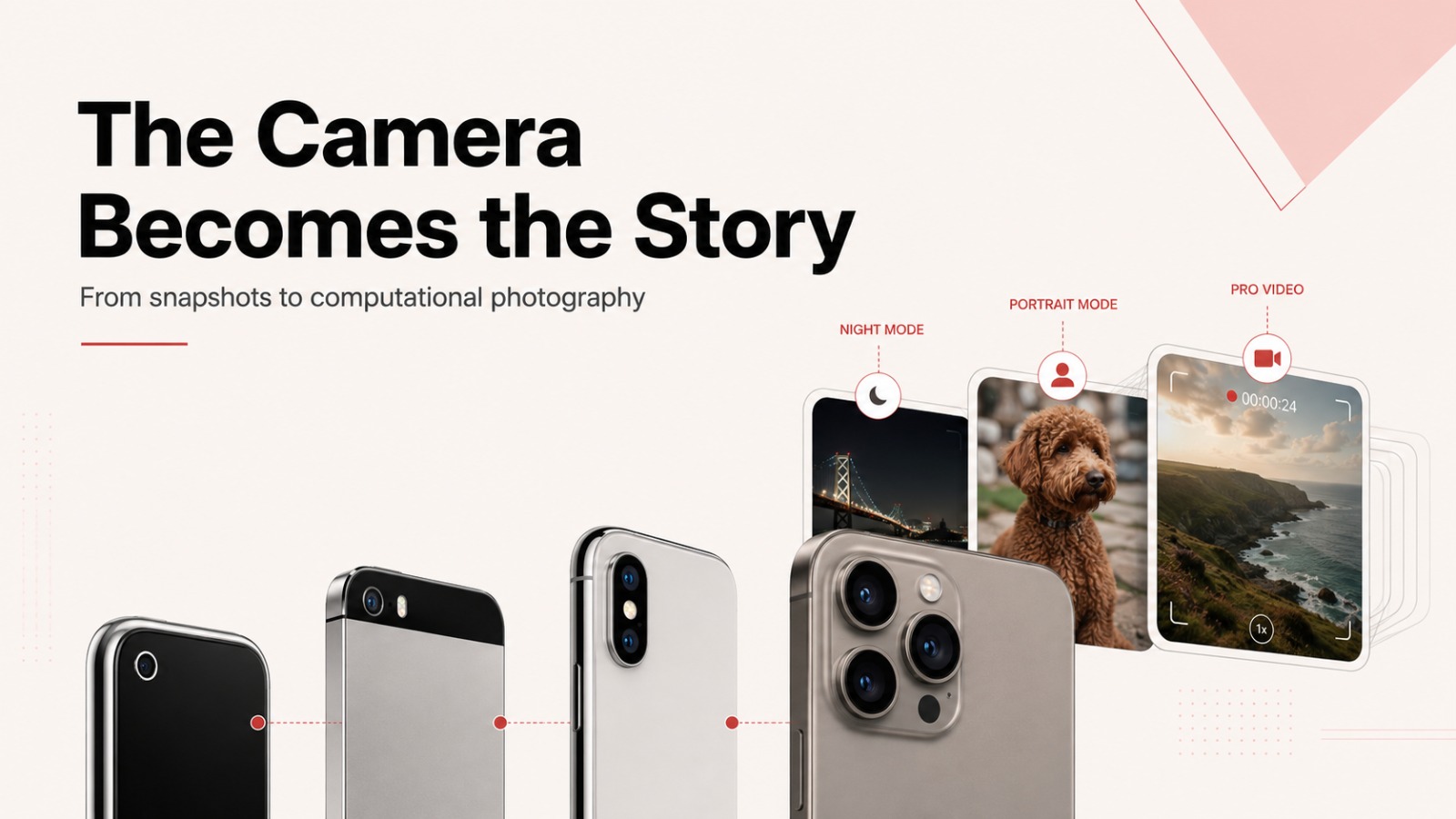
On the Pro models, Apple introduced ProMotion displays with refresh rates up to 120Hz.
But one of the more revealing features was Cinematic mode.
The iPhone could create video with software-generated depth effects and shift focus between subjects.
Again, the important point was not whether a smartphone could perfectly replace professional cinema equipment.
It could not.
The important shift was computational.
Techniques that once required substantial optical equipment and post-production work were increasingly being simulated, assisted or automated inside a pocket-sized device.
2022: The notch turns into software
The iPhone 14 Pro offered a clever example of Apple responding to a hardware limitation through interface design.
Rather than pretending the camera cutout did not exist, Apple built software around it.
Dynamic Island turned the area around the front sensors into an interactive space for alerts and live information.
The generation also introduced a 48-megapixel main camera on the Pro models and an always-on display.
But perhaps the more consequential safety feature was Emergency SOS via satellite.
Supported iPhones could communicate with emergency services in situations where cellular and Wi-Fi connectivity were unavailable, using satellite connectivity and a guided interface that helped users point their devices toward a satellite.
Crash Detection was another safety-focused addition.
These features expanded the definition of connectivity.
For most of the iPhone’s history, “connected” meant Wi-Fi or a cellular tower.
Satellite communication changed that assumption.
2023: Lightning finally gives way to USB-C
The connector story came full circle with the iPhone 15 family.
After 30-pin and more than a decade of Lightning, Apple moved the iPhone to USB-C.
For customers already surrounded by USB-C laptops, tablets and accessories, the practical effect was significant.
One connector could increasingly serve a wider range of devices.
The iPhone 15 Pro and Pro Max also moved from stainless steel to a titanium design and replaced the traditional Ring/Silent switch with a configurable Action button.
Inside was the A17 Pro.
Apple placed unusual emphasis on graphics performance and hardware-accelerated ray tracing, presenting the iPhone increasingly as a platform capable of running demanding games that had traditionally belonged to dedicated consoles or PCs.
The Pro Max also introduced a 5x telephoto camera using a tetraprism design.
The camera race was no longer simply about adding sensors.
It was becoming a packaging and computational-engineering problem.
2024: The iPhone begins to be designed around AI
The iPhone 16 generation marked another strategic turn.
Apple introduced the A18 and A18 Pro chip families and explicitly positioned the hardware around Apple Intelligence.
This matters because AI changes what smartphone hardware needs to optimise for.
Traditional performance discussions revolved around CPU speed, graphics performance, memory and battery life.
AI introduces another layer: neural processing, memory bandwidth, privacy, on-device inference and the relationship between local processing and cloud computation.
The iPhone 16 generation also introduced Camera Control, a physical control designed specifically around camera access and operation.
The Action button, previously limited to the iPhone 15 Pro generation, expanded across the lineup.
On the Pro models, Apple pushed video capture to 4K Dolby Vision at up to 120 frames per second.
Look back to 2007.
The original iPhone had a fixed-focus 2-megapixel still camera and could not officially record video through its built-in Camera app.
Less than two decades later, Apple was building phones around multi-camera computational systems and high-frame-rate 4K Dolby Vision recording.
That is an extraordinary amount of technological compression into one product category.
The 18 decisions that really shaped the iPhone
Individual specifications make for good launch-day headlines. Decisions explain the longer story.
1. Replacing physical controls with software
The original Multi-Touch interface allowed the controls of a phone to change with the application.
That was foundational.
2. Opening the App Store
Apple transformed the iPhone from a finished device into an extensible computing platform.
3. Building its own silicon
A-series processors gave Apple increasingly deep control over performance, cameras, security, graphics and machine learning.
4. Treating displays as a competitive technology
Retina, OLED, HDR and high-refresh-rate ProMotion displays became central parts of the iPhone experience.
5. Making the camera strategic
Photography moved from a useful feature to one of the main reasons to upgrade.
6. Normalising biometric authentication
Touch ID made fingerprint authentication routine. Face ID later moved Apple’s flagship products toward depth-based facial authentication.
7. Growing the screen
The move from 3.5 inches to larger displays acknowledged that smartphones were becoming people’s main computing screens.
8. Creating multiple price and size tiers
Plus, SE, mini, standard and Pro variants showed that one iPhone could no longer serve every buyer.
9. Turning payments into a phone feature
Apple Pay helped reposition the iPhone as part of everyday financial infrastructure.
10. Removing the headphone jack
The decision accelerated Apple’s transition toward wireless audio and its broader accessories ecosystem.
11. Moving from one camera to camera systems
Dual and triple-camera arrangements allowed software to combine specialised optics with computational processing.
12. Killing the Home button
The iPhone X fundamentally changed how users navigated the phone.
13. Betting on Face ID
Apple replaced an already successful fingerprint system on its flagship design rather than keeping it indefinitely.
14. Making photography computational
Night mode, Smart HDR, Portrait mode and related systems shifted image quality toward silicon and software.
15. Adding 5G
The iPhone 12 made the latest generation of mobile-network technology part of Apple’s mainstream hardware cycle.
16. Creating MagSafe as an accessory platform
Magnets became both a charging solution and a physical interface for accessories.
17. Adding satellite communication
The iPhone expanded beyond the assumption that emergency communication always required terrestrial network coverage.
18. Designing around AI workloads
The iPhone 16 generation signalled that artificial intelligence would increasingly influence chip design, memory requirements, software architecture and the way Apple describes the purpose of its hardware.
The real story is subtraction
One unusual way to understand the iPhone is to look at what disappeared.
The physical keyboard disappeared before the journey even began.
The 30-pin connector disappeared.
The headphone jack disappeared.
The mechanical Home button changed and eventually disappeared from Apple’s flagship design.
Touch ID disappeared from the flagship line when Face ID arrived.
Lightning disappeared from the current-generation design.
Even the traditional mute switch gave way to the Action button on newer models.
Technology companies usually advertise what they add.
Apple’s iPhone history is equally defined by what the company was prepared to remove.
This strategy has a cost. Removing familiar hardware can inconvenience customers and create backlash.
But subtraction also frees physical space, simplifies interfaces or pushes users toward a different technology.
Sometimes that gamble works brilliantly.
Sometimes it merely creates irritation.
The willingness to make the gamble is the recurring theme.
Three connectors tell the whole story
If somebody wanted to display the history of the iPhone in a museum using only three objects, three cables would do a surprisingly good job.
First, the 30-pin dock connector.
It belonged to an era when the iPhone was still closely related to the iPod ecosystem.
Second, Lightning.
Its smaller reversible design arrived as mobile devices became thinner and accessories increasingly revolved around the smartphone.
Third, USB-C.
Its arrival reflected an industry that had increasingly converged around a common physical connector across phones, computers, tablets and other electronics.
Thirty-pin to Lightning to USB-C is not just a cable history.
It is a miniature history of Apple’s relationship with standards, accessories and control.
The camera may be the iPhone’s biggest transformation
The original iPhone’s 2-megapixel camera almost feels like a footnote today.
Modern iPhone photography is an entirely different kind of engineering problem.
Multiple lenses cover different focal lengths.
Sensors capture more information.
Optical image stabilisation compensates for movement.
Image signal processors analyse exposures.
Machine-learning systems identify scenes and subjects.
Multiple frames can be combined before the user even sees the finished photograph.
Depth information can influence portraits.
Video can be captured with resolution, dynamic range and frame-rate combinations once associated with much larger equipment.
This progression helps explain why simply comparing megapixels between phones became increasingly meaningless.
The modern smartphone camera is not really one camera.
It is an imaging computer.
Apple’s biggest advantage became integration
By the middle of the iPhone’s life, Apple controlled most of the crucial layers.
It designed the phone.
It designed iOS.
It designed the application framework.
It operated the App Store.
It increasingly designed the main processor, GPU architecture elements, neural-processing capabilities and other custom silicon.
It controlled services that connected the iPhone with the Mac, Apple Watch, AirPods and other devices.
That integration allowed Apple to make decisions that would be much harder if separate companies controlled the operating system, processor, hardware and services.
Face ID is one example.
Computational photography is another.
Apple Intelligence represents the same philosophy moving into another technological era.
The iPhone increasingly works not because one component is extraordinary in isolation, but because hardware and software are engineered around each other.
What can actually be said about iPhone 18 Pro?
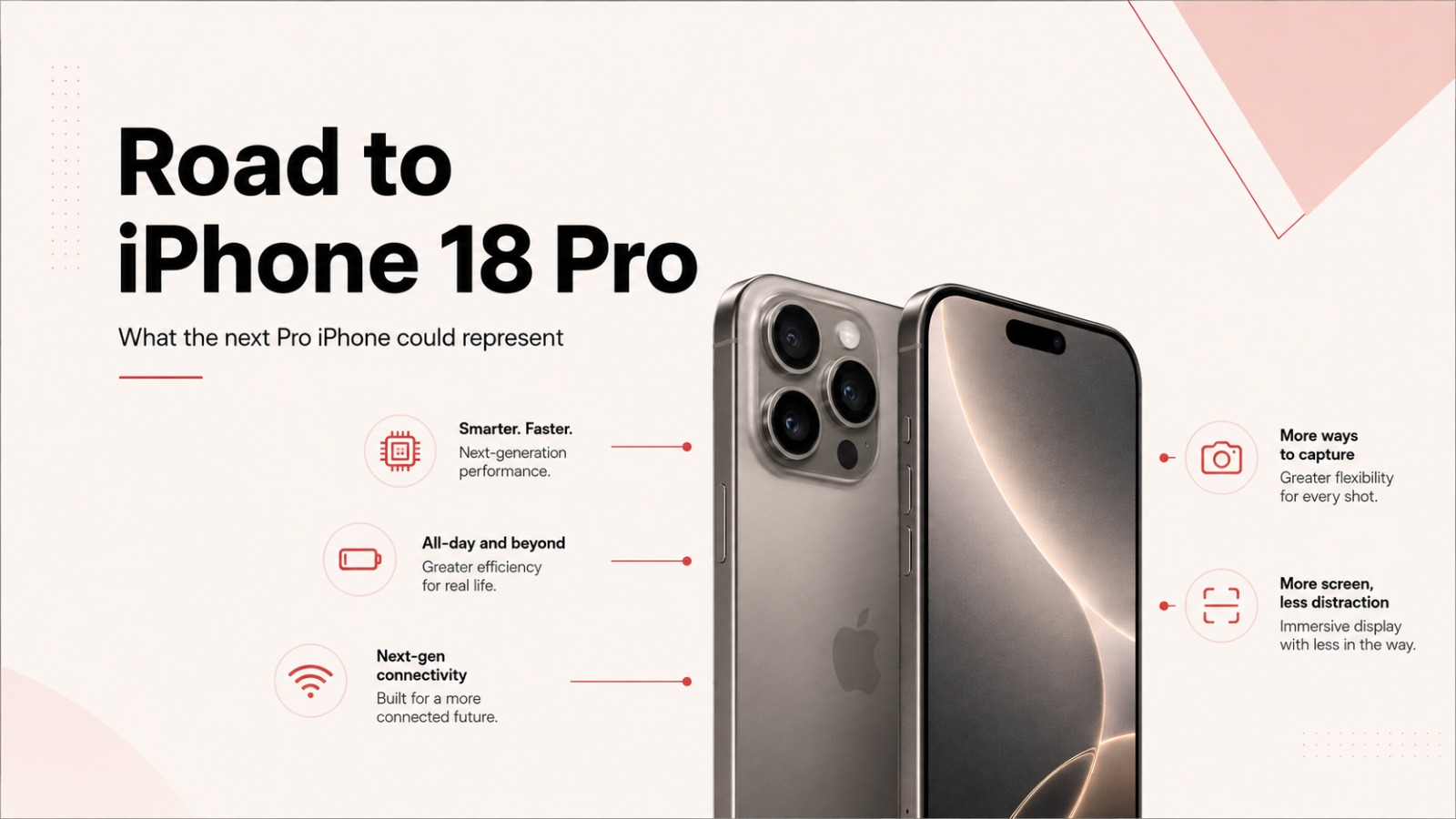
The iPhone 18 Pro is expected to focus on deeper upgrades rather than a major redesign. Reports point to a possible 2nm A20 Pro chip, a smaller Dynamic Island, variable-aperture camera technology, a more efficient LTPO+ display and Apple’s next-generation C2 modem. The Pro Max could also get a larger battery, with reports suggesting an increase of nearly 10% over its predecessor. Apple has not confirmed these specifications, so they remain expected rather than official.
Did Apple invent everything that made the iPhone successful?
No.
And saying otherwise actually makes the iPhone story less interesting.
Apple did not invent every underlying technology found in the device.
Touchscreens existed.
Smartphones existed.
Fingerprint sensors existed.
OLED displays existed.
NFC existed.
Wireless charging existed.
USB-C certainly existed.
Apple’s distinctive strength has often been integration, timing and scale.
It takes a technology, combines it with hardware, software and services, simplifies the interaction and introduces it to an enormous installed base.
There is a meaningful difference between inventing a technology and making hundreds of millions of ordinary consumers use it routinely.
The iPhone’s history contains examples of both technical innovation and exceptionally effective productisation.
Confusing the two produces marketing copy.
Separating them produces a more accurate history.
Why Apple’s controversial decisions matter more than its easy ones
The safest product decision is to preserve everything customers already understand.
Apple repeatedly chose otherwise.
Removing the keyboard was risky.
Changing connectors was risky.
Making a bigger phone after defending smaller screens required changing direction.
Removing the headphone jack generated ridicule.
Replacing Touch ID with Face ID required users to abandon a biometric system they already liked.
Removing the Home button eliminated an interaction that had defined the iPhone for a decade.
Not every choice was universally popular, and not every Apple experiment survived.
That is exactly the point.
The modern iPhone emerged through a mixture of successful bets, corrections, abandoned ideas and relentless iteration.
Its history looks obvious only in hindsight.
The journey is really about choices
There is a temptation to tell iPhone history as a parade of keynote slides.
2007 brought this.
2010 brought that.
2017 removed something.
2023 changed the connector.
But that misses the reason the story matters.
The iPhone became influential because Apple repeatedly made decisions about which direction personal computing should move next.
Software controls instead of permanent buttons.
Apps instead of a fixed feature set.
Biometrics instead of constant passcode entry.
Custom silicon instead of dependence on generic computing roadmaps.
Computational imaging instead of treating a phone camera like a miniature conventional camera.
Wireless accessories instead of physical audio connections.
Satellite communication when terrestrial networks disappear.
AI increasingly running inside the computing architecture itself.
The coming iPhone 18 Pro will eventually be judged against that history, not simply against the phone released immediately before it.
A thinner border will not define another era.
A higher benchmark score will not define another era.
Another camera specification by itself will not define another era.
The meaningful question is whether Apple can still make the kind of product decision that appears uncomfortable at first and obvious five years later.
That is what took the iPhone from a 3.5-inch screen in 2007 to one of the defining computing platforms of the modern era.
And it is the question that will determine what the next chapter is worth.
Also Read: iPhone 17 Pro Max Gets Rs 16,000 Price Cut on Flipkart Ahead of Freedom Sale