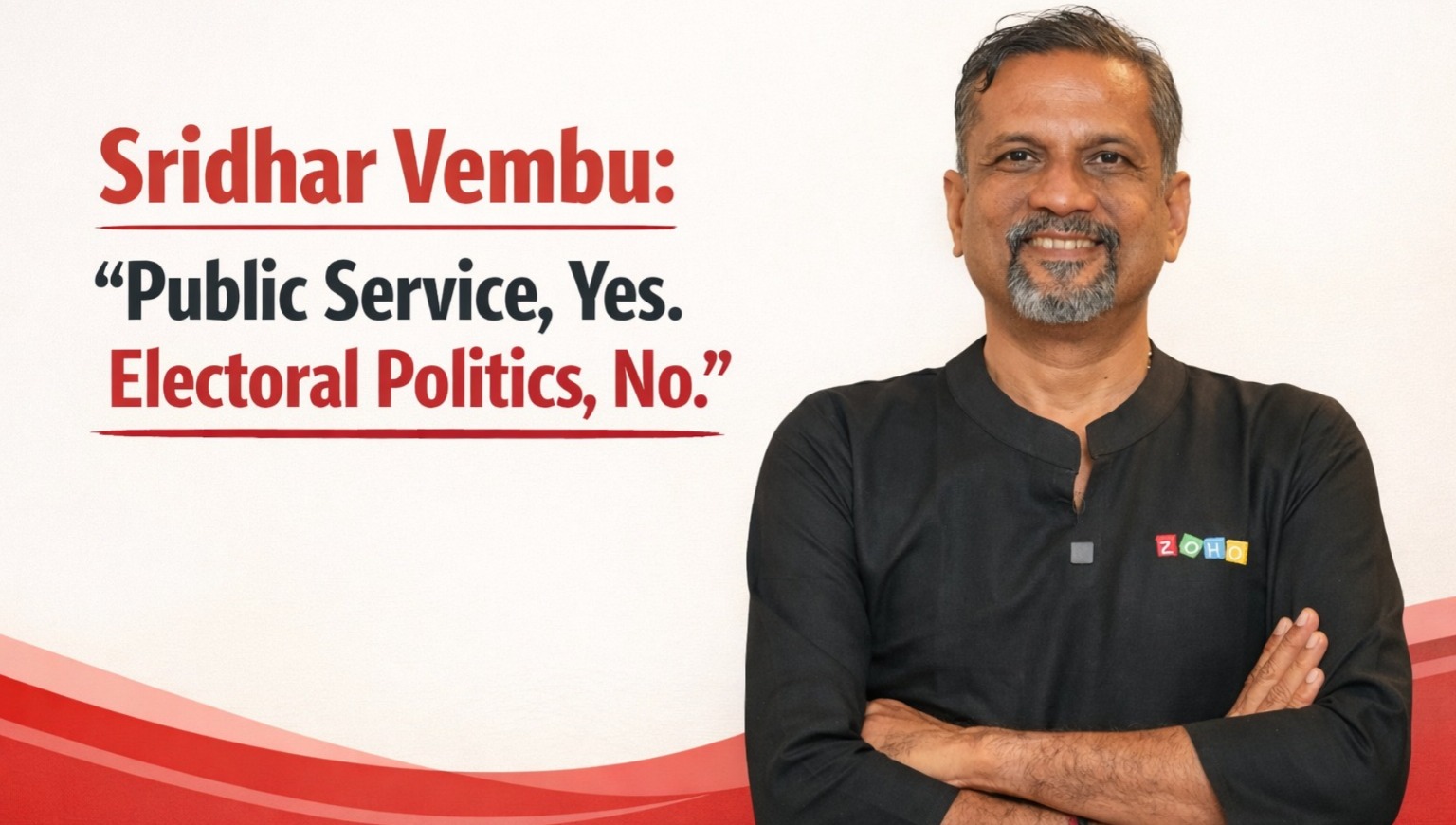
Sridhar Vembu, founder and former CEO of Zoho, has drawn a clear and deliberate line between public service and electoral politics, stating that while political participation is a democratic duty, he will not enter active electoral politics.
In a detailed public statement outlining his life’s priorities, Vembu described politics as “public service” and emphasised that citizen involvement is essential in a democracy. At the same time, he made it unambiguous that his personal mission does not lie in contesting elections or holding political office.
Sridhar Vembu’s Stance: Politics acknowledged, power declined
Vembu’s stance does not negate politics as a system or as a duty. On the contrary, politics is presented as a collective civic duty rather than a profession. “I view politics as public service and as a democratic duty in which citizens must be involved,” he wrote, underlining the legitimacy and necessity of political participation in a functioning democracy.
However, he immediately followed this with a personal boundary: “Given my overriding priority in life, I cannot be and will not be in active electoral politics.”
A hierarchy of national service
Vembu situates this decision within what he calls his “single point agenda in life”: making Bharat technologically strong and self-reliant. In his framing, national service can take multiple forms, and for him, the highest impact lies in deep technological work rather than legislative or executive authority.
By explicitly placing technology-building above political office, Vembu presents R&D as an alternative mode of public service, one he believes is more aligned with his skills and with the country’s long-term needs.
Implicit in the statement is a rejection of the idea that nation-building must necessarily flow through electoral power. Vembu argues that strengthening the nation’s technological foundations, particularly through deep research and rural talent, addresses economic resilience, social equity, and civilisational confidence without requiring formal political office.
Such positioning goes against the traditionally accepted act that politics and influence are the grounds for patriotisms. Vembu proposes an approach in which politics and other forms of engagement co-exist.
A preventative clarification
By involving politics directly in his agenda, it seems that Vembu wishes to pre-empt any question of future political aspirations that could arise. His message is quite unequivocal: as a citizen, maybe, but as an elected representative of the masses? No way!
The clarity of this stance distinguishes it from vague declarations of being “apolitical.” Vembu does not distance himself from civic responsibility; he distances himself from electoral contestation.
The statement concludes with “Bharat Mata ki Jai ”, reinforcing the nationalist and civic sentiment underlying his views. Taken as a whole, Vembu’s remarks position politics as an essential democratic function, but not the path through which he intends to serve the nation.
Also Read: Who Is Pratham Mittal? Shark Tank India 5’s New Campus Judge