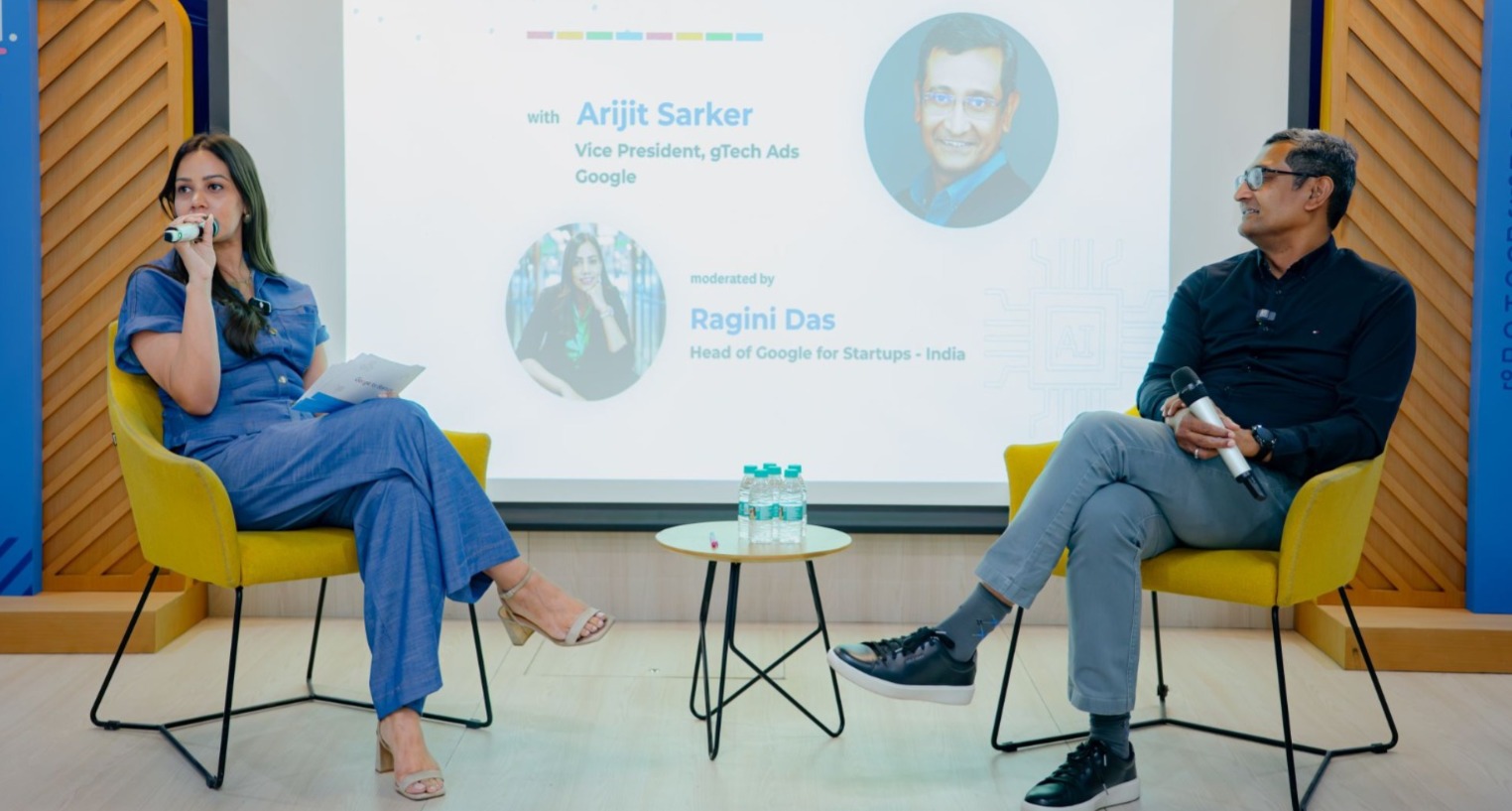
In a startup world crowded with conversations around artificial intelligence, a recent Google for Startups masterclass at T-Hub in Hyderabad turned the spotlight back on something more fundamental: people, execution and resilience.
The session was moderated by Ragini Das, Head of Google for Startups, India, and featured Arijit Sarker, Vice President at GTech Ads, Google. The discussion brought together more than 50 AI-first founders from Hyderabad for a candid conversation on what it takes to build durable companies in a fast-changing technology environment.
Although artificial intelligence took center stage in terms of the wider backdrop of the event, the key point that came across was neither one of tools nor models but of the fundamentals that entrepreneurs constantly grapple with: go-to-market, execution, hiring, and money management.
Sarker, who has spent 20 years at Google, reflected on the company’s journey from a young search engine to a global technology platform. His central message to founders was clear: technology alone does not build enduring companies. Execution does.
One of the sharpest ideas from the session was the importance of hiring for “high agency.” In a market where credentials often get more attention than character, Sarker urged founders to look beyond elite degrees. The better signal, he suggested, is whether a person has already faced failure, adapted, and come back stronger. Resilience, in his view, is not something easily taught in a classroom. It is proven in moments of pressure.
The masterclass also focused on what he described as the operator’s edge. When technology becomes widely available, the real difference between companies comes down to how well they execute. Trust, consistency and the ability to solve problems across functions become decisive advantages.
Another takeaway is the CPI model: conserve cash, pivot if necessary, and grow the investment once the flywheel is in motion. For founders starting out, particularly those working on AI, it is worth noting that growth should be based on proof rather than hype.
Sarker also reminded founders that category creation is not always the winning move. Google, he noted during the session, was not the first search engine. Its rise came from out-executing others in the category. For founders, the lesson was simple but demanding: being early matters less than being better, sharper and more persistent.
The conversation captured a mood that is becoming increasingly relevant in India’s AI startup ecosystem. Founders are excited about intelligence-led products, but many are also searching for first-principles guidance on building companies that can survive beyond the hype cycle.
The evening ended with a reminder for entrepreneurs working through late-night product failures and uncertain pivots: chaos is often where meaningful innovation begins. Durable companies are not built by avoiding difficult moments. They are built by staying in the game through them.
Also Read: Banza Secures $1 Million Pre-Seed Funding to Build Personal AI Twin Platform