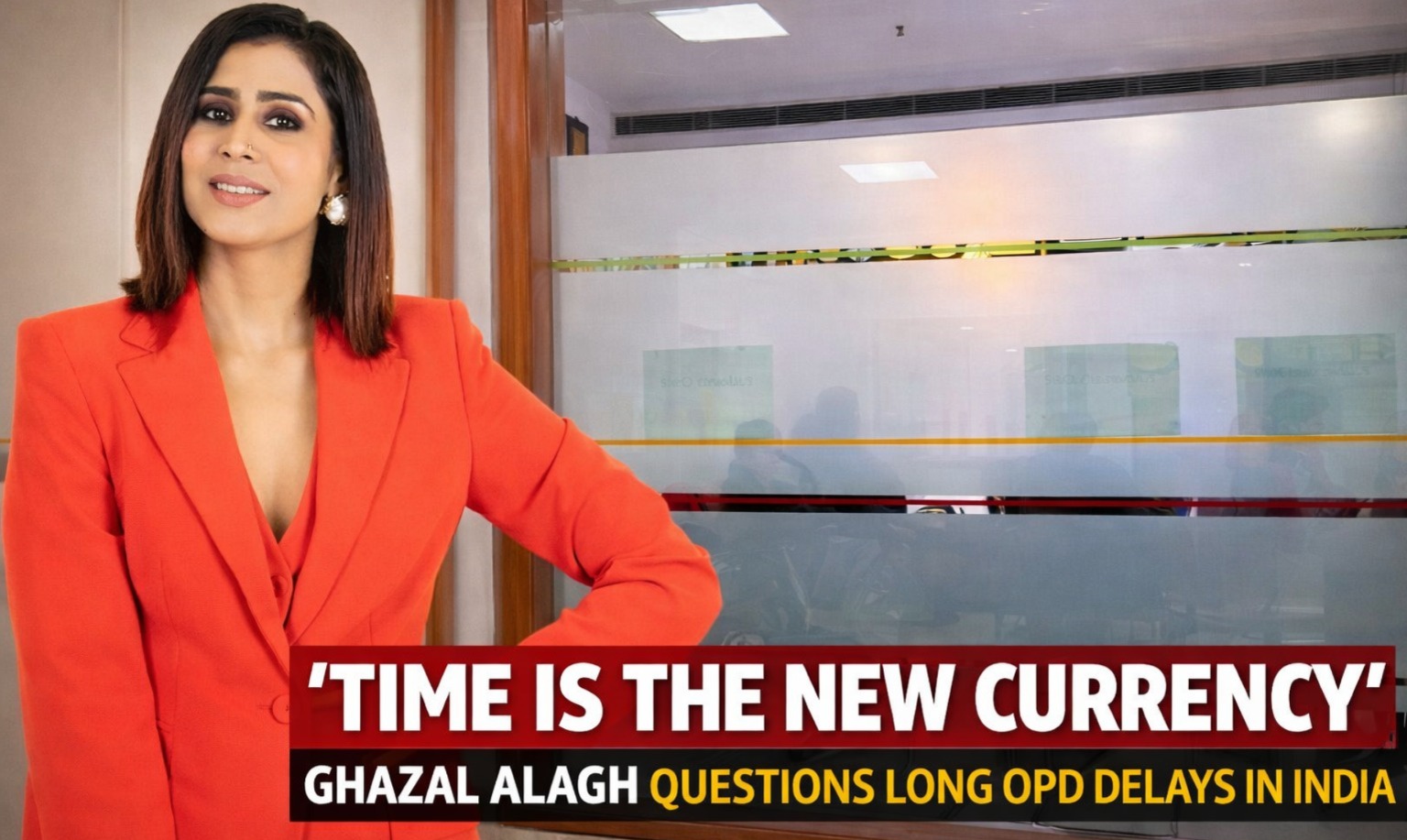
Long waiting hours at hospitals are often dismissed as an unavoidable inconvenience. A recent social media post by Ghazal Alagh, co-founder of Mamaearth, has challenged that acceptance by framing patient waiting time as a serious failure of healthcare operations rather than a minor discomfort.
The experience of visiting a Fortis Healthcare facility was made known by Alagh herself, who wrote about her experience on Saturday. She had an appointment scheduled for 3:00 pm, but by the time 5:30 pm arrived, she was still waiting in the waiting area. Others like her were waiting, tired, frustrated, and sick, as evidenced by the situation that she described. There was nothing in her experience that suggested incompetence with medical treatment. It had only one concern, respect for her time.
Ghazal Alagh Describes Waiting as a silent cost of illness
In her post, Alagh argued that time becomes even more valuable when a person is sick. Minutes spent in a crowded waiting room are not neutral; they add to physical discomfort, mental stress, and fatigue. Yet, long delays continue to be treated as normal in Indian hospitals, with patients rarely informed about how long the wait will actually be.
This, she suggested, reflects a deeper problem in how patient experience is understood. While hospitals invest heavily in advanced treatment and infrastructure, everyday operational systems, appointment scheduling, queue visibility, and communication, remain weak.
The question of accountability
One of the central concerns raised in the post was accountability. Alagh asked why it is socially acceptable for hospitals to run two to three hours behind schedule without providing real-time updates to patients. In most service-driven industries, such delays would demand explanation, apology, or compensation. In healthcare, patients are often expected to adjust silently, even when the delay stretches far beyond the promised appointment time.
Her observation points to a cultural imbalance in healthcare delivery, where urgency is expected from patients but not always reciprocated by institutions.
Technology exists, but where is it applied?
Alagh also drew a comparison with everyday consumer technology. If customers can track a food delivery minute by minute, she asked, why can’t patients track where they stand in a doctor’s queue? The contrast highlights how deeply technology has penetrated retail and logistics, while hospital operations still rely on opaque, manual systems that leave patients guessing.
The issue, as her post implied, is not the absence of technology, but the lack of priority given to patient-facing operational transparency.
A challenge to founders and operators
Rather than ending with criticism, Alagh used her platform to pose an open challenge. She asked whether startups or tech-led businesses in India are genuinely solving hospital queue management and OPD efficiency, and invited founders working in this space to speak up.
By doing so, she framed the problem as both a healthcare and an entrepreneurial opportunity, one that sits at the intersection of operations, technology, and empathy.
Beyond medicine, towards operational empathy
The larger point of Alagh’s post is that healthcare quality is not defined by treatment alone. How care is delivered, the waiting, the communication, the predictability, shapes a patient’s experience just as powerfully. Long, unexplained delays signal indifference, even when the clinical outcome may be excellent.
As Indian healthcare continues to improve in medical capability, the post serves as a reminder that progress must also be measured in how systems respect patients’ time. In a country where millions rely on outpatient care every day, managing time better is not a luxury. It is a basic expectation and one the system can no longer afford to ignore.