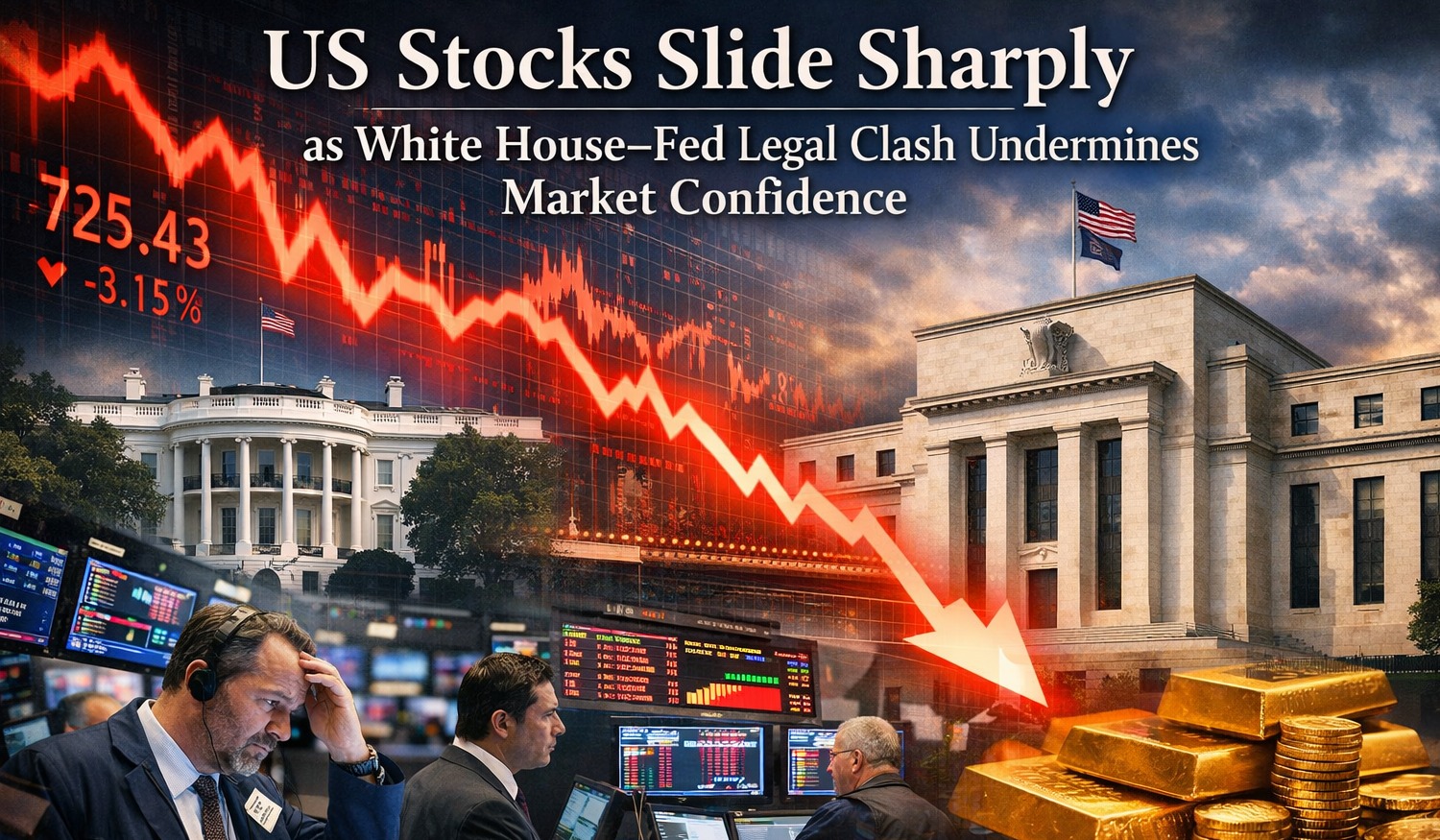
U.S. equities suffered a broad and abrupt sell-off on Tuesday, as a deepening legal confrontation between the White House and the Federal Reserve unsettled investors and reignited long-standing concerns over the autonomy of the central bank. The episode triggered a pronounced risk-off move across asset classes, pushing equities lower while propelling gold to record highs.
The Dow Jones Industrial Average fell sharply, while the S&P 500 and the Nasdaq Composite also registered steep declines. Losses were broad-based, spanning cyclical sectors, financial institutions, and growth-oriented technology stocks. Trading volumes rose markedly, indicating elevated institutional participation and forced portfolio rebalancing as volatility intensified.
Market participants said the scale of the sell-off reflected not a reaction to economic data or corporate earnings, but a deeper reassessment of political and institutional risk in the United States. The legal dispute, which touches directly on executive authority and the Federal Reserve’s leadership, has introduced uncertainty into the policy outlook at a time when markets are already sensitive to interest-rate guidance and inflation management.
Institutional Risk Reprices Markets
Investors pointed to growing unease that the dispute could set a precedent for political encroachment into monetary policymaking. The Federal Reserve’s independence has long been viewed as a cornerstone of U.S. financial credibility, anchoring inflation expectations and underpinning global confidence in dollar-denominated assets.
“The issue is not the immediate legal outcome, but the signal it sends,” said a senior portfolio manager at a U.S.-based asset management firm. “Markets can digest weak data or tighter financial conditions, but uncertainty around institutional integrity forces a repricing of risk across the board.”
Financial stocks declined amid fears that policy uncertainty could disrupt credit conditions and interest rate transmission. Bank shares were particularly pressured as investors weighed the implications for lending margins and regulatory stability. Technology stocks led losses on the Nasdaq, reflecting reduced appetite for higher-duration assets that are more sensitive to shifts in discount rates.
Volatility indicators moved higher during the session, pointing to expectations of continued turbulence in the near term. Several analysts noted that algorithmic trading and volatility-linked strategies likely amplified intraday swings, accelerating the pace of declines once key technical levels were breached.
Flight to Safety Lifts Gold
As equities retreated, investors sought refuge in traditional safe-haven assets. Gold surged to a fresh record high, underscoring the defensive shift in market positioning. Demand for U.S. Treasuries also strengthened, while the dollar showed signs of softness as confidence in policy clarity weakened.
Analysts said the rally in gold reflects not only short-term hedging activity but also broader concerns about policy credibility and institutional stability. Historically, periods marked by political uncertainty and perceived threats to central bank independence tend to favor precious metals, particularly when inflation risks remain uneven.
“The move into gold suggests investors are preparing for prolonged uncertainty rather than a short-lived shock,” said a commodities strategist.
Global Spillovers and Dollar Sensitivity
The sell-off in U.S. markets had immediate global repercussions. European equities closed lower, while Asian markets signaled caution in early trading, highlighting the extent to which U.S. institutional stability remains a global anchor. Emerging market assets also faced pressure as risk sentiment deteriorated.
The U.S. dollar’s reaction was closely watched. While it retained some safe-haven support, analysts warned that sustained doubts over Federal Reserve independence could eventually weigh on the currency, particularly if foreign investors reassess their exposure to U.S. assets.
Outlook: Volatility Likely to Persist
Strategists cautioned that markets are likely to remain highly sensitive to developments surrounding the legal standoff. Any clear reaffirmation of institutional boundaries could help stabilize sentiment, while further escalation risks prolonging volatility and suppressing risk appetite.
For now, the sharp decline in U.S. equities highlights a notable shift in investor focus, away from earnings growth and macroeconomic indicators and toward the integrity of economic governance itself. In that sense, Tuesday’s sell-off may prove less about near-term fundamentals and more about confidence in the framework that underpins the global financial system.
Also Read: Master Buds 2 and Luna clinch multiple honours at CES 2026: Noise Founder