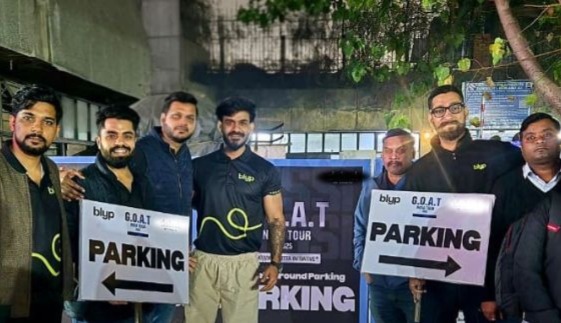
As Delhi’s live entertainment scene continues to draw massive crowds, one pain point has repeatedly shadowed the excitement: parking, a challenge that parking startup blyp says it is now trying to address.
The capital recently witnessed the frenzy around major performances by Karan Aujla and Honey Singh, but the larger conversation around big-ticket concerts in Delhi has remained unchanged. Despite being one of India’s biggest urban markets for music and live events, Delhi has often faced criticism for struggling to host large concerts smoothly, especially when compared to cities like Mumbai and Bengaluru. Infrastructure limitations around venue access, vehicle movement and parking management have remained at the centre of that debate.
Delhi’s Concert Struggle and Blyp
For events expecting footfalls of 40,000 to 60,000 people, parking has emerged as one of the toughest operational challenges. Around major venues such as IG Stadium, JLN Stadium and AJ stadium areas, the pressure is not just about space. It is about safety, traffic movement, public order and the lack of dependable systems for visitors arriving by private vehicles.
The result, according to the account shared by Dhananjaya Bharadwaj, founder of parking startup blyp, has been a deeply frustrating experience for concertgoers. Local contractors, he said, often overcharged people without offering any safety assurance. In many cases, vehicles were towed, damaged or challaned despite advance payments already having been made. For fans, there were few reliable options near event venues. For police and civic authorities, the situation created an equally difficult balancing act between crowd safety and citywide traffic management.
That gap, Bharadwaj says, is what blyp set out to address.
In a recent statement, he said the company began working on the problem in Delhi-NCR by partnering with organisers, ticketing partners and local authorities to manage parking operations for high-footfall events. The broader aim, he indicated, was not just to provide parking slots, but to improve the event experience from the very first touchpoint.
“blyp is now working closely with the Govt authorities, event organising teams and ticketing partners to make the event experience delightful, stress-free from the first touch point — which in this case, is parking,” Bharadwaj said.
The startup is positioning itself around a pain point that has long remained under-discussed in India’s events ecosystem. While the spotlight usually stays on artist line-ups, ticket sales and crowd turnout, the on-ground experience often begins much earlier, with arrival logistics. In cities where event venues are located in already congested urban zones, parking can quickly become the difference between a smooth evening and a chaotic one.
What makes the issue particularly sensitive in Delhi is the combination of large crowds and limited flexibility for authorities. Visitors often feel stranded because they cannot find parking close enough to event locations. On the other hand, police and public authorities operate within clear constraints: they must maintain traffic flow, prevent disorder, and ensure that emergency movement and public safety are not compromised. In that setting, unmanaged or poorly managed parking becomes more than an inconvenience; it turns into a civic risk.
Bharadwaj has stopped short of claiming full victory. In his statement, he acknowledged that the problem has not been solved “100%”, but added that blyp is now “very close.” He said the company spent time quietly refining its operations before speaking publicly, and now believes its operating playbook is ready.
That confidence is now translating into a broader pitch. According to Bharadwaj, event organisers across Delhi, Mumbai and Bengaluru who are planning concerts with expected footfalls of over 20,000 can now reach out to the company.
The language of that pitch is notable. Rather than presenting parking as an isolated service, blyp is framing it as core event infrastructure, the operational layer that can unlock everything else. In a market where high-footfall concerts are growing in scale and visibility, that argument could resonate strongly with organisers who have seen public excitement collide with logistical bottlenecks.
For Delhi especially, the conversation feels timely. The city has the audience, the appetite and the event energy. But it has also repeatedly faced questions over whether supporting infrastructure is keeping pace. If parking can be made more organised, more predictable and more secure, it could remove one of the most persistent friction points in Delhi’s large-event ecosystem.
That is the opportunity blyp appears to be chasing: not just managing parked vehicles, but reducing a layer of stress that begins well before the first song starts.
And in a city where a concert night can quickly spill into congestion, confusion and last-mile chaos, solving even part of that equation may matter more than most people realise.