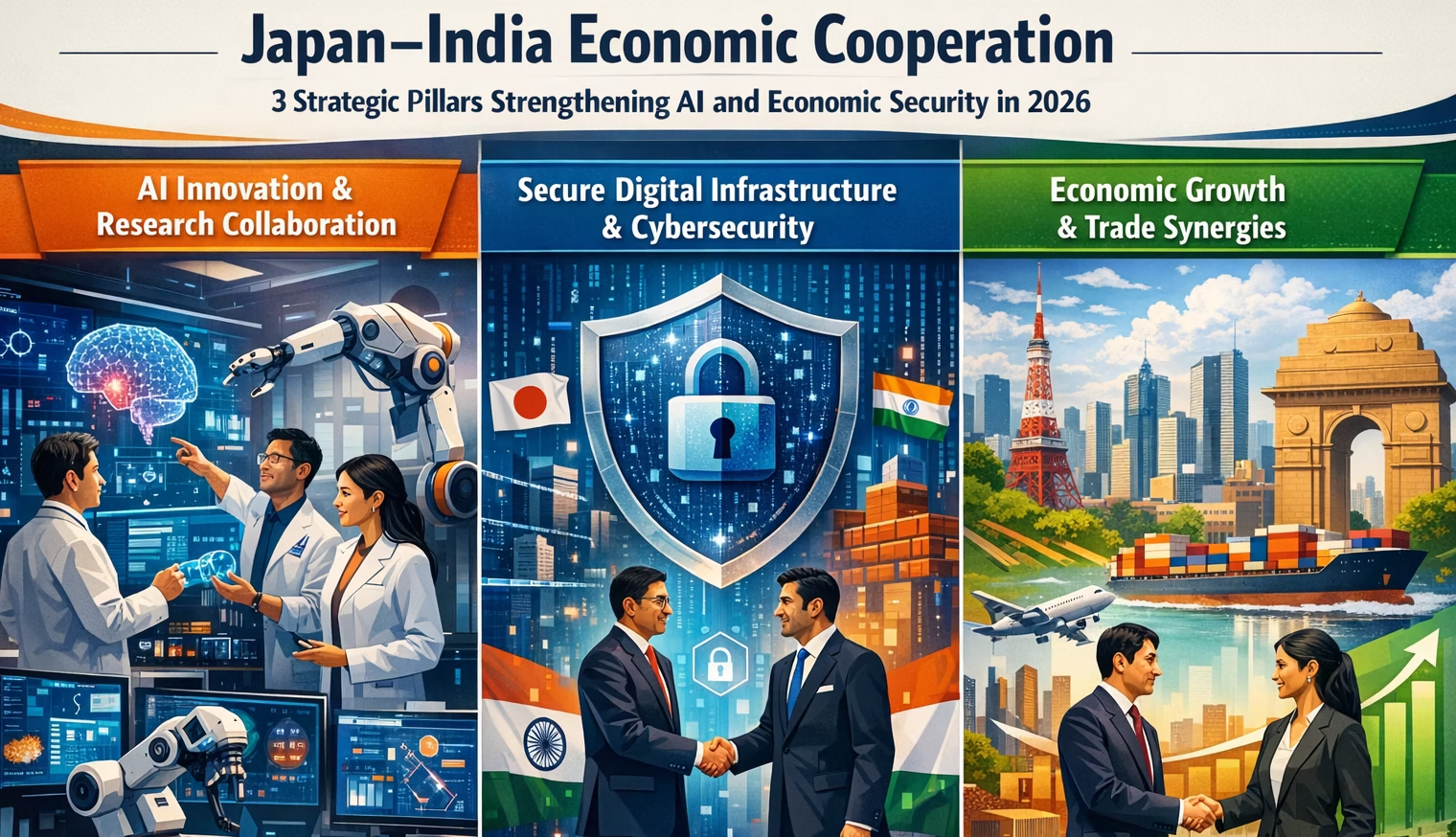
Japan–India Economic Cooperation has become one of the most consequential bilateral economic partnerships in 2026. Japan-India Economic Cooperation is a conscious effort by two leading economies in Asia to ensure resilience during a period in the global economy where growth is decelerating, geopolitical fragmentation is a reality, and intermittent supply chain disruptions are taking place.
Technological sovereignty, reliable production chains, and long-term economic growth are the issues that grow in influence on the partnership between Japan and India. Instead of staying within traditional trade and investment models, this collaboration is currently geared towards future-focused sectors that would tend to determine competitiveness, stability, and power within the next decades.
Japan-India Economic Cooperation and Artificial Intelligence
The place of artificial intelligence in the center of Japan-India economic cooperation represents a larger change in attitude to advanced technologies in both countries. The AI is not considered only a productivity-enhancing instrument but a strategic resource that has direct impacts on the economical security, the ability of the government to govern, and the foreign positions.
Japan and India have consequently shifted to stronger alignment in thinking on policy matters related to AI, joint research, and systems of innovation. It involves discussion about regulatory strategies, ethical principles, and the application of AI to major industries like manufacturing, logistics, health services, and government. The focus on accountable and responsible usage of technology indicates as well as a common ground that there is a possibility that unrestrained technological reliance may result in novel vulnerabilities.
By encouraging cooperation among academic institutions, research centers, startups, and established industries, Japan-India Economic Cooperation aims to strengthen domestic technological capacity while reducing reliance on external ecosystems. This approach supports innovation without undermining national autonomy, a balance that has become increasingly important in a fragmented global technology landscape.
Japan-India Economic Cooperation in Economic Security and Supply Chains
Economic security has emerged as a defining pillar of Japan-India Economic Cooperation, particularly in response to disruptions that have exposed the fragility of global supply chains. Recent crises have demonstrated how dependence on limited production hubs or constrained logistics routes can quickly escalate into systemic economic risks.
Japan and India face similar vulnerabilities in sectors such as semiconductors, clean-energy technologies, electronics manufacturing, and advanced industrial inputs. In response, both countries are working toward closer coordination on critical minerals, industrial policy, and supply-chain diversification. The objective is not disengagement from global trade, but the creation of more reliable, transparent, and resilient networks.
Through policy coordination and industrial collaboration, Japan–India Economic Cooperation supports long-term production stability and investor confidence. This effort also reinforces national economic resilience by reducing exposure to sudden external shocks, an increasingly important consideration in an era of geopolitical uncertainty.
Japan-India Economic Cooperation and the Indo-Pacific Economic Order
Beyond bilateral interests, Japan–India Economic Cooperation carries broader significance for the Indo-Pacific economic order. Both countries support a rules-based system that prioritizes transparency, predictable trade practices, and secure technological standards. Their alignment reflects a shared interest in preserving openness while managing risk.
By coordinating economic governance approaches and technology norms, Japan and India contribute to regional confidence and economic balance. This cooperation offers an alternative model to fragmented or coercive economic arrangements, positioning both countries as reliable partners within the wider Indo-Pacific region.
As global economic governance faces strain, Japan-India Economic Cooperation plays a stabilizing role by reinforcing norms that support sustainable growth, fair competition, and institutional trust.
Why Japan-India Economic Cooperation Matters in 2026
The relevance of Japan-India Economic Cooperation in 2026 lies in its practical orientation and long-term perspective. Japan benefits from India’s scale, expanding market, and growing industrial base, while India gains from Japan’s capital strength, advanced manufacturing expertise, and experience in high-quality industrial systems. The partnership reflects economic complementarity rather than short-term political alignment.
More importantly, this cooperation addresses structural challenges that neither country can effectively manage alone. By linking innovation with security and growth with resilience, Japan-India Economic Cooperation responds to the realities of a changing global economy rather than abstract strategic ambitions.
In an era defined by economic uncertainty, technological competition, and shifting global power structures, Japan-India Economic Cooperation stands out as a pragmatic and forward-looking alliance. Its significance lies not only in the sectors it prioritizes but also in the principles it reflects: balance between openness and security, innovation anchored in responsibility, and cooperation grounded in long-term stability.
By strengthening coordination in artificial intelligence, economic security, and resilient supply chains, Japan and India are reinforcing their bilateral relationship while contributing to a more stable regional and global economic environment. As the international system continues to adjust to new realities, Japan-India Economic Cooperation offers an example of how strategic partnerships can evolve beyond traditional trade to address the deeper structural challenges of the twenty-first-century economy.