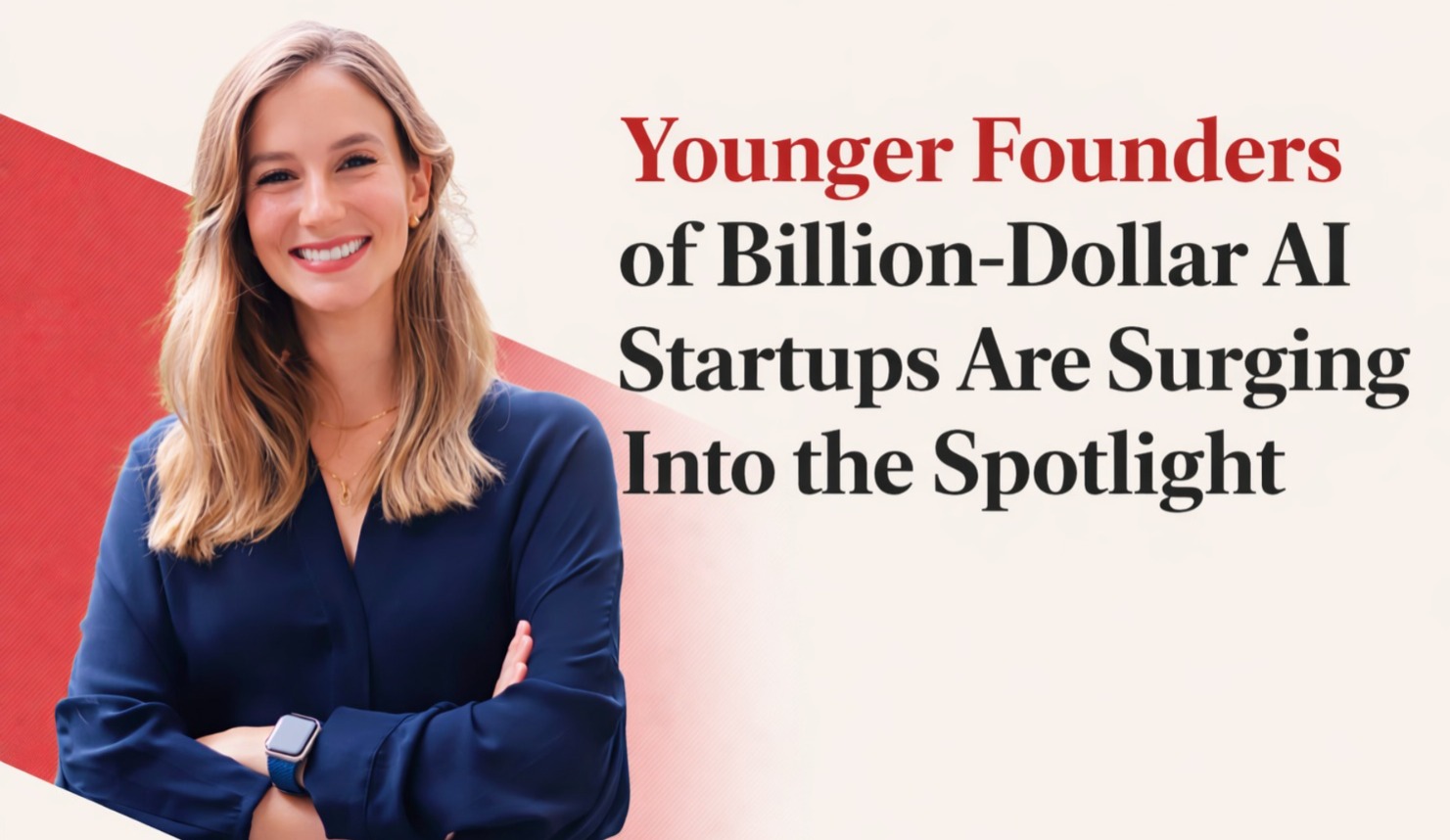
A quiet demographic shift is taking hold in the AI startup world: the people building the next wave of billion-dollar companies are getting noticeably younger.
A recent report from venture capital firm Antler, The Anatomy of Greatness (released Jan. 7), analyzed 3,512 founders behind companies that crossed the $1-billion valuation mark and found the average age of AI unicorn founders dropped to 29 in 2024, down from 40 in 2020.
The same story is now playing out across 2025, with AI-driven wealth creation surfacing in new records as well: Forbes counted 13 self-made billionaires under 30 this year, up from the previous high of seven .
The youngest examples investors keep pointing to
The numbers are abstract until you attach names to them. One recent example cited is Mercor, an AI-powered hiring platform co-founded by Brendan Foody, Adarsh Hiremath and Surya Midha, each 22 years old, recently valued at more than $10 billion.
The trend shows up at the upper end too. Alexandr Wang, described as the 29-year-old co-founder of Scale AI, with the company valued at $29 billion. Wang was recruited by Meta in June as part of a $14.3 billion deal to lead a new AI research unit called “TBD Labs,” following a restructuring after Meta’s Llama 4 model underperformed.
Luana Lopes Lara, also 29, becoming the world’s youngest self-made female billionaire after co-founding Kalshi, valued at $11 billion. She is an MIT computer science graduate and had internships at Bridgewater Associates and Citadel Securities, and that Kalshi scaled into a unicorn within six years,
Why youth is suddenly “an advantage” in AI
Antler’s cofounder and chief business officer Fridtjof Berge frames the shift as structuralm not just a string of headline-friendly prodigies.
Berge says investors increasingly reward founders who can “move fast and break things” and who “continuously iterate and test and improve” . In that logic, deep industry tenure matters less than adaptability and entrepreneurial instinct, traits he associates with founders in their twenties.
He also points to technical fluency at a younger age as a practical edge: approaching problems from a “blank-slate state” and applying the latest emerging technologies without being boxed in by legacy assumptions .
The caution hiding behind the hype
If this sounds like a straight-line story, young founder builds unicorn, stays in charge, retires early, Berge adds a reality check.
He cautions that early success doesn’t guarantee long-term control. Young founders can start companies and even create unicorns, he says, but that doesn’t ensure they’ll still be leading those businesses five to 10 years from now.
What this means for the next AI cycle
Taken together, the data and examples point to a venture market that’s optimizing for speed: rapid iteration, fast learning loops, and comfort with shipping imperfect products, improving them publicly, and moving again.
That model naturally tilts toward founders who grew up inside software, and now, inside AI. And if Antler’s numbers are the new baseline, the next “standard” AI unicorn origin story may look less like a decade-long climb up corporate ladders and more like a sprint that starts in the early 20s.
Also Read: Nootie: A Family Business Reimagined for India’s Pet Nutrition Boom