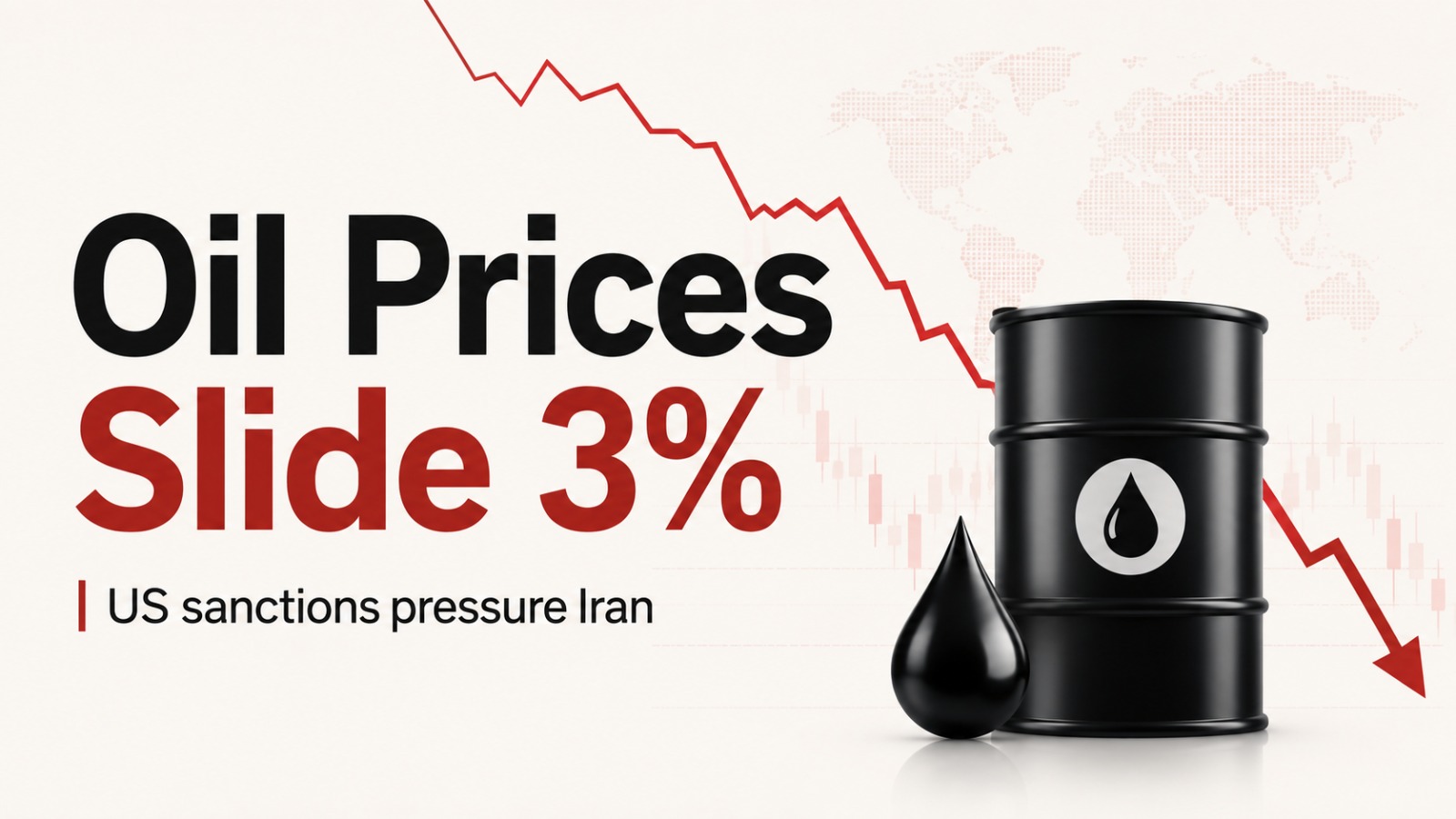
Oil prices fell around 3% on Tuesday as the United States shifted its focus toward economic sanctions against Iran, easing concerns that the conflict could quickly return to large-scale military action.
Brent crude, the international benchmark, declined 3.3% to $89.14 a barrel, while U.S. West Texas Intermediate crude fell 3.1% to $82.36 a barrel. Oil prices have dropped more than 5% this week as Washington increased economic pressure on Tehran and expanded sanctions against entities continuing to trade with Iran.
Washington Puts Economic Pressure at the Center
The latest U.S. strategy marks a stronger focus on economic measures rather than an immediate return to military strikes. Treasury Secretary Scott Bessent has described the campaign as a major financial offensive against Iran and said the increased economic pressure makes a large-scale military escalation less likely for now.
The administration has expanded sanctions targeting Iran and businesses and entities that continue to support its economy. The measures are intended to put further pressure on Tehran by restricting access to international financial and trading networks.
Bessent has indicated that the current approach is aimed at using economic pressure to weaken Iran without immediately restarting large-scale military operations.
The change in strategy has also influenced market expectations. Oil prices, which had been supported by concerns over renewed conflict and disruptions around the Strait of Hormuz, have come under pressure as investors assess the possibility of a prolonged economic campaign instead of an immediate military escalation.
Hormuz Remains a Major Flashpoint
Tensions around the Strait of Hormuz remain an important factor for energy markets. President Donald Trump said Tuesday that the U.S. Navy had informed him that all mines had been removed or detonated from international waters in the strategic waterway.
Trump also warned that any vessel involved in placing new mines would face an immediate U.S. response. The Strait of Hormuz is a critical route for global energy shipments, making developments in the waterway closely watched by oil traders.
The U.S. State Department is also preparing to return evacuated American diplomats to the Middle East as early as this week. The planned return would indicate that Washington is not currently expecting an immediate return to full-scale warfare in the region.
However, the possibility of military action has not been completely removed.
Pentagon Keeps Military Option Open
U.S. Defense Secretary Pete Hegseth said Monday that further American strikes remained an option if circumstances required them. While economic pressure is currently being emphasized, Washington has not ruled out military action around Iran or the Strait of Hormuz.
This leaves the situation in a delicate position. The U.S. is attempting to increase economic pressure while keeping military options available if tensions rise again.
For oil markets, that uncertainty remains important because any renewed disruption around the Strait of Hormuz could quickly affect global crude supplies and prices.
Iran Says It Can Withstand More Sanctions
Iran has responded by insisting that it is prepared for another round of U.S. economic restrictions.
Iranian Economy Minister Ali Madanizadeh said Tehran was fully prepared to withstand additional sanctions. He said the government had a two-year plan to manage the economic pressure and had developed its own measures to deal with the situation.
Iran has faced extensive sanctions for years, and the latest U.S. measures are intended to increase the pressure on its economy and international trade.
China Pushes Back Against Washington
China has also rejected the expanded U.S. sanctions strategy. Beijing is one of Iran’s major trading partners and a significant buyer of Iranian oil.
Chinese Foreign Ministry spokesperson Lin Jian said Tuesday that Beijing would take necessary steps to protect its rights and interests. China has consistently opposed unilateral sanctions and has called for a diplomatic resolution to the conflict.
The latest U.S. measures could therefore create additional pressure on China’s economic relationship with Iran. At the same time, targeting Chinese financial institutions and businesses more aggressively could create wider economic tensions between Washington and Beijing.
Oil Market Watches the Next Move
For now, oil traders appear to be responding to signs that Washington is prioritizing economic pressure over an immediate military escalation. Brent and WTI both posted sharp declines on Tuesday, extending the week’s losses.
Still, the outlook remains closely tied to developments involving Iran, the Strait of Hormuz and the possibility of further U.S. action. While the sanctions strategy has reduced immediate fears of renewed large-scale fighting, the military option remains open, keeping geopolitical risks firmly in focus for global oil markets.
Also Read: US Judge Strikes Down Trump Immigrant Visa Freeze Affecting 75 Countries