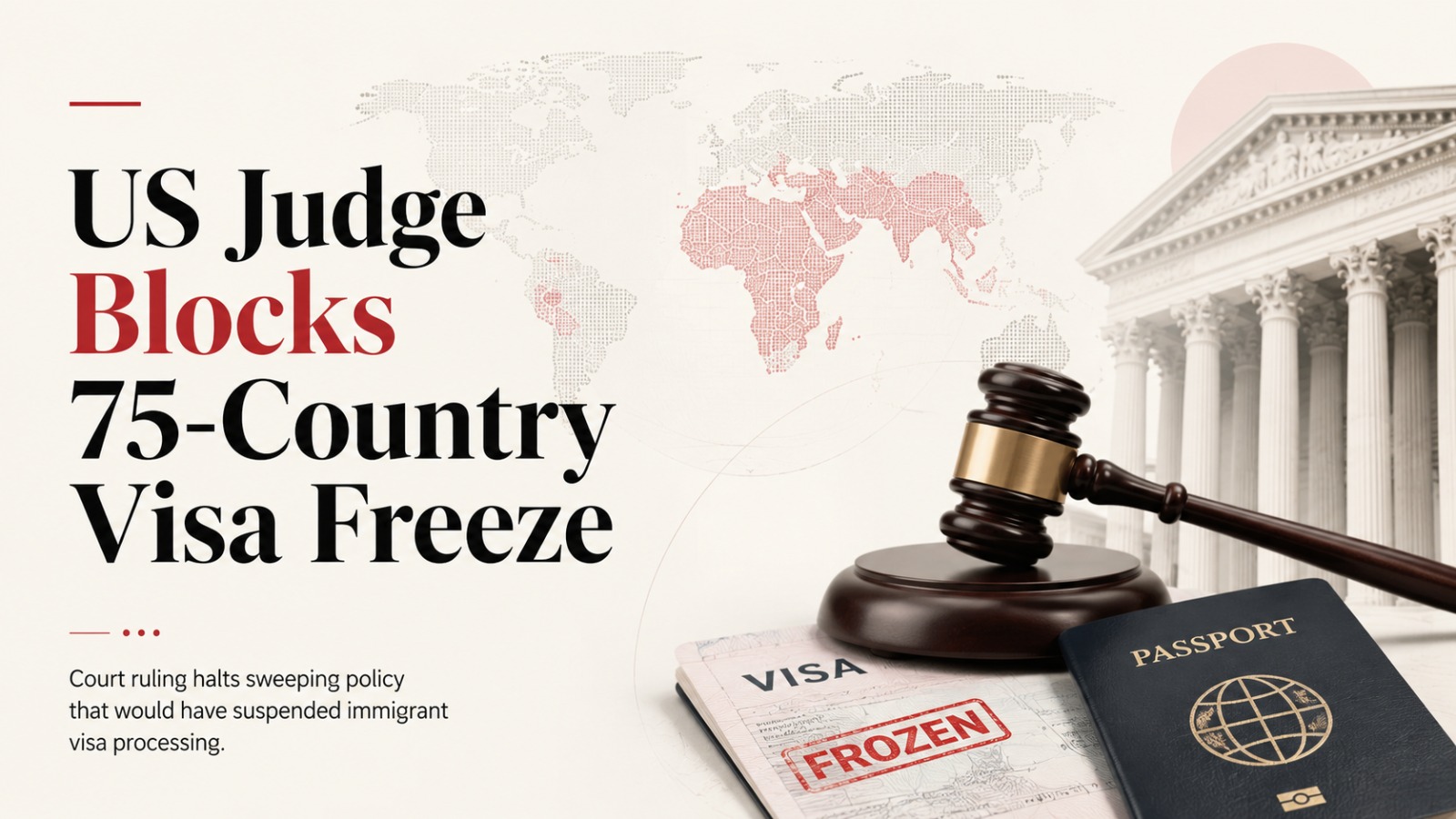
A federal judge in New York has struck down a Donald Trump administration policy that suspended immigrant visa processing for nationals of 75 countries, finding that the State Department went beyond the authority granted to it under federal immigration law.
U.S. District Judge Jeannette Vargas vacated the policy after concluding that Secretary of State Marco Rubio exceeded his statutory authority when consular officials were directed to stop processing immigrant visas for nationals of countries whose applicants were considered more likely by the administration to rely on public assistance after entering the United States.
The ruling, issued on Friday, August 21, 2026, rejected the use of nationality as a blanket basis for restricting immigrant visas. Vargas found that federal immigration law instead gives consular officers responsibility for determining whether individual applicants meet the requirements for a visa.
That distinction sits at the centre of the case. The policy did not simply introduce tougher scrutiny for applicants. It effectively stopped immigrant visa issuance for people covered by the 75-country list, without first resolving their eligibility individually.
Court rejects nationality-wide restriction
Vargas wrote that the policy was “contrary to law and in excess of statutory authority” and conflicted with the Immigration and Nationality Act. Her ruling found that Congress had placed visa eligibility decisions with consular officers on an individual basis, rather than allowing applicants to be excluded through broad nationality-based restrictions.
The ruling also said the policy “categorically prohibits the issuance of immigrant visas based upon the nationality of the applicant,” which the court found inconsistent with the legal framework established by Congress.
The State Department introduced the suspension in January, indefinitely pausing immigrant visa issuance for applicants from 75 countries. The list included nations across several regions, with Afghanistan, Iran, Russia, Somalia and Nigeria among those identified in the coverage.
The administration had defended the restriction on “public charge” grounds, arguing that applicants from the affected countries carried a higher risk of relying on government resources after moving to the United States.
Newsweek reported that when the policy was introduced, the State Department cited data indicating that more than 30 percent of households with immigrants from the affected countries received some form of public assistance. Officials said the restriction was intended to ensure that prospective immigrants would not become a charge to the public.
The court, however, rejected the idea that those concerns could support a categorical nationality-based suspension.
Families and immigrant applicants challenged the policy
The legal challenge was brought by two nonprofit organisations and 11 individuals affected by the restrictions. The plaintiffs included people whose relatives had been denied visas and foreign nationals seeking to immigrate through employment-based petitions.
The organisations involved included the Catholic Legal Immigration Network, known as CLINIC, and African Communities Together. The case also involved immigrant visa applicants and U.S. citizens sponsoring relatives whose applications had been affected by the suspension.
Anna Gallagher, executive director of CLINIC, welcomed the decision, saying the case was ultimately about keeping families together. African Communities Together described the ruling as “a tremendous victory for the rule of law” and said the restrictions had separated families.
The State Department, meanwhile, defended the administration’s broader immigration screening approach, saying its focus remained on “protecting the American people by upholding the highest standards of screening and vetting of visa applicants.” The department declined to comment directly on the lawsuit while the litigation remained ongoing.
What changes after the ruling
The decision removes the visa-processing restriction unless a higher court intervenes. The Trump administration retains the option of appealing the ruling.
For applicants from the affected countries, that could reopen immigration cases that had effectively been frozen under the January suspension. It does not, however, mean immigrant visas will automatically be granted. Applicants must still meet individual eligibility requirements and go through the normal consular process.
The ruling therefore changes the basis on which those applications can be considered rather than removing the underlying requirements for obtaining an immigrant visa.
At the heart of the court’s decision is a narrower but consequential legal question: whether the executive branch can shut down immigrant visa issuance for entire nationalities when Congress has directed consular officers to determine eligibility applicant by applicant. Vargas concluded that, under the policy before her court, it could not.
Also Read: iPhone 18 Pro Release Timeline: September 9 to September 18