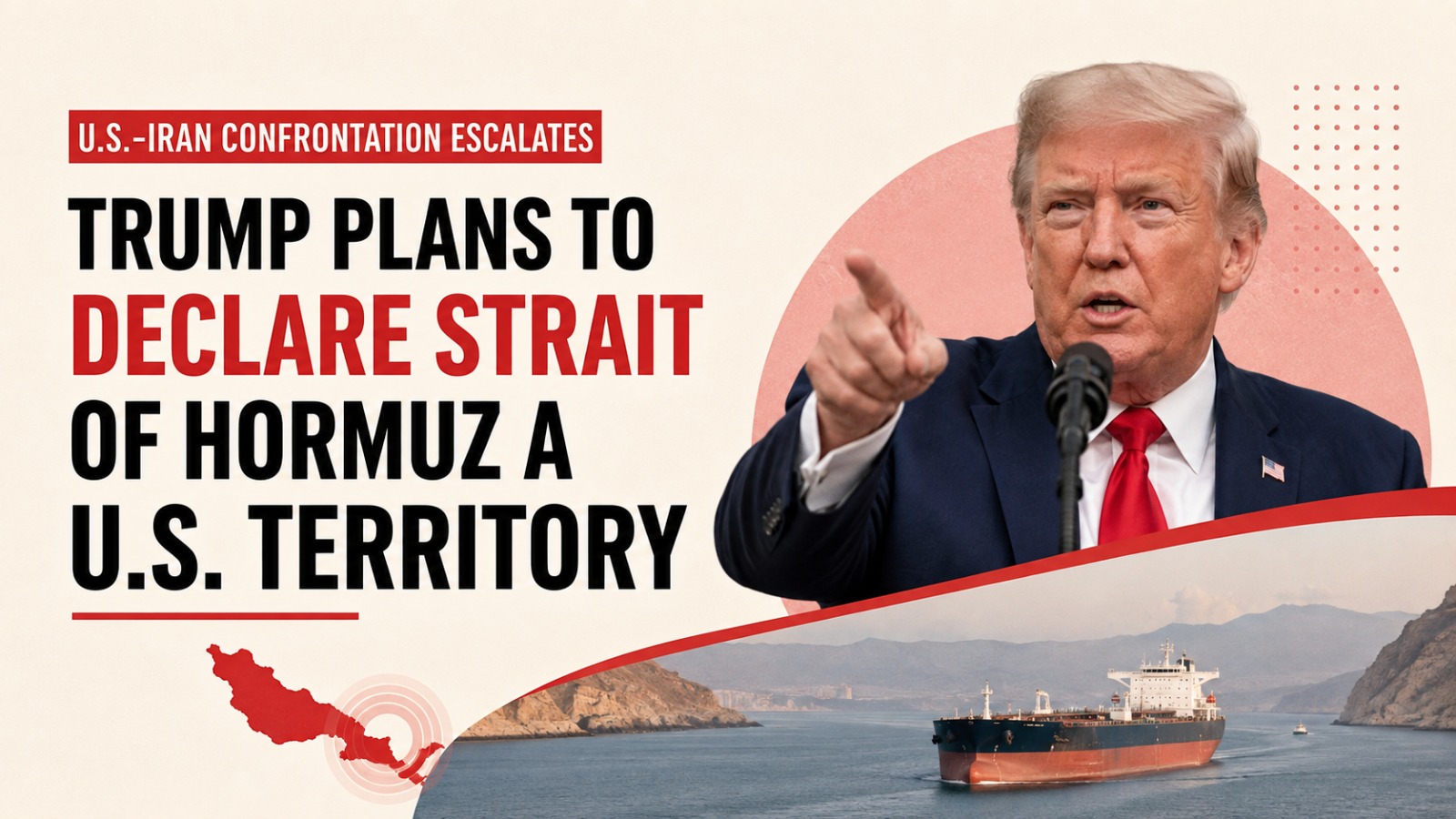
President Donald Trump said Friday that he plans to declare the Strait of Hormuz a territory of the United States after what he described as the defeat of Iran, adding a new and highly consequential dimension to the ongoing conflict between Washington and Tehran.
Speaking at an event in Nassau, New York, Trump said the United States would soon take steps concerning the strategically important waterway. “Pretty soon I’ll be declaring the Hormuz Strait a territory of the United States,” he said.
Trump made the remarks while discussing the U.S. military campaign against Iran and the naval blockade currently being enforced around the country’s ports.
U.S. blockade remains at the center of the standoff
Trump has repeatedly claimed that the United States has control over the Strait of Hormuz. On Friday, he again highlighted the strength of the U.S. naval blockade, saying ships could not pass through the waterway unless Washington allowed them to.
He described the blockade as “a wall of steel” and praised the capability of the U.S. military. The blockade was reinstated in July after a memorandum of understanding between the United States and Iran, which had temporarily paused hostilities, broke down following accusations from both sides that the agreement had been violated.
The Strait of Hormuz has since become one of the main points of confrontation in the conflict. Iran has continued to insist that it controls the waterway and has rejected repeated U.S. claims of complete control.
Iran rejects Trump’s claim over the waterway
Iranian officials quickly dismissed Trump’s statement. Deputy Foreign Minister Kazem Gharibabadi said the Strait of Hormuz could not be taken over through political declarations, military force or public statements.
He maintained that the waterway belongs under Iranian authority and said Tehran would continue to determine when the strait could be opened or closed.
Iran has consistently rejected Trump’s assertions that the United States controls the waterway. Iranian officials have also said that commercial vessels cannot safely pass through the strait without permission from Iranian forces.
The conflicting claims have further raised tensions over one of the world’s most important maritime routes, with the United States and Iran taking opposing positions on who has authority over shipping through the area.
Also Read: Pat Cummins-Backed Everlab: Inside the $500 Million Preventive Health Startup
Shipping disruption adds pressure to global energy markets
The confrontation has also created wider economic concerns because the Strait of Hormuz is a critical route for international oil and gas shipments. Reduced maritime traffic through the waterway has contributed to higher energy prices as the conflict continues.
Oil prices moved higher as uncertainty over the strait’s reopening increased. On August 11, U.S. crude was trading at about $84 a barrel, while global crude was close to $90, according to the figures provided in the developing conflict coverage.
Trump has acknowledged the effect of the conflict on American consumers, telling people they may have to pay more for gasoline while the United States continues its pressure campaign against Iran.
Regional tensions continue to grow
The dispute over Hormuz is unfolding alongside wider military tensions across the Middle East. The United States and Israel launched major combat operations against Iran on February 28, targeting military, government and infrastructure sites.
Although representatives from the United States and Iran entered negotiations in June over a possible agreement to end the war, the two countries have continued exchanging strikes. Communications have since largely taken place through intermediaries, while Iran has also held discussions with Oman over arrangements for shipping through the Strait of Hormuz.
The UAE has meanwhile condemned an attack on a vessel associated with Abu Dhabi National Oil Company in the strait. The incident followed attacks involving two other ADNOC ships earlier in the week, adding to concerns about the safety of commercial shipping in the region.
Hormuz becomes a key test in U.S.-Iran confrontation
Trump’s latest statement places the Strait of Hormuz even more firmly at the center of the confrontation between the United States and Iran. While Washington says its naval forces have established control over the waterway, Tehran continues to reject that position and insists that the strait remains under Iranian authority.
With military operations continuing and diplomatic efforts facing major obstacles, the future of the strategic waterway remains closely tied to the broader conflict and negotiations between the two countries.
Also Read: DLI-Backed Chip Firms Raise Over $100 Million, Complete 35 Tape-Outs