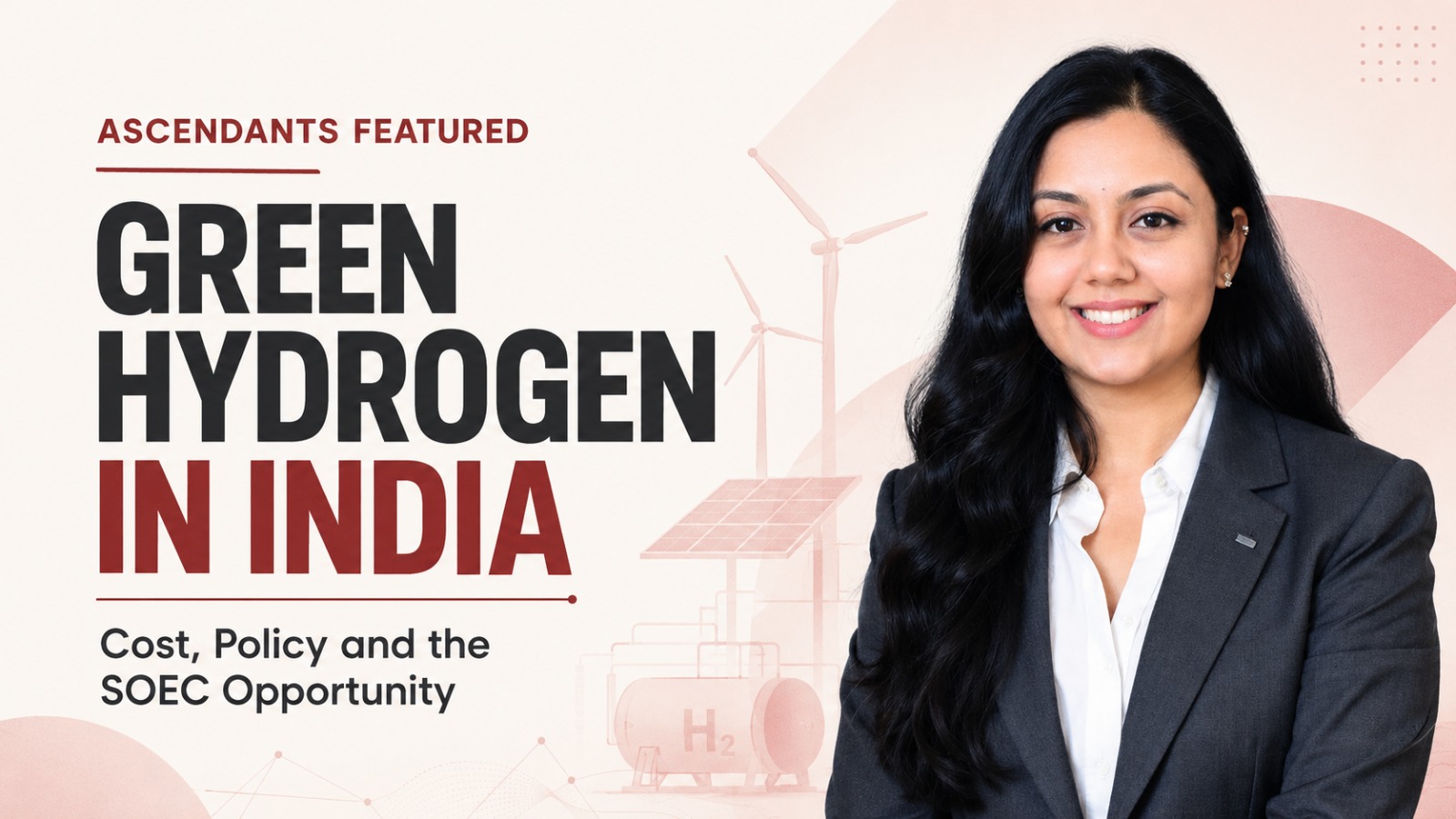
Green Hydrogen in India: By Sinchana P Heggade, Early Stage VC, Warmup Ventures
Hydrogen is already essential to refineries, fertilizer plants, steel production and other hard-to-abate industries. The problem is how it is made. More than 95 per cent of industrial hydrogen continues to come from fossil fuels, resulting in substantial carbon dioxide emissions.
Green hydrogen offers an alternative by using renewable electricity to split water through electrolysis. The process can help industries reduce their dependence on grey hydrogen produced from natural gas or coal.
What was once treated largely as an environmental investment theme is now becoming an industrial and infrastructure priority. Carbon pricing, energy security concerns and pressure on companies to reduce supply-chain emissions are pushing green hydrogen closer to commercial deployment.
The Technology Race Is Not One-Sided
Four main electrolyser technologies are shaping the market.
Alkaline electrolysis is the most mature and generally offers lower capital costs. Its main limitation is its ability to respond efficiently to fluctuating solar and wind power.
Proton Exchange Membrane, or PEM, electrolysers respond more quickly to changing power supply and can handle higher power densities. However, they depend on expensive and scarce metals such as platinum and iridium.
Anion Exchange Membrane, or AEM, technology aims to combine the lower material costs of alkaline systems with the flexibility of PEM. It remains at an earlier stage, with membrane durability still a concern.
Solid Oxide Electrolysis Cells, or SOEC, take a different approach. Instead of processing liquid water at relatively low temperatures, SOEC systems use steam at temperatures between 700°C and 850°C.
That high-temperature operation gives SOEC its main advantage.
Why SOEC Is Attracting Industrial Interest
Water splitting requires both electrical and thermal energy. At higher temperatures, part of the electrical requirement can be replaced by heat. This makes SOEC particularly attractive for factories that already generate high-temperature waste heat.
SOEC can reduce net electricity consumption to about 40 kilowatt-hours for every kilogram of hydrogen produced. Comparable alkaline and PEM systems generally require roughly 50 to 55 kilowatt-hours per kilogram.
The technology also relies mainly on ceramic oxides, nickel and zirconates rather than the noble metals used in PEM systems. This could reduce exposure to iridium-related supply constraints.
SOEC systems can also be designed to operate in reverse as Solid Oxide Fuel Cells. In such a configuration, a system could produce hydrogen when renewable electricity is abundant and generate electricity when power demand rises.
Another emerging application is co-electrolysis. An SOEC stack can process steam and captured carbon dioxide together to produce synthesis gas, a mixture of carbon monoxide and hydrogen used in methanol, chemicals, plastics and synthetic fuels.
These advantages, however, have not yet translated into broad commercial deployment.
High Efficiency Comes With Engineering Risk
SOEC systems operate under intense thermal and electrochemical stress. Their ceramic components are brittle and can be damaged by rapid heating and cooling.
This creates a difficult match with intermittent renewable power. A sudden fall in solar or wind generation can trigger temperature changes that cause cracking, seal failure or delamination inside the stack.
SOEC stacks are estimated to degrade by about 0.5 per cent to 2 per cent for every 1,000 operating hours. Replacement may be required every three to five years, weakening the long-term economics compared with mature alkaline systems.
Manufacturing is also capital-intensive. A 100 MW annual solid oxide stack production facility is estimated to require between $25 million and $60 million. Much of that cost comes from ceramic sintering kilns, robotic screen-printing equipment and specialised quality-control systems.
This explains why large companies are studying SOEC technology but continue to restrict most activity to pilot projects and research programmes.
Fertilizers Could Become India’s First Large Market
Among industrial users, fertilizer producers appear best placed to adopt green hydrogen derivatives first.
Hydrogen is combined with atmospheric nitrogen through the Haber-Bosch process to manufacture ammonia, which is then used in nitrogenous fertilizers. Because ammonia plants already operate with heat-intensive processes, they may also offer opportunities to integrate SOEC systems with existing thermal infrastructure.
The Solar Energy Corporation of India’s green ammonia auction allocated 724,000 tonnes of annual capacity across 13 domestic fertilizer units. The participating units include facilities linked to IFFCO, Coromandel International and Paradeep Phosphates.
The auction produced fixed 10-year prices ranging from ₹49.75 to ₹64.74 per kilogram. This gives the fertilizer industry a clearer long-term offtake framework than most other green hydrogen applications currently have.
Refineries are another immediate opportunity. They already consume large amounts of hydrogen for hydrotreating and hydrocracking. Their operations also produce high-temperature waste heat that could support SOEC integration.
Steel is likely to become a major market over time. Hydrogen-based Direct Reduced Iron can replace coking coal as the reducing agent used to remove oxygen from iron ore. The process, however, requires a continuous supply of high-purity hydrogen at a competitive price.
Policy Is Creating Demand, but Economics Still Decide Adoption
India’s National Green Hydrogen Mission has an initial outlay of ₹19,744 crore. Its Strategic Interventions for Green Hydrogen Transition programme supports both domestic electrolyser manufacturing and green hydrogen production.
Large industrial groups and public sector companies, including Reliance Industries, Adani New Industries, Larsen & Toubro, NTPC and Indian Oil, are developing integrated projects, captive production facilities or pilot applications.
Export pressure is also becoming more important. Carbon-related trade measures and Scope 3 emission requirements can affect Indian steel, engineering and chemical suppliers selling into international markets.
Even with policy support, the price gap remains substantial.
Grey hydrogen is estimated to cost between $1.50 and $2.50 per kilogram. Green hydrogen in India currently costs about $3.50 to $5 per kilogram, with some configurations reaching $6.70.
Electricity represents roughly 60 per cent to 70 per cent of the levelised cost of green hydrogen. Projects therefore depend on access to reliable renewable electricity at very low tariffs.
The electrolyser stack is only part of the investment. Transformers, rectifiers, switchgear and control systems can account for 30 per cent to 50 per cent of a plant’s capital cost.
Transport adds another layer of difficulty. In the absence of dedicated hydrogen pipelines, producers must use high-pressure tube trailers or convert hydrogen into ammonia, increasing the delivered cost.
The Commercial Winners Will Be Defined by Integration
Green hydrogen is not simply a contest to build the largest electrolyser.
Alkaline systems may remain attractive where low capital cost and steady operation matter most. PEM systems are better suited to rapidly changing renewable power. SOEC could offer the strongest efficiency in refineries, fertilizer plants and other facilities where high-temperature heat is already available.
The winning projects are likely to be those that combine low-cost renewable electricity, continuous industrial demand, waste-heat integration, long-term offtake agreements and manageable transport distances.
India now has policy support, corporate interest and an emerging fertilizer offtake market. The next stage will depend on whether developers can reduce production costs while proving that advanced systems such as SOEC can operate reliably for years, not merely perform efficiently in pilot installations.