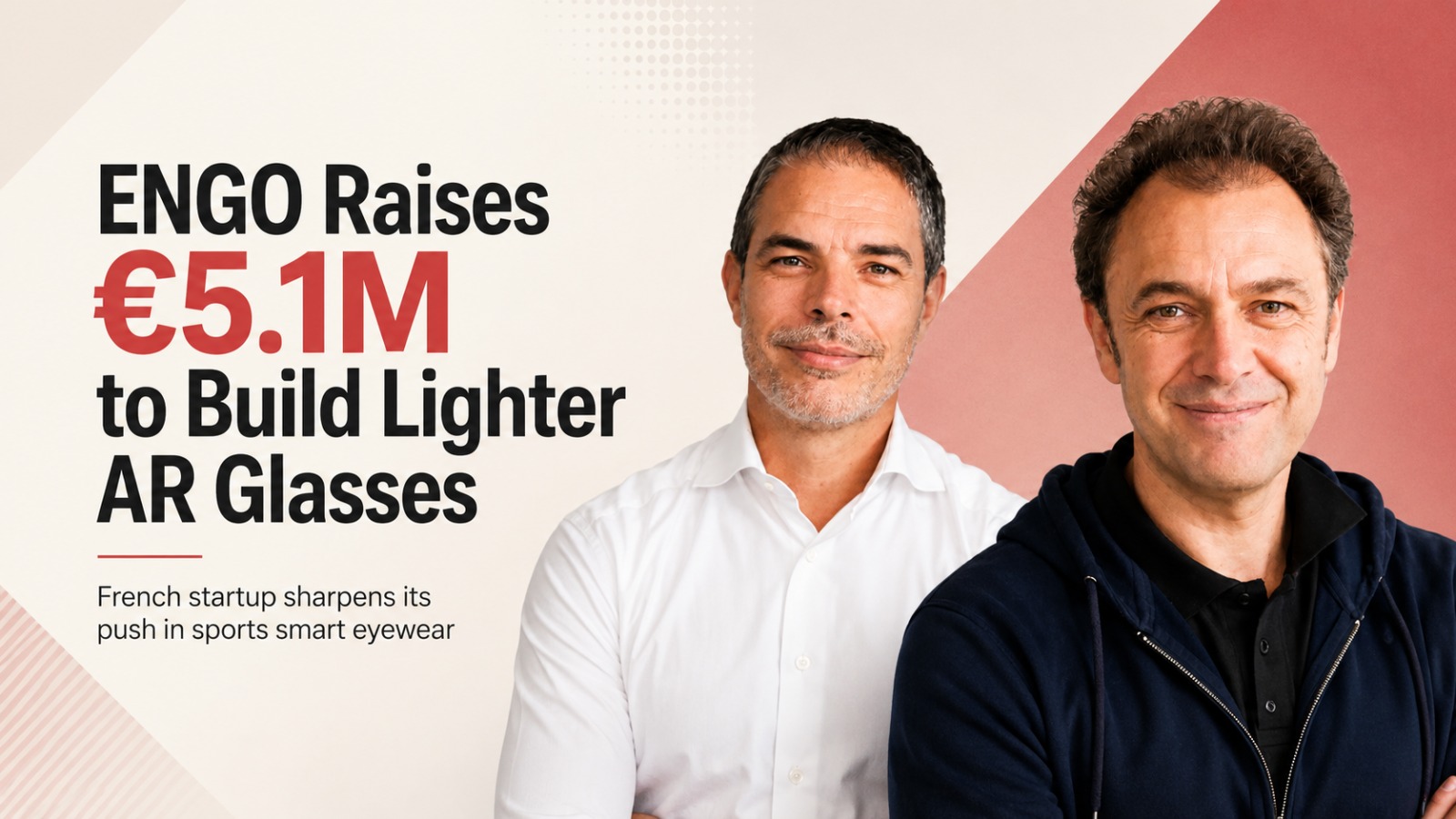
For endurance athletes, checking a watch can mean briefly taking their eyes off the road, trail or bike. French startup ENGO believes the most useful sports data should sit directly in an athlete’s field of view, without making the eyewear feel like another piece of heavy technology.
The Grenoble-based company has raised €5.1 million to expand its team and continue developing lighter, smaller augmented reality glasses for runners and cyclists.
The funding round was led by Ventech, Odyssée Venture and Bpifrance Amorçage Industriel. Blueprint Partners advised ENGO during the fundraising process.
ENGO intends to recruit 20 employees across engineering, marketing and business development. Part of the investment will also go towards reducing the size of its heads-up display technology.
ENGO: A different approach to smart glasses
While much of the smart-glasses market is focused on adding cameras, notifications and broader consumer features, ENGO is pursuing a narrower goal: giving endurance athletes access to performance information without forcing them to look down.
Its glasses can display data such as pace, heart rate and cycling power through a Micro-OLED display. The product works with platforms including Garmin and Apple Watch, allowing athletes to view familiar training metrics while continuing to look ahead.
The glasses weigh less than 40 grams and can operate for up to 20 hours on a charge, according to the company.
That emphasis on weight is central to ENGO’s strategy. Rather than competing only through display brightness, processing power or a longer feature list, the company is trying to make the technology less noticeable during exercise.
For a runner covering a long distance or a cyclist spending hours on the road, comfort can be as important as the information appearing on the lens. A device that becomes distracting, uncomfortable or tiring is unlikely to remain useful throughout a demanding training session.
Building around the athlete, not the screen
ENGO was founded in Grenoble in 2020 by Fabrice Berger Duquene and Éric Marcellin-Dibon.
Marcellin-Dibon also founded Grenoble-based microdisplay company MicroOLED in 2007. ENGO draws on that optical and display expertise as it develops its sports eyewear.
The connection gives the startup a technical foundation in an area where many smart-glasses companies depend on externally sourced display components. It also supports ENGO’s attempt to reduce the physical footprint of the technology rather than simply adding more functions.
Marcellin-Dibon has described the company’s goal as making the eyewear feel lighter, more natural and more intuitive, allowing athletes to concentrate on performance instead of the device itself.
That philosophy gives ENGO a clear product identity. Its glasses are not being presented as a replacement for a smartphone, camera or everyday communication device. They are designed around a specific moment: an athlete moving at speed and needing information without breaking focus.
Funding to support international growth
ENGO already generates most of its business outside its home market. The company says 90% of its revenue comes from outside France, with half of that amount coming from the United States.
The new investment will support further international expansion alongside product development.
Chief operating officer Fabrice Berger Duquene said the funding would allow the company to accelerate its growth, strengthen its position in sports smart eyewear and respond to increasing use among both amateur and professional athletes.
The company’s ability to grow overseas will be important. Smart glasses are attracting larger technology companies and heavily funded startups, making it difficult for a smaller business to compete through scale alone.
ENGO’s answer is specialisation. Instead of building a general-purpose wearable for every possible use, it is concentrating on the needs of runners and cyclists, including low weight, long battery life and direct access to training data.
Lightweight design becomes the competitive test
ENGO’s next challenge will be turning that focused proposition into a durable advantage.
Larger competitors have more resources to improve displays, software and hardware. They may also be able to introduce lighter models over time. ENGO therefore needs to keep reducing size and weight while maintaining battery life, visibility and comfort.
Its sport-specific approach could still give it room to grow. Athletes do not necessarily need the widest possible range of features. They need a product that works reliably during training, stays comfortable over long periods and presents useful information without becoming a distraction.
The €5.1 million round gives ENGO additional resources to pursue that goal. The company is betting that the future of wearable displays will not be decided only by what users can see, but also by how little hardware they feel while seeing it.
Also Read: OnePlus India Shutdown Rumours Return, but the Company Says Operations Remain Normal