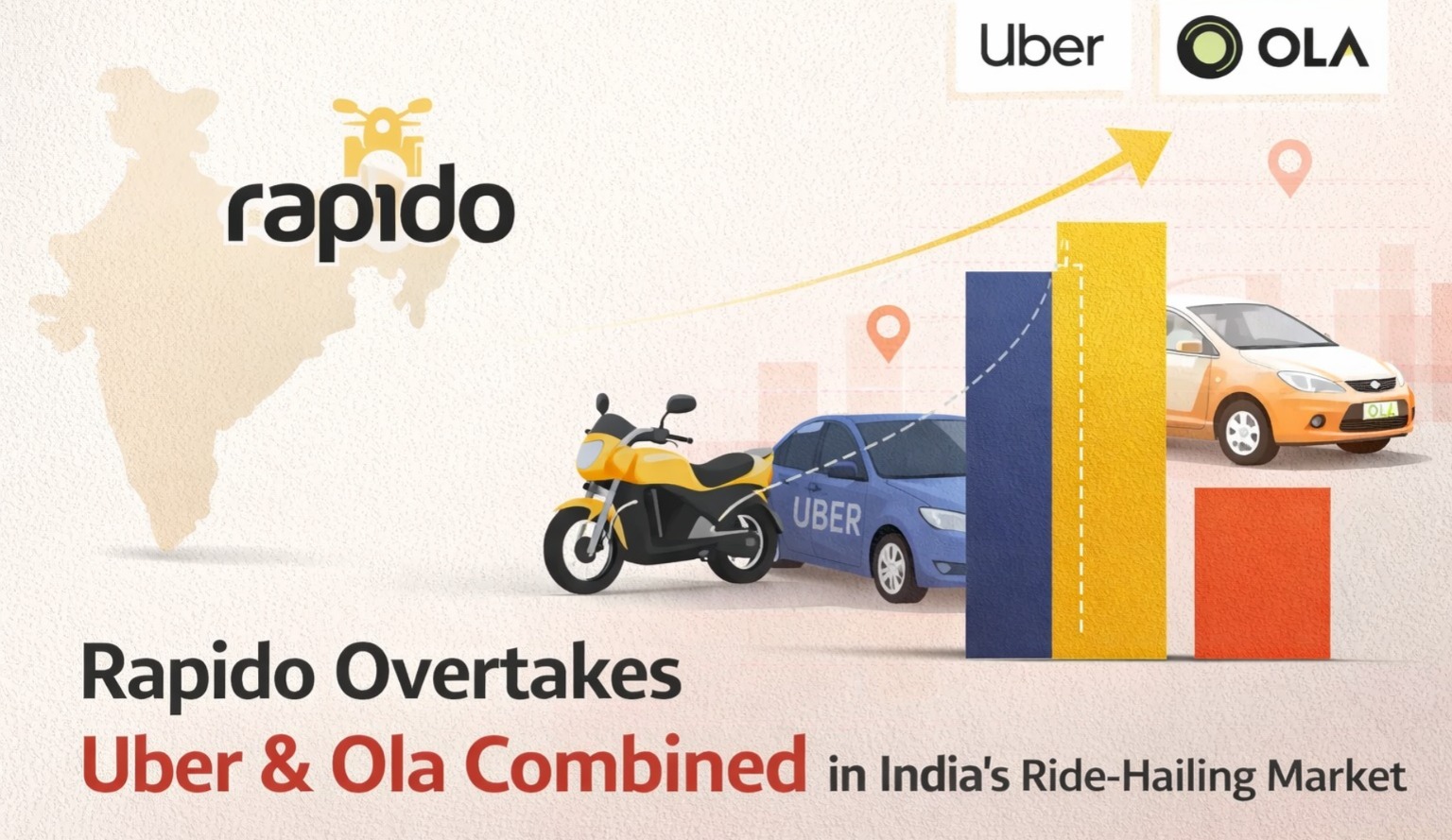
For much of the past decade, India’s app-based mobility market has largely been framed as a two-horse race. Ola, the homegrown startup that expanded rapidly across Indian cities, and Uber, the global ride-hailing giant, defined how millions of Indians hailed a ride.
However, the market that these two companies dominated in the past is now changing and evolving in a manner that is very different. New user trends and industry trends point towards the fact that Rapido has become a force to reckon with in the Indian mobility industry.
A chart presented by Manish Singh of India Dispatch, shows Rapido’s monthly active users steadily rising through 2025 and early 2026, reaching roughly 74 million by February 2026. Over the same period, Uber’s monthly active users are shown at around 38 million, while Ola’s appear to be around 26-27 million.
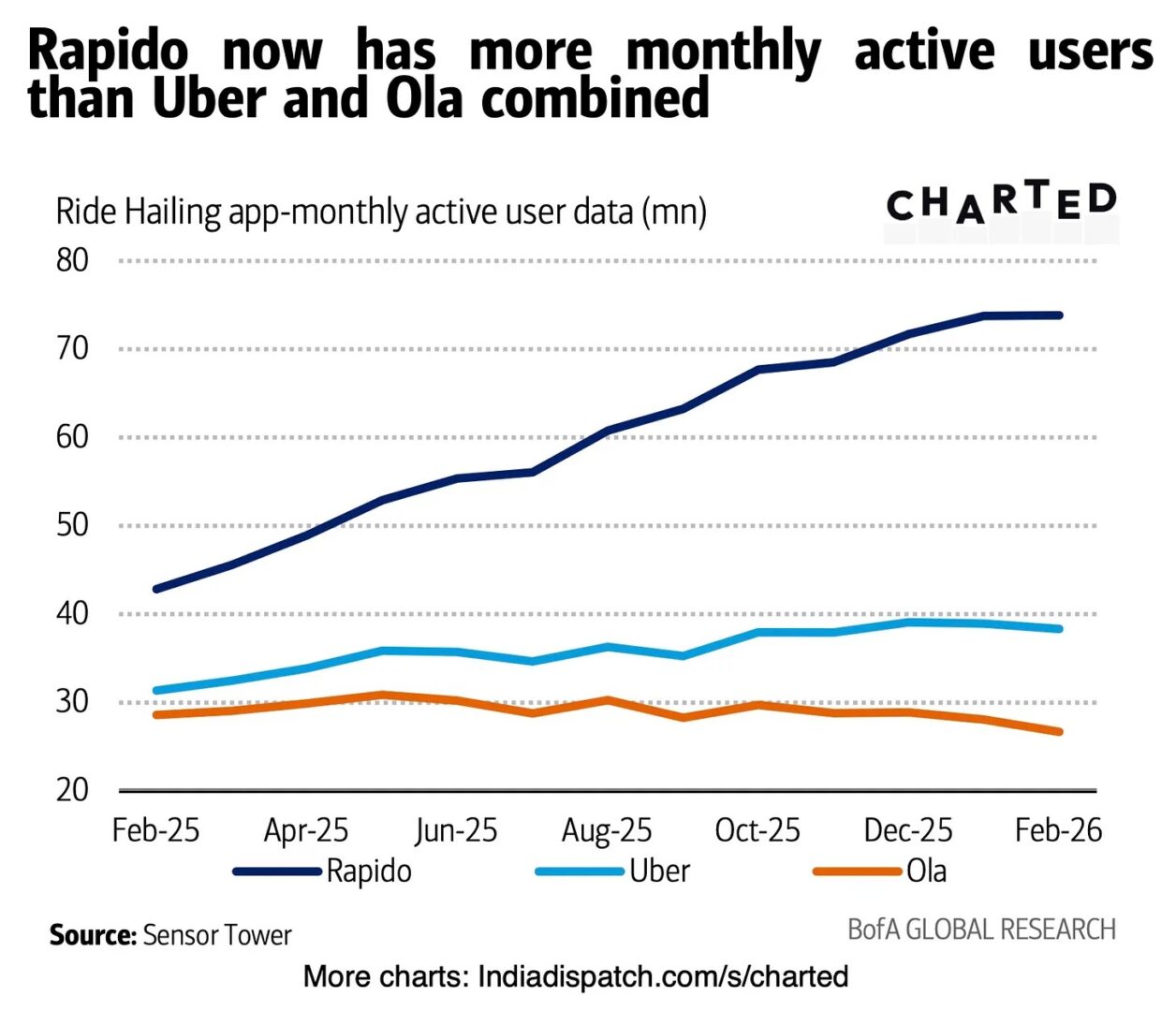
Taken together, that means Rapido’s user base alone now exceeds the combined monthly users of Uber and Ola, marking a striking moment in the evolution of India’s ride-hailing industry.
A Market That Once Belonged to Two
In the early years of India’s app-based mobility boom, Ola and Uber dominated the conversation. The companies expanded aggressively across metropolitan cities and smaller urban centres, building large driver networks and introducing digital ride booking to millions of users.
For years, the competition between the two shaped pricing strategies, driver incentives and consumer behaviour.
But the landscape today looks more fragmented and more dynamic.
Industry estimates suggest the market now broadly divides among three major platforms:
Estimated Market Share (approx.)
- Rapido: ~50%
- Uber: ~40%
- Ola: ~20–25%
These numbers reflect how rapidly Rapido has expanded its presence in recent years.
The User Base Story
The shift becomes clearer when looking at active users.
Industry estimates place monthly active users roughly at:
- Rapido: ~50 million users
- Uber: ~30 million users
- Ola: ~28 million users
The chart shared by India Dispatch indicates that Rapido’s user base has grown sharply over the past year, rising from roughly 42 million users in February 2025 to about 74 million by February 2026.
Uber, on the other hand, indicates a steady but moderate growth rate over the same period, while Ola users remain flat before declining slightly up to early 2026.
The above data indicates that Rapido has grown its footprint at a faster rate than its older competitors.
Rapido, Ola Or Uber? Who Leads in Daily Rides?
Daily ride volumes show a slightly different picture, highlighting how each platform occupies its own niche within the broader mobility ecosystem.
Approximate daily rides across platforms indicate:
- Uber: ~1.8–2 million rides per day
- Rapido: ~1.6 million rides per day
- Ola: ~1 million rides per day
Uber seems to have the highest daily ride volume among the three services. This is a testament to their strong cab ecosystem. However, Rapido has managed to narrow down the gap significantly, especially considering their short-distance ride options.
The Rise of Affordable Mobility
One of the most important shifts in India’s mobility market is the growing importance of affordability.
While cab rides initially drove the app-based transport revolution, many urban commuters today are choosing bike taxis and autos for shorter distances, especially in congested cities.
Rapido’s growth appears closely tied to this shift.
Industry observers attribute Rapido’s expansion to three factors frequently highlighted by users:
- Lower fares compared with traditional cab rides
- Faster navigation through traffic in dense cities
- Availability of bike taxis for short trips
In effect, the platform has positioned itself around everyday urban mobility rather than premium ride-hailing.
Uber, meanwhile, continues to rely heavily on its cab ecosystem, while also offering autos and two-wheelers in several cities. Ola appears to be undergoing a broader transition in its business strategy, with its mobility platform evolving alongside other initiatives.
A Structural Change in the Market
The broader takeaway from the data is that India’s mobility ecosystem is no longer defined solely by cab services.
Instead, the market appears to be moving toward a multi-format mobility model, where users choose between bikes, autos and cabs depending on price, distance and urgency.
That transition is reshaping how platforms compete.
The next phase of competition may depend less on brand recognition and more on three operational fundamentals:
- Driver earnings
- Ride affordability
- Vehicle availability
Platforms that can balance these factors effectively are likely to capture the largest share of India’s urban mobility demand.
The Next Decade of Urban Transport
India’s cities continue to grow, traffic congestion remains a daily reality, and millions of commuters rely on flexible transport options to navigate urban life.
In that environment, app-based mobility is expected to remain a critical part of everyday transportation.
The emerging trend suggests the market may no longer be about who launched first or who built the biggest cab fleet. Instead, it could increasingly be about who provides the most accessible and affordable mobility options to millions of riders every day.
If the current user data is any indication, the contest for India’s ride-hailing market is entering a new chapter and the company best positioned for the future may be the one that understands the economics of everyday commuting.
Also Read: Suniel Shetty steps into startup spotlight with ‘Bharat Ke Super Founders’