In boardrooms across large enterprises, talent conversations still begin with instinct and end with fragmented data. A performance tool here. An HR dashboard there. A manual spreadsheet tying it all together. Zeko AI believes that gap is not just operational friction, it is a strategic blind spot.
Positioned as the world’s first Enterprise Talent Intelligence platform built for business units, Zeko.ai is attempting to redefine how organizations understand people performance. Instead of treating talent data as an HR function, the company is building an intelligence layer that allows business leaders to read workforce capability the same way they read financial data, in real time, with clarity and predictive depth.
That ambition has begun drawing national and international attention.
At the India AI Impact Summit 2026, Zeko AI was recognised among global winners under the AI by HER, Global Impact Challenge, an award track spotlighting women-led ventures building scalable and inclusive artificial intelligence systems.
The Summit itself recorded over 15,500 registrations, more than 4,600 formal applications, representation from 136 nations, and over 900 startup exhibitors. Twenty-eight awards were presented, each carrying a grant of ₹25 lakh, by Union Minister Ashwini Vaishnaw.
For Zeko.ai, the recognition signals more than visibility. It marks entry into a broader conversation about what enterprise AI should actually solve.
Beyond Recruitment Software
Zeko.ai’s positioning is clear: this is not a recruitment automation tool. It is an enterprise-grade intelligence platform designed to enhance precision hiring, workforce optimization, and skills-based discovery across departments.
The company focuses on transforming scattered talent information into structured, actionable intelligence. In most enterprises, capability data is trapped in silos, between HRIS systems, performance dashboards, and productivity platforms. Zeko.ai integrates with these existing systems to create a unified intelligence layer that business units can access directly.
The platform’s capabilities include unit-level talent intelligence, capability mapping to identify skill gaps, predictive people analytics to anticipate attrition or performance shifts, and integration-ready architecture that connects seamlessly with enterprise systems already in place.
The philosophy is straightforward: HR remains central, but business units must also think like talent strategists.
Structured Intelligence as the Next Competitive Advantage
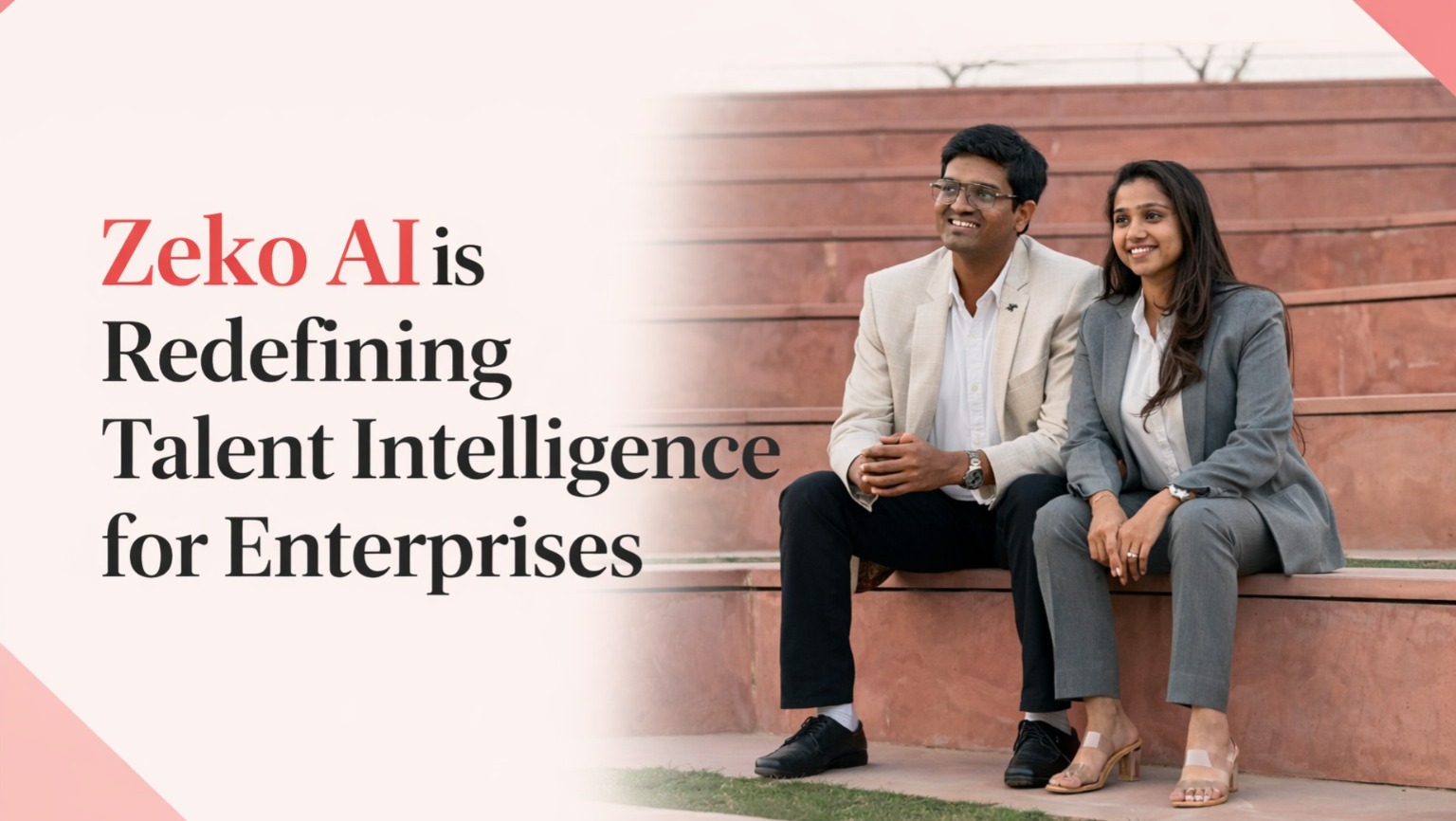
At the Summit, co-founder Tanvi Jain articulated the company’s thesis clearly. AI in enterprises, she said, is no longer about automating recruitment workflows. The future lies in structured intelligence, where data supports fairness, alignment, and long-term workforce strategy.
Her co-founder, Samyak Jain, expanded on the organizational challenge Zeko.ai aims to address: decision misalignment between HR, business units, and leadership teams. According to him, enterprises often struggle to connect people data with operational execution. Zeko.ai’s goal is to embed organizational intelligence into everyday workflows so that talent decisions become measurable and aligned with business outcomes.
He also shared operational metrics that suggest platform adoption momentum. Over the last year, the company facilitated more than 1.5 million minutes of AI-led discussions and AI interviews, reporting growth exceeding 100 percent quarter-on-quarter.
Those numbers reinforce the company’s larger claim: enterprises are beginning to demand systems that do more than screen resumes. They want predictive, integrated intelligence that informs planning, redeployment, and long-term workforce architecture.
A Shift in Enterprise Thinking
The timing of the entry of Zeko.ai is quite interesting. It has taken years for organizations to digitize HR functions, but many organizations are still struggling to provide quick answers to basic questions such as:
Which teams possess the best capability depth for a given initiative?
Where are future skill gaps emerging?
Which internal resources can be repurposed before external recruiting starts?
What are the early indicators of attrition risk before resignation letters appear?
Zeko.ai claims to be the solution to this visibility gap. It is not a solution that provides reactive reporting but predictive analytics through advanced machine learning and multilingual AI capabilities.
Coverage surrounding the India AI Impact Summit emphasized its ability to enhance hiring accuracy, reduce bias, accelerate screening cycles, and support skills aligned to future-of-work demands.
The company also emphasizes inclusive and bias-aware intelligence systems, a focus that aligns with the AI by HER recognition track under which it was awarded.
Recognition of Zeko AI Beyond One Summit
The recognition at the Summit is an extension of the validation that has been achieved in the ecosystem. In 2025, Zeko AI was chosen as one of the Top 20 startups out of 10,000 applications for the UAE-India CEPA Council Start-up Series. At the India AI Impact Summit 2026, it was shortlisted as one of the Top 30 innovators globally before being declared a finalist for the award.
These recognitions place the company within a broader inflection point in enterprise AI. Industry narratives are shifting from automation to decision infrastructure. Talent intelligence, once treated as a subset of HR tech, is increasingly being discussed as foundational to enterprise competitiveness. Zeko.ai is building squarely in that space.
The Long-Term Bet
The company describes its vision as helping every business unit become talent-intelligent. In its framing, the next decade of enterprise growth will be defined by leaders who understand people data as deeply as financial data.
That is an ambitious thesis.
If finance teams rely on daily dashboards to steer strategy, why should workforce capability be assessed quarterly? If cost optimization is continuous, why should talent redeployment lag behind? Zeko.ai’s core argument is that human capital deserves the same analytical rigor as capital allocation.
Whether the market adopts the language of “Enterprise Talent Intelligence” remains to be seen. But the underlying problem, fragmented people data and misaligned decision-making, is real, measurable, and widely acknowledged across industries.
For now, Zeko.ai is placing its bet on structured intelligence becoming the new norm as the default layer within progressive organizations. Not as a replacement for HR. Not as another dashboard. But as the operating system behind talent decisions.
And in an economy that is rapidly being shaped by skill velocity and agility, this bet may not be so premature.
Also Read: Adani Initiative Rekindles Hopes for Formula 1 Return to India