When her children grew up and the daily rush of school runs and tiffin boxes faded, 45-year-old Delhi homemaker Suman Sukhija found herself facing something she’d never had before: long, quiet afternoons.
“I realised this free time could either pull me into negativity or push me towards purpose,” she recalls. That private moment of reckoning inside her home would eventually give India Orange Herb, a Cordyceps militaris mushroom brand that now sells around Rs 40 lakh worth of products a year and runs regular training programmes for aspiring growers.
A Familiar Story of an ‘Ordinary’ Indian Mother
Suman’s life, for decades, looked like that of countless middle-class women.
Born in Hansi, Haryana, and raised in Delhi from the age of eight, she followed the expected milestones, education, marriage, motherhood, and the invisible labour of running a household. Her days were filled with cooking, keeping the home in order, helping her children with their studies and careers, even supporting her daughter’s salon work.
There was no business plan, no entrepreneurial ambition, no science degree in the background. Just a steady belief that her primary role was to hold the family together.
It was only when her children became independent that she encountered an unfamiliar feeling: time for herself. Instead of slipping into boredom or anxiety, she decided to build something of her own, even if she had no idea what that would be.
YouTube, Curiosity and a First Glimpse of Keeda Jadi
Like many self-taught entrepreneurs of the digital age, Suman’s turning point began on YouTube.
She started watching videos on mushroom cultivation, first the more common varieties such as button, milky and oyster mushrooms. Intrigued, she signed up for a five-day practical training programme in Murthal, hoping to understand the basics of mushroom farming.
During that course, she heard repeated, almost whispered references to a different kind of fungus: Cordyceps militaris, often called Keeda Jadi in popular parlance. It wasn’t even part of the official syllabus, but each time the name came up, she felt drawn to it.
Cordyceps is no regular crop. Grown in sterilised lab conditions, this bright orange mushroom is known for its medicinal and wellness properties, particularly around stamina, immunity and energy. It doesn’t demand acres of farmland; instead, it needs clean rooms, careful processes, and discipline.
For a woman who had never stepped into a lab, the idea that such a high-value product could be grown in a small indoor space, even at home, felt nothing short of transformative.
In February 2018, she travelled to Meerut for specialised training focused on Cordyceps. That trip quietly shifted the direction of her life.
Turning a 10×10 Room Into a Makeshift Laboratory
Back in Delhi, Suman picked the most unlikely setting for a high-value agri-business: a 100-square-foot (10×10 ft) room in her home.
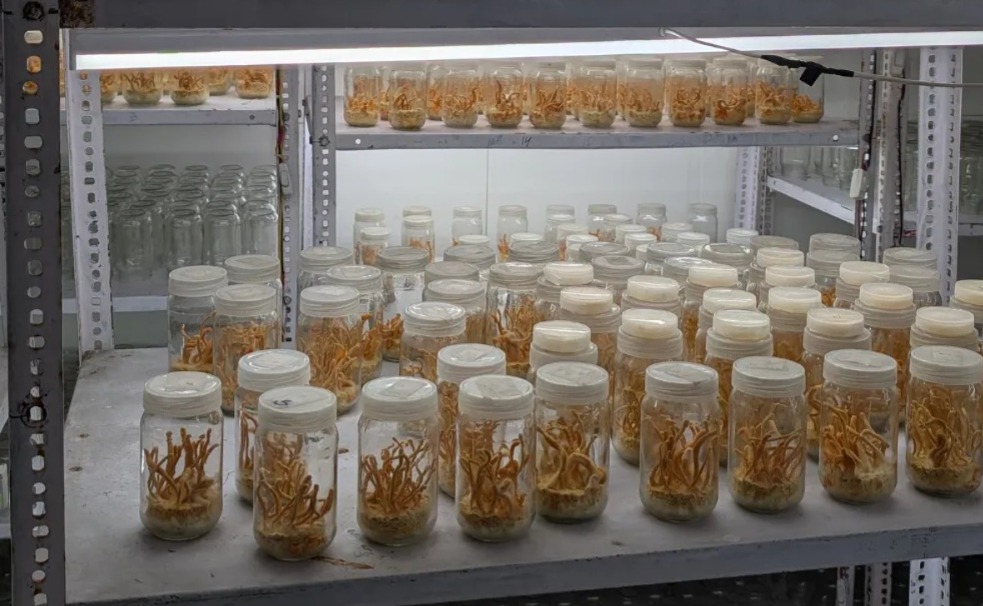
She scrubbed it thoroughly, added basic insulation and began assembling what she thought a lab should look like. The shopping list was long and, as she later realised, more expensive than necessary: an autoclave, laminar flow hood, rotary shaker, BOD incubator, humidifier controller, racks, partitions, glass jars, conical flasks, petri dishes and four air conditioners. Her initial investment crossed Rs 11 lakh.
Only later, with experience, did she understand that a beginner can get started with a much leaner setup, roughly Rs 3-4 lakh, depending on space and scale. But at the time, driven by enthusiasm and inexperience, she tried to get everything “perfect” right away.
She filled every rack and shelf with jars and cultures. And then came the first hard lesson that every grower eventually meets.
The entire batch failed.
Contamination, invisible, unforgiving, and common in mushroom labs, wiped out her first crop. She had misunderstood one of the core rules of scientific cultivation: start small, learn, then scale.
Learning the Science, One Failed Jar at a Time
The failed harvest might have been the end of the experiment. Instead, Suman treated it as unpaid tuition.
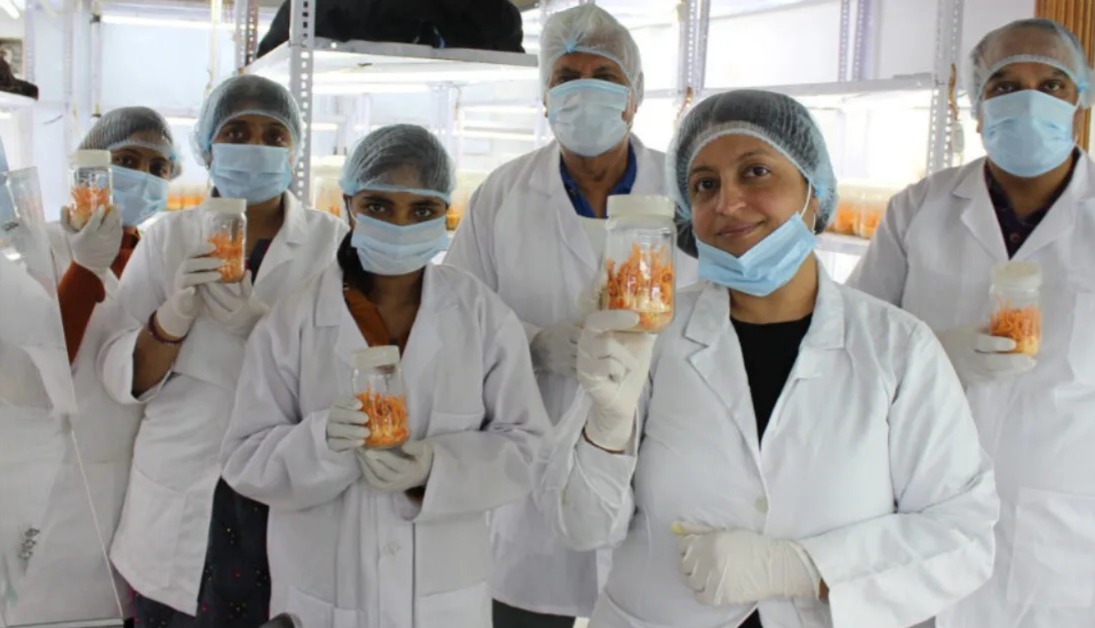
She ordered fresh petri dishes, sat down with hygiene manuals, and rebuilt her process from scratch. This time, she focused obsessively on sterility and discipline:
- Working only near the laminar flow hood
- Wearing gloves, masks and sterilised coats
- Meticulously cleaning tools, jars and every corner of the workspace
Gradually, the science stopped feeling alien.
Cordyceps cultivation follows a clear three-stage process:
- Tissue culture (about 15 days), where the fungus stabilises
- Liquid spawn (around six days), where it multiplies in a shaking nutrient broth
- Fruiting (40–50 days), when the characteristic orange mushrooms grow inside jars under controlled temperature and humidity conditions
Once she internalised these steps and the importance of contamination control, the results changed. Instead of cloudy, spoilt jars, she began to see bright orange Cordyceps pushing up from the substrate.
Her first successful harvest weighed just 200–250 grams, a tiny quantity by commercial standards, but for Suman it was proof that she could learn a completely new discipline from zero and make it work.
From Rohini to Dwarka: Scaling a Lab-Based Farm
A couple of years later, in 2020, Suman shifted fully to Delhi to support her children’s education and began focusing on building Cordyceps as a serious business. She first operated out of a small space in Rohini, and then moved to a larger, 250-square-foot laboratory in Dwarka once it became clear that demand and production both needed more room.
Today, the Dwarka lab alone produces around 9-10 kg of Cordyceps per cycle. Over time, she also helped set up two additional labs in collaboration with relatives, taking total production to roughly 16–20 kg per cycle.
Her son Rahul eventually joined the business full-time, handling core operations and management, a shift Suman openly credits as crucial for scaling beyond a one-woman enterprise.
Inside the labs, strict hygiene protocols have become routine: dedicated sterilised footwear, surgical coats and masks, air-conditioned rooms with controlled humidity, and thorough sterilisation of every tool and surface. What once terrified her, a single contaminated jar, is now just another operational challenge that experience has taught her to solve calmly.
Suman Sukhija: Building the Orange Herb Brand
By late 2020, customer feedback began signalling that the work was having real-world impact. Buyers spoke of better stamina, fewer breathing issues, improved immunity and relief from joint pain after using Cordyceps regularly. Suman realised she was no longer just growing a niche fungus; she was entering the wellness and nutraceutical space.
In 2021, she formally launched Orange Herb as a brand.
The product line started with:
- Cordyceps tea – a box with 30 sachets of 1 g each
- Cordyceps capsules – a pack of 60 capsules, with a total of 30 g
Both are priced at Rs 2,800 per 30 g, targeting customers who see Cordyceps as a long-term supplement rather than a casual purchase. Her regular buyers now include gym-goers, athletes, senior citizens, and people dealing with asthma, diabetes or low immunity, according to Suman’s account.
She emphasises that the business is run as a scientific operation, with compliance under FSSAI (Food Safety and Standards Authority of India) and GST frameworks firmly in place.
In 2022, Orange Herb branched into saffron cultivation under controlled conditions, followed more recently by microgreens, transforming the Dwarka lab into a multi-crop wellness unit rather than a single-product facility.
Today, annual Cordyceps sales are around Rs 40 lakh, with saffron bringing in an additional Rs 4–5 lakh per year, as per Suman’s figures.
Training a New Generation of Cordyceps Growers
Even as Orange Herb’s own sales grew, Suman found herself repeatedly approached by people who wanted to learn the cultivation process.
In 2019, she launched a two-day training programme for aspirants interested in Cordyceps and saffron. Participants receive:
- Hands-on practice inside the lab
- Step-by-step exposure to tissue culture, liquid spawn and fruiting
- Guidance on contamination control, equipment choices and basic costing
- A starter tissue culture to begin their first batch at home or in a rented space
Importantly, Suman doesn’t position the programme as a one-time event. Trainees regularly stay in touch, sending photos and videos of their setups, troubleshooting contamination issues, and seeking clarity as they grow.
Several of them have gone on to launch their own Cordyceps labs in different towns, attributing their confidence to her accessible teaching style and continued support.
Over time, she has trained more than 1,000 people, many of them first-generation entrepreneurs who do not come from scientific or agribusiness backgrounds.
A Small Team, a Tight System and a Bigger Vision
What began as a one-woman experiment in a 10×10 room is now run by a compact team that includes Suman, Rahul, support staff for operations, and people handling digital outreach and customer communication.
The lab is run with standard operating procedures that would look familiar in any small biotech or food-tech unit:
- Controlled temperature and humidity in air-conditioned rooms
- Clear protocols for what happens when contamination appears in a jar
- Defined roles for production, packaging, customer support and marketing
Suman’s strongest distribution channel, interestingly, is not a retail shelf but a screen. She sells through Amazon, IndiaMART, Justdial and social media, but repeatedly points to YouTube as the platform that truly changed her business. By openly showing her process and explaining both the benefits and limitations of Cordyceps, she has built a community that trusts what it can see rather than just marketing slogans.
A Story Which Inspires Many
At one level, Suman Sukhija’s journey is an individual success story, a homemaker who found a high-value niche, learned a complex process from scratch, and built a Rs 40 lakh-plus wellness business around one of the world’s more unusual mushrooms.
At another level, it quietly challenges a set of assumptions that still hold many Indian women back:
- That serious science is only for people with formal degrees
- That entrepreneurship needs big capital, big offices and big networks
- That middle-aged women who have spent years at home are “too late” to start
Suman started with none of those advantages. What she did have was time, discipline and the refusal to waste either.
Today, when she points to her lab and says, in effect, if this can grow out of a 10×10 room, so can your idea, the message lands with credibility. Because behind that statement lies a very real journey of missteps, failed batches, late-night sterilisation sessions, and slow but steady learning.
Her story is not about overnight success, but about compounding small, disciplined steps into a business that now sustains a family, trains others, and nudges more women to believe that their second innings can be built on their own terms.
Also Read: Airwallex CEO Jack Zhang Reveals Why He Rejected Stripe’s $1.2Bn Offer?