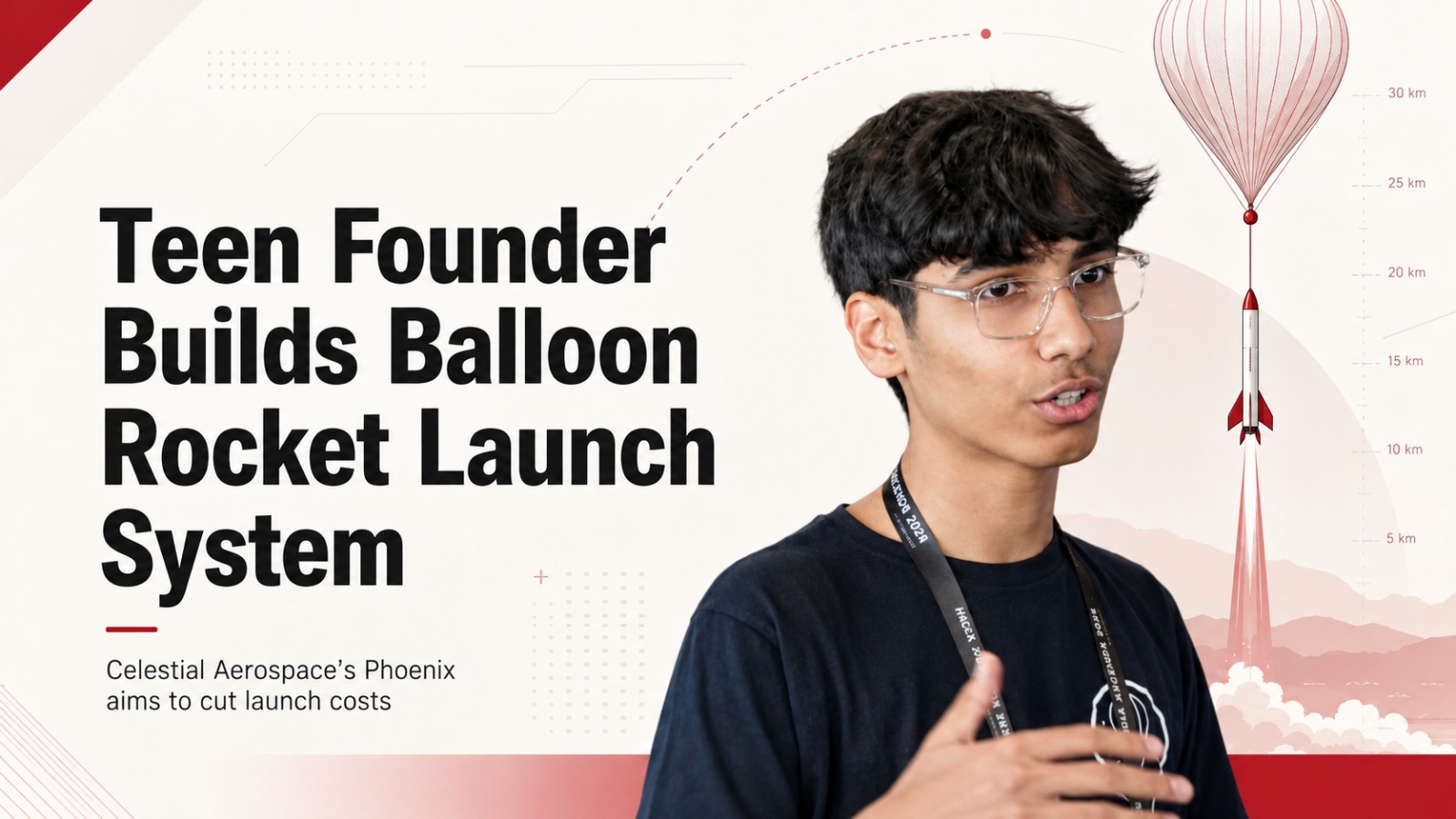
Founded by Shreyans Jain, the young deep-tech startup is betting on a balloon-assisted launch architecture to cut the costly first leg of a rocket’s journey through the atmosphere. A prototype test is targeted for late 2026, followed by a planned commercial launch in 2029.
Most rockets begin their journey at ground level, where the atmosphere is thickest and the vehicle must burn significant amounts of propellant simply to climb through it.
Celestial Aerospace wants to change where that journey effectively begins.
Founded in 2025 by Shreyans Jain, the Gurugram-based deep-tech startup is developing a balloon-assisted rocket launch system commonly described as a “rockoon”, combining the lift of a high-altitude platform with a conventional rocket.
The central idea is straightforward. Instead of igniting the rocket on the ground, Celestial plans to carry it to an altitude of roughly 25 kilometres and start the rocket engines there.
At that height, the vehicle would already be above much of the densest part of the atmosphere. The approach is intended to reduce drag during the initial climb, lower the amount of fuel required during that phase and ease some of the structural demands placed on a rocket during a conventional ground launch.
Celestial is not presenting the high-altitude platform as a simple free-floating balloon. Jain has described the system as a controlled airship equipped with propulsion and designed for greater aerodynamic control.
That distinction matters because lifting the rocket is only one part of the challenge. The vehicle also has to separate safely at altitude and transition almost immediately into powered flight.
Phoenix puts the 25-km idea at the centre of the launch system
Celestial’s proposed orbital launch vehicle, named Phoenix, is being designed to carry payloads of up to 800 kg.
Under the planned launch sequence, the airship would take Phoenix to around 25 km before releasing it for ignition. The vehicle is being developed as a two-stage rocket using kerosene and liquid oxygen propulsion, with the company also working around a partially reusable architecture.
Rather than trying to replace the rocket itself, Celestial’s approach is aimed at changing one of the most punishing parts of the flight profile: getting through the lower atmosphere.
It is also where the startup believes it can improve launch economics.
Celestial is targeting launch costs around 20% to 30% lower than existing alternatives, with the economics of smaller satellite launches forming a central part of its pitch.
The company’s own development work remains at an early stage, however, and those cost reductions are targets rather than demonstrated commercial results.
That distinction will become increasingly important as Celestial moves from engineering calculations and designs to actual flight testing.
A prototype test could be the first major proof point
Celestial is aiming to conduct a prototype launch in late 2026.
For a company attempting an unusual launch architecture, that test could become one of its most important milestones. The concept depends not only on reaching the required altitude, but also on controlling the airship, separating the rocket safely and managing the transition from suspended flight to engine-powered ascent.
Jain has said the testing programme is intended to generate the data the company needs to improve the vehicle and validate the concept. The source material also makes clear that the rocket-airship separation sequence is among the technical problems the team is working through.
Celestial’s longer-term target is a commercial orbital launch by 2029. The company’s stated timeline places several years between its prototype work and the point at which it hopes to begin carrying commercial payloads, reflecting the gap that still exists between an experimental system and a functioning launch service.
The original coverage similarly records the company’s ambition to reach commercial orbital operations by early 2029.
An old launch idea being revisited with a new vehicle
The rockoon concept itself is not new.
Balloon-assisted rocket experiments date back decades, and other companies have explored variations of high-altitude launch systems. What Celestial is trying to establish is whether the approach can be engineered into a practical orbital launch vehicle with competitive economics.
The startup says its focus is not on relying on a single technological breakthrough. Instead, the team is trying to simplify the launch sequence and combine existing engineering ideas into a workable system.
That makes Celestial’s challenge different from simply proving that a balloon can carry a rocket to altitude. The commercial test is whether the complete system can eventually launch payloads reliably, repeatedly and at a cost attractive enough for customers.
Lightspeed programme puts Celestial on the deep-tech radar
Although Celestial Aerospace was formally started only in 2025, it has already drawn attention within India’s deep-tech ecosystem.
The startup was selected for Lightspeed India’s Ascends 2026 programme, emerging from a pool of more than 5,000 applicants.
The programme has placed the company in closer contact with investors, mentors and technology networks at a stage when its engineering plans still need to be translated into successful hardware tests.
Jain began working on the underlying idea before formally starting Celestial Aerospace in March 2025. The project subsequently developed into the balloon-assisted launch architecture now being pursued by the company.
For Celestial, the next milestone is not simply another design iteration or programme selection. It is flight.
If its late-2026 prototype can demonstrate that a rocket can be carried to the intended altitude, separated safely and transitioned into powered flight, the company will have evidence for one of the most consequential assumptions behind Phoenix.
Until then, the 25-kilometre ignition point remains an ambitious engineering proposition.
What makes Celestial Aerospace worth watching is the way it has framed the problem. Instead of asking only how to build a cheaper rocket, the startup is asking whether a rocket needs to begin the hardest part of its journey from the ground at all.
Also Read: Michael Wright, The Five Heartbeats Actor, Dies at 70