

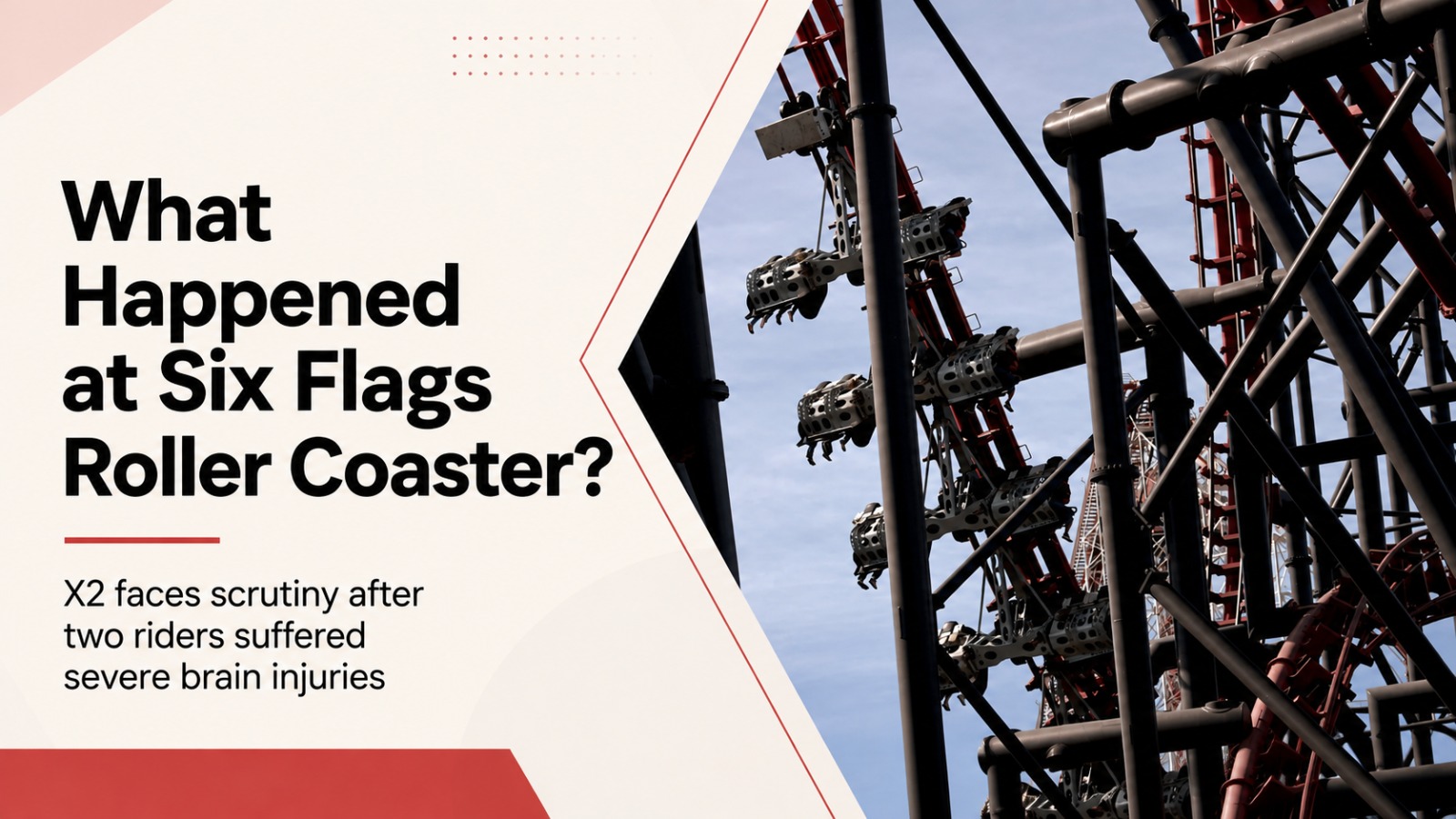
Two women who boarded the same Six Flags roller coaster only six days apart in July suffered severe brain injuries that required emergency surgery, bringing fresh attention to a ride with a documented history of serious injury complaints.
The attraction, X2, has remained closed since July 12 at the Valencia, California, amusement park. Six Flags has declined to explain what specifically led to the shutdown, while the California Division of Occupational Safety and Health has said its inspection is ongoing. A separate report also confirmed that the coaster has remained closed since July 12 and that regulators were continuing their review.
What makes the latest cases particularly striking is how closely they resemble each other.
Pamela Guillen, a 40-year-old Hawaii resident, rode X2 while visiting the park with her family to celebrate her daughter’s 16th birthday. During the ride, Guillen repeatedly struck her head against the headrest, according to ambulance records. By the time the train returned to the station, she needed help getting out of her seat and had begun vomiting. She soon lost consciousness on a nearby bench. Paramedics found her unresponsive, with unequal and sluggish pupils.
A CT scan later showed a severe subdural hematoma, a collection of blood around the brain, along with dangerous compression. Doctors intubated Guillen and rushed her into surgery, where part of her skull was removed to relieve pressure on her brain.
One detail connects her case to an earlier X2 tragedy. The surgical team treating Guillen was the same team that had treated Christopher Hawley, a 22-year-old rider who suffered catastrophic brain bleeding after riding X2 in 2022 and died less than 10 hours later.
Guillen did not fully regain consciousness for weeks. After waking, she initially struggled to speak more than one word at a time and later had to relearn basic skills, including walking and talking. She has described continuing headaches and brain fog and said she requires medication to prevent seizures.
Six days after Guillen’s ride, 25-year-old Los Angeles resident Naomi Greer-Wilkinson boarded X2 with her twin brother and younger sister.
She too lost consciousness after leaving the coaster and was taken to a hospital for emergency brain surgery. Her parents said doctors told them she had suffered a severe traumatic brain injury and warned them to prepare for the worst. More than a month later, she remained in critical condition in a coma, dependent on a ventilator and feeding tube.
Doctors point to rapid acceleration and deceleration
Three neurosurgeons involved in treating the two women concluded that the severe injuries requiring emergency neurosurgical care resulted from a traumatic rapid acceleration and deceleration event while the women were riding X2.
X2 is unlike a conventional roller coaster because its passenger seats rotate independently around the track. Riders can be turned through 360 degrees while the train itself travels at speeds approaching 80 mph during a ride lasting roughly two minutes. The coaster also includes steep drops and sequences in which passengers can move head-first or face-down.
That does not mean roller coasters generally carry a high risk of traumatic brain injury. Research cited by mechanical engineering professor Lyndia Wu of the University of British Columbia has found the overall risk to be very low. Wu, however, said much of that research is old and suggested that unusually intense rides such as X2 may deserve further examination.
Earlier riders reported similar head injuries
The July cases did not emerge in isolation.
Medical records, depositions and legal filings reviewed over nearly two decades have linked X2 to more than a dozen reports of serious injuries and hospitalizations. Those cases include riders who suffered lasting disabilities, entered comas or died after their injuries.
In 2014, 17-year-old Selena O’Neill developed a severe headache, trouble seeing and difficulty walking after riding X2. Her condition deteriorated, and she suffered a seizure during a medical appointment the following day. Doctors diagnosed a subdural hematoma and attributed the injury to the ride. Records later obtained during litigation indicated that at least five other riders had previously gone to hospitals complaining of head pain.
In 2020, Sheila Katerelos described feeling her head slam into a headrest while riding X2. She later became nauseated and dizzy, began dragging one leg and developed slurred speech. She spent five days in hospital and was diagnosed with a traumatic brain injury and multiple subdural hematomas, according to court records.
A year later, Lucy Alvarez reported hitting the back of her head during the ride. Nine days later, persistent light-headedness and head pain led her to an emergency room, where she was diagnosed with a traumatic subdural hematoma attributed in her medical records to the coaster ride. Her attorney has said she continues to experience memory problems, balance difficulties and chronic migraines.
A 2022 death brought another state inspection
The most serious previous case involved Christopher Hawley.
Hawley rode X2 with his brother and cousin in June 2022. Court records described the three hitting their heads repeatedly against their seats. After leaving the ride, Hawley became lightheaded, collapsed and lost consciousness.
Doctors discovered extensive brain bleeding that was forcing his brain toward one side of his skull. He died less than 10 hours after riding X2. The neurosurgeon who treated him compared the nature of the injury to the severe forces seen in shaken baby syndrome, while the medical examiner determined that his death resulted from blunt head trauma caused by a park ride accident.
An expert retained by Hawley’s family later stated that Six Flags’ internal records contained at least 70 complaints involving head and neck injuries from X2 riders during the three years before his death.
California officials ordered X2 shut immediately after Hawley’s death so the ride could be inspected. It was allowed to reopen within days. Records later discussed during a deposition indicated that state inspectors may not have known maintenance workers had replaced a wheel on one of the train cars before the inspection. The inspection also relied on safety and testing information supplied by Six Flags rather than interviews with witnesses or medical experts.
Six Flags has defended X2’s safety in court
Six Flags has previously rejected claims that X2’s normal operating forces are capable of causing traumatic brain injury in a rider who uses the attraction as instructed.
In legal proceedings, attorneys for the park have pointed to warnings telling passengers that amusement rides carry inherent risks. They have also argued that X2 is regularly tested and operates within applicable safety standards.
In another case involving Alvarez, Six Flags argued that any injuries were attributable to her own negligence and again raised the principle that riders assume certain risks when boarding an attraction.
After Hawley’s family sued the park, Six Flags maintained that X2 complied with approved industry standards and disputed that the ride’s forces were sufficient to cause a hematoma.
The company did not provide detailed answers about the two July cases and has not publicly said why X2 was closed. Its stated position was that the ride remained shut while the regulatory inspection continued.
For the families now dealing with the consequences of the latest injuries, the central question is no longer how intense X2 is designed to feel. It is why two riders suffered closely similar medical emergencies within less than a week, and whether the ride’s longer history of reported head injuries should have triggered stronger intervention earlier.
Until the California inspection is completed or Six Flags provides further information, that question remains unresolved.
Also Read: Tesla Roadster 2026: Release Date, Price, Specs & SpaceX Tech
















