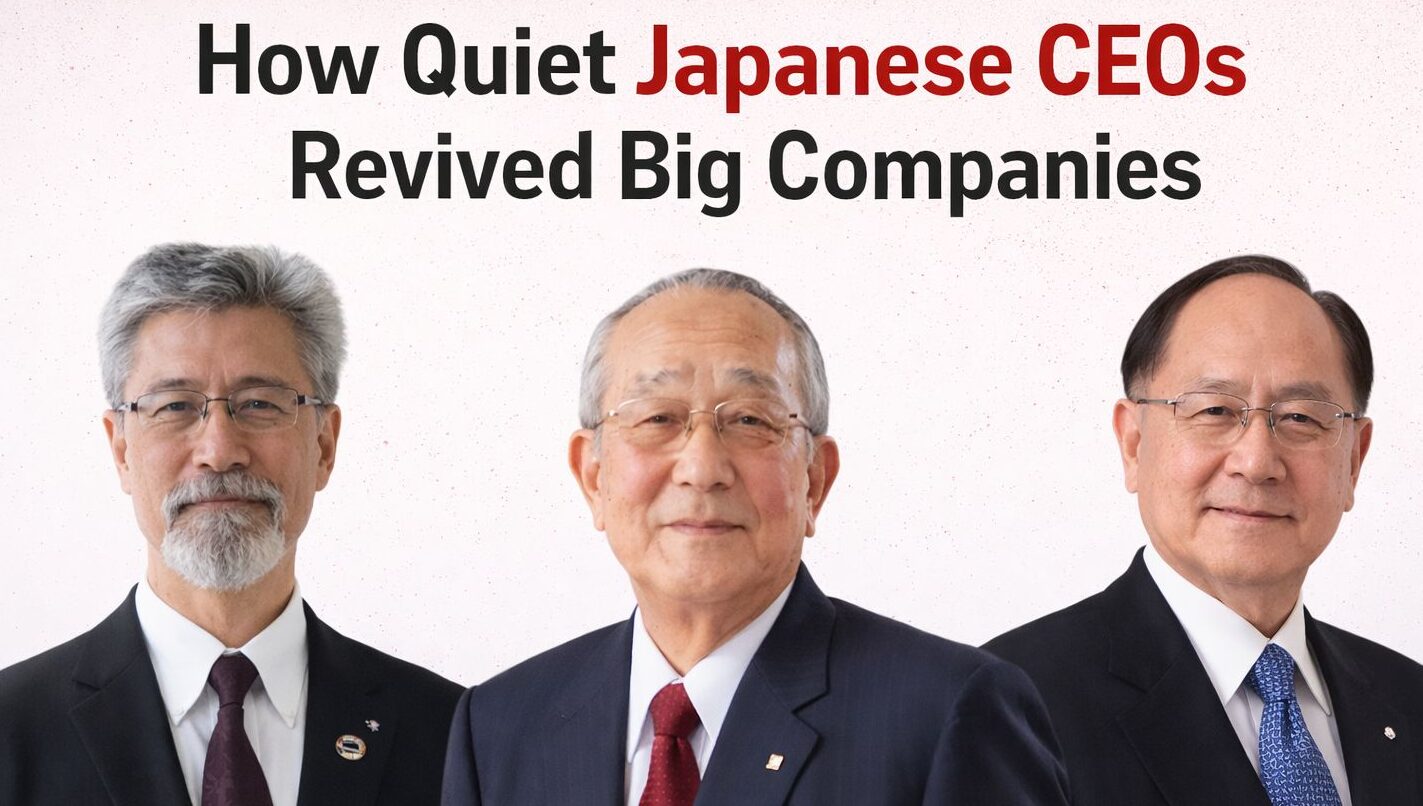
There’s a certain kind of business story that doesn’t hit the front page but quietly reshapes entire industries. In Japan, where long‑term thinking and careful execution are prized more than flashy announcements, some of the most remarkable corporate turnarounds happened under leaders who preferred results over publicity. This is the story of how a Buddhist monk revitalised a bankrupt airline, how a steady strategist shaped a global camera giant, and how a fresh leader is steering Japan’s most famous convenience store operator through pressure and change.
The Monk Who Saved Japan Airlines
Japan Airlines (JAL) wasn’t always on solid footing. After years of expansion in unrelated businesses and a burst economic bubble, the airline slipped into seven straight years of losses in the 1990s and early 2000s. By 2010, JAL had filed for bankruptcy protection, making it one of the largest corporate failures in Japan outside the financial sector. The company had more than ¥2 trillion in debt and was bleeding money as it struggled to adapt to global competition and economic shocks, including the aftereffects of 9/11 and SARS.
In stepped Kazuo Inamori, a 77‑year‑old founder of Kyocera and an ordained Buddhist monk with no aviation experience. At first glance, he was an unlikely candidate to save an airline. But his approach wasn’t about flying innovation or marketing sparkle. It was about culture and clarity.Inamori introduced what he called the Amoeba management system, a way of breaking the organization into small business units that were responsible for their own profitability and figures. This was a sharp departure from JAL’s previous bureaucratic model, where decisions were slow and accountability was diffused. He shifted power closer to the people doing the work and made sure everyone understood how their part contributed to the whole.
He also led by example, taking no salary at JAL and making empathy a core value. Inamori believed that if people could see their leader was personally invested in the company’s success, they’d rise to the moment. The impact was dramatic. Within two years, JAL went from bankruptcy to being recognised as one of the most profitable major airlines in the world. It was relisted on the Tokyo Stock Exchange in 2012 in one of the biggest IPOs of the year.Inamori’s philosophy was less about quick fixes and more about instilling confidence across the entire workforce. That focus on people, purpose, and profit working together was what turned a failing giant into a renewed force in aviation.
Fujio Mitarai and Canon’s Steady Transformation
Canon is now known worldwide for its cameras, printers, and imaging solutions. Yet its rise into a dominant tech company wasn’t a product of aggressive headlines; it was solid strategy over decades.
Fujio Mitarai, who became Canon’s CEO, blended Japanese management principles with a willingness to adopt effective Western business ideas. He took time to understand each division’s strengths, reined in inefficiencies, and focused innovation on areas where Canon could win globally. By doing so, Canon improved profitability and expanded its reach in consumer and business markets.
Mitarai didn’t chase flashy product launches. Instead, he strengthened the company’s underlying operational discipline while encouraging thoughtful risk‑taking. Under his leadership, Canon’s balance sheet, product quality, and global reputation improved steadily. The result was a business that could hold its own on strategy and performance without relying on short‑term bursts of attention.
Stephen Dacus and a New Chapter for Seven & i Holdings
Not all turnaround stories are about bankruptcy or crisis. Some are about evolution and responding to pressure from investors and the market. Seven & i Holdings, best known as the parent of 7‑Eleven convenience stores, is a Japanese retail icon with more than 80,000 outlets worldwide. In recent years, it faced investor criticism and even a near-hostile takeover bid of about $47 billion. Instead of accepting the bid, the company chose to strengthen itself from within.
In March 2025, Seven & i appointed Stephen Hayes Dacus as its first foreign CEO, giving him the mandate to overhaul the business and fend off takeover pressure. Dacus had previously worked with Walmart and Fast Retailing and brought a fresh, global perspective to a company used to traditional Japanese corporate governance.
Under Dacus’s leadership, Seven & I announced major strategic moves. The company agreed to sell its underperforming supermarket and speciality store units and return around ¥2 trillion in cash to shareholders through share buybacks and dividends. It also plans to pursue an IPO for its North American 7‑Eleven business, aiming to unlock value that the market had not fully recognised.Dacus’s leadership isn’t about flashy fixes either. It’s about strategic simplification, focus on core strengths, and shareholder value creation. He is maintaining a majority stake in the North American unit and steering the company through a rapidly shifting global retail landscape.
Also Read: Biographica Secures Fresh Seed Capital
Why Their Approach Works
What connects these leaders, Inamori, Mitarai, and Dacus, is their focus on substance over style. They didn’t seek headlines or temporary applause. Instead, they looked at the hard questions, listened to their people, and made disciplined choices that strengthened their companies from the inside out.
In a world where CEOs often feel pressured to chase quarterly headlines and short‑term spikes in stock prices, these Japanese examples show that deep resilience often comes from steady leadership, cultural clarity, and a human sense of purpose. Whether it’s reviving a bankrupt airline, guiding a global tech company, or defending a beloved retail brand, these leaders prove that results can speak louder than press releases.