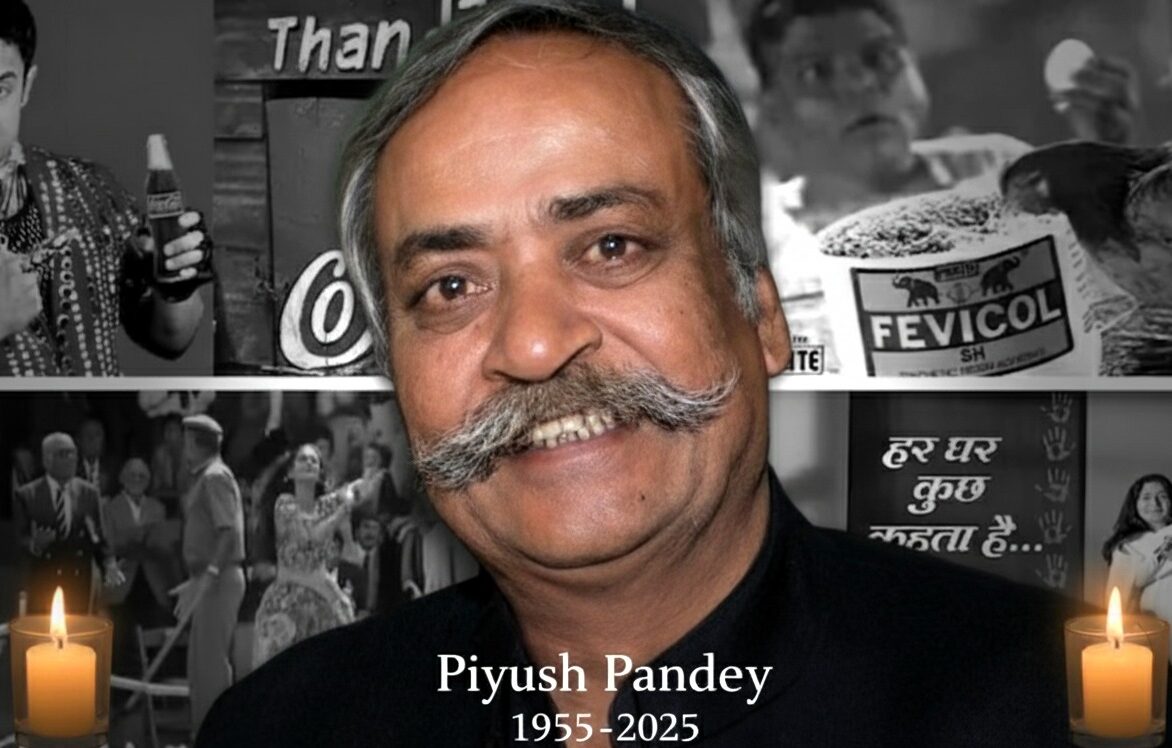
India has lost its advertising conscience. Piyush Pandey, the man who taught brands to speak the country’s language, passed away on Friday at the age of 70. For more than four decades, Pandey transformed Ogilvy & Mather India from an agency into an institution, and gave Indian advertising its most authentic voice.
Piyush Pandey: The Adman Who Made India Feel Seen
Before Pandey, most ads looked outward, polished, urban, borrowed. He turned the camera back home. His commercials smelled of dust and festivals, echoed with street sounds, and celebrated middle-class aspirations without condescension. In his work, humor met heart, and brands became companions rather than commodities.
His philosophy was simple yet profound: “Talk to people, not consumers.”
Moments That Became Memory
“Kuch Khaas Hai” – Cadbury Dairy Milk
A young woman running onto a cricket field to dance with abandon, Pandey’s 1993 masterpiece broke gender stereotypes and made chocolate about unfiltered joy. The line “Kuch Khaas Hai” became an emotion, not a slogan.
“Mazboot Jod” – Fevicol
A wooden bench packed with passengers, a bus that never falls apart, Pandey found poetry in glue. Fevicol’s rustic humor made the brand part of everyday vocabulary, and India smiled each time something “Fevicol-strong” refused to budge.
“Har Ghar Kuch Kehta Hai” – Asian Paints
He humanized paint. Homes were not products of color charts; they were living diaries. Pandey’s storytelling made renovation a reflection of life itself.
The Pug and the Boy – Hutch/Vodafone
A little dog following a boy across lanes and lawns was all it took to explain network reliability. The campaign, tender and wordless, gave telecommunication a heart.
The ZooZoos – Vodafone
Later came the white, balloon-limbed ZooZoos, oddballs that spoke no language but reached every age. Pandey showed that simplicity could outwit spectacle.
“Do Boond Zindagi Ke” – Pulse Polio
When he lent his creativity to a government cause, India listened. With Amitabh Bachchan’s voice and Pandey’s emotional clarity, the campaign became a national movement that saved lives.
His Grammar Was Human
Pandey’s genius was not in artifice but in understanding people. He mined humor from daily chaos, emotion from ordinariness. His casting was natural; his music hummable; his Hindi, conversational and confident.
He erased the line between the “English-speaking India” and the one that dreamt in Bhojpuri, Tamil, or Marathi, proving that good storytelling speaks every tongue.
The Man Beyond the Boardroom
Off-camera, colleagues described him as disarmingly informal, a mentor who laughed loudly, wrote by instinct, and never treated a brief as sacred. Under his leadership, Ogilvy India became a talent nursery that blended intuition with craft.
His twin loves, cricket and creativity, often collided in metaphors. “An idea should feel like a sixer,” he once said, spontaneous yet rooted in practice.
A Voice That Still Echoes
Even as agencies evolve with algorithms and AI, Pandey’s work remains a reminder: emotion cannot be automated. His ads are still quoted in weddings, memes, and memories, proof that the strongest bond between brand and audience is empathy.
He leaves behind not just campaigns, but a country that learned to see itself in them.
Piyush Pandey is gone.
But in every bus that refuses to break, in every wall that tells a story, and in every child who still hums an old jingle, his voice endures, steady, smiling, unmistakably Indian.
Also Read: Who Coined “Abki Baar Modi Sarkar”: The Inside Story from BJP’s 2014 War Room