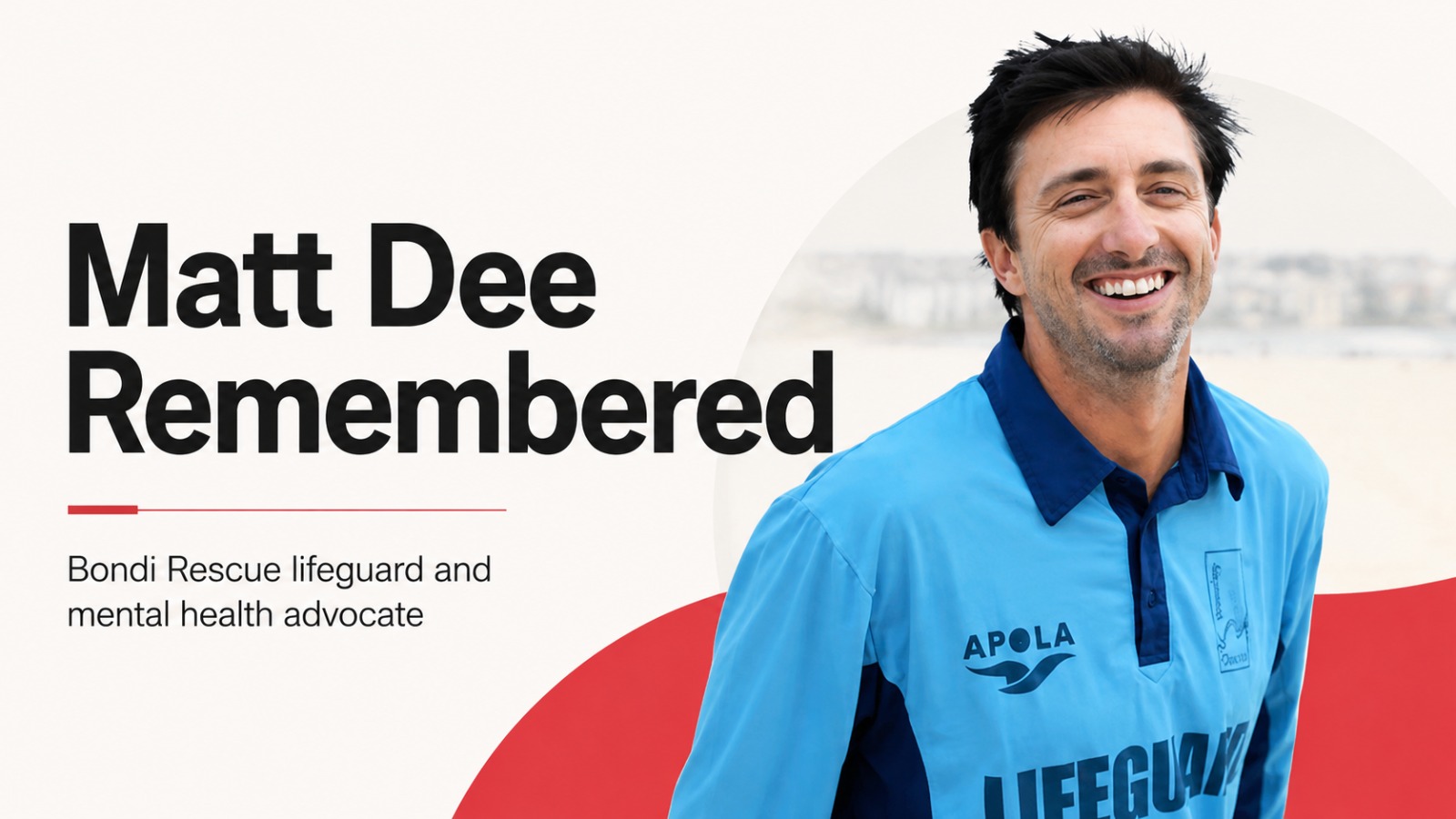
Former Bondi Rescue lifeguard and mental health advocate Matt Dee has died, prompting tributes to a man whose public life stretched well beyond the Sydney beach where millions of viewers came to know him.
Dee’s death was announced on Wednesday by FTW Revolution, the clothing and events venture he co-founded. The organisation said he had “touched the lives of many” and would be deeply missed by those who knew and loved him. Funeral arrangements were still being finalised. His cause of death has not been publicly confirmed.
For television audiences, Dee was one of the recognisable faces of Bondi Rescue. He appeared on the Australian reality series from 2008 until 2017, giving him an association with the show that lasted close to a decade.
But the work that increasingly defined him away from television began in a far more personal place.
Before Bondi, there was Melbourne, Torquay and the surf
Dee grew up in a close family raised by a single mother in Melbourne. The family would holiday in Torquay, where the siblings learned to surf.
That connection to the water would eventually lead Dee into the world of lifeguarding and onto Bondi Rescue, but his later advocacy was shaped by devastating loss within his own family.
His younger sister Rachel Bridger Dee died aged 30 in December 2009 after living with schizophrenia for about a decade. His older brother Jonathan, who had bipolar disorder, had died months earlier at the age of 34.
In a 2011 interview with The Sun-Herald, Dee spoke about the way he viewed their illnesses and deaths.
“What happened was not their fault,” he said.
“They did their best to manage their illnesses. It wasn’t their fault. They had a problem inside their heads. It’s something we don’t understand. How would we know what it’s like?”
That experience became an important part of the work Dee pursued in the years that followed.
Building something for people who might never make the call
Dee co-founded FTW Revolution as a clothing and events brand with a suicide-prevention purpose, particularly aimed at young Australians. He later became an ambassador for Suicide Prevention Australia. FTW Revolution said it had raised at least $500,000 for the organisation.
What made the project distinctive was its attempt to speak to people who might not feel comfortable approaching conventional mental health services.
Australian big-wave surfer Justen “Jughead” Allport described that approach in 2015, saying Dee wanted FTW to provide a point of connection for young people who would otherwise stay outside the usual support networks.
“Matty just wanted kids that were down, that were from poor backgrounds, to connect with something that could help them,” Allport said.
“Matt’s just trying to be an alternative for the people who aren’t gonna ring Lifeline. Matt and FTW are about turning negatives into positives.”
It was a message Dee delivered in his own blunt style.
Writing about FTW Revolution on LinkedIn, he described the group as representing “the underdogs in the trenches, the battlers in the dark places” and used the platform to demand greater action on suicide prevention.
That language captured an important part of Dee’s public persona. His advocacy did not sound like a polished institutional campaign. It drew heavily on the language of mateship, surfing, struggle and people who felt overlooked.
He was also an ambassador for the Schizophrenia Research Institute, another connection between his public work and the illness his sister had lived with.
A life remembered for more than television
Following the announcement of his death, tributes appeared beneath FTW Revolution’s post, including a message from the official Bondi Lifeguards account and former lifeguard Trent Maxwell, who wrote, “rest easy brother”.
Other messages remembered Dee not simply as a television personality but for his humour, his friendships and the causes he backed.
One tribute described him as a favourite lifeguard whose work away from the show had deepened that admiration. Another remembered his “humour” and “heroism”, while a longtime friend recalled surfing with Dee growing up and said he had “lived life to the fullest”.
That distinction matters when looking back at Dee’s life.
Bondi Rescue gave him a national platform. His years on the program put his face in homes around Australia and beyond. But Dee used that visibility for something much less glamorous: talking openly about mental illness, grief and people who could easily slip beyond the reach of established support systems.
FTW Revolution said funeral details would be released once arrangements were finalised and thanked people for the messages and tributes sent following the announcement.
The organisation also directed people affected by the news towards mental health support services, reflecting the work Dee had spent years championing.
Also Read: JioHotstar Goes Global With Launch in UK, Canada and Singapore