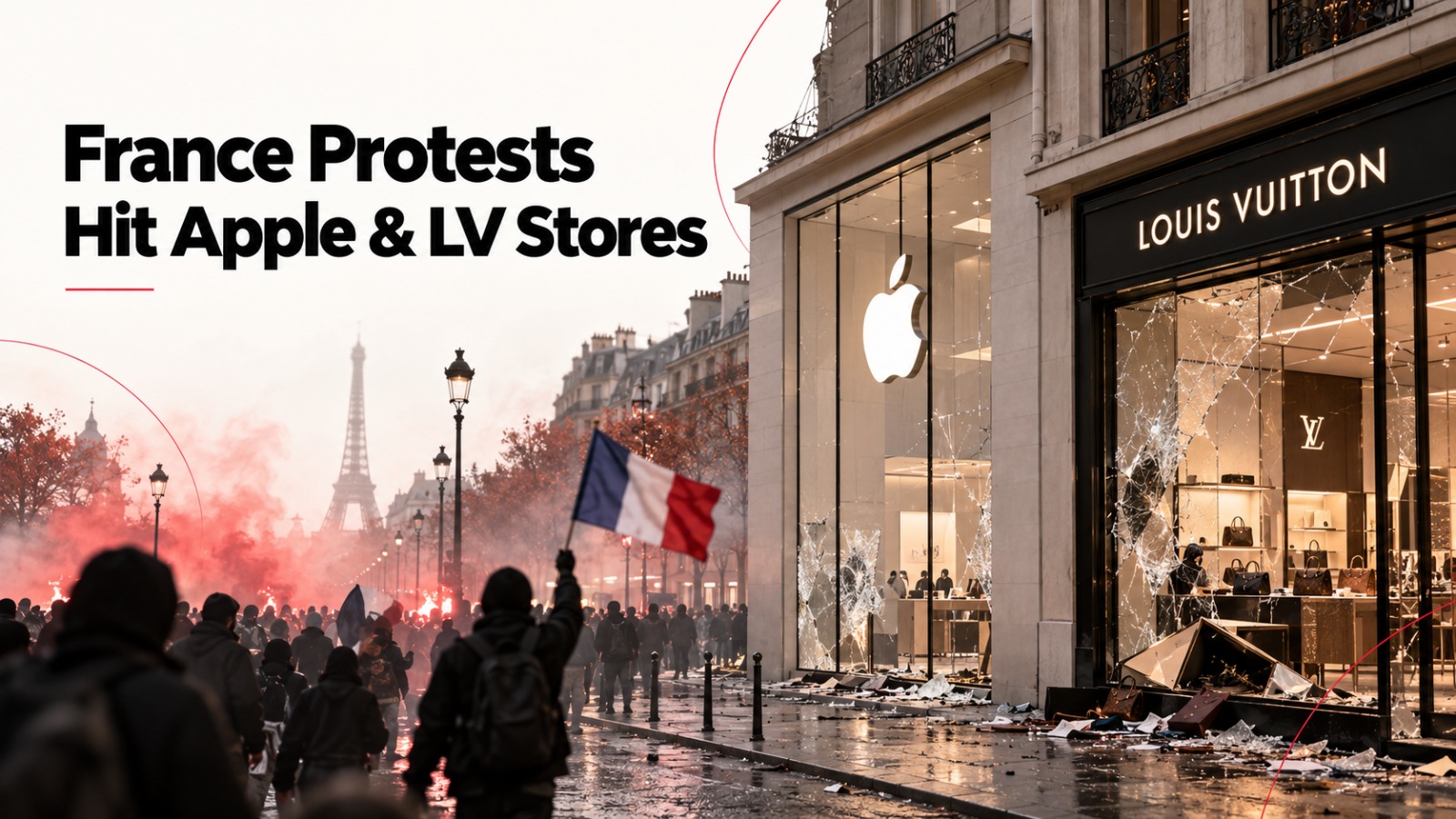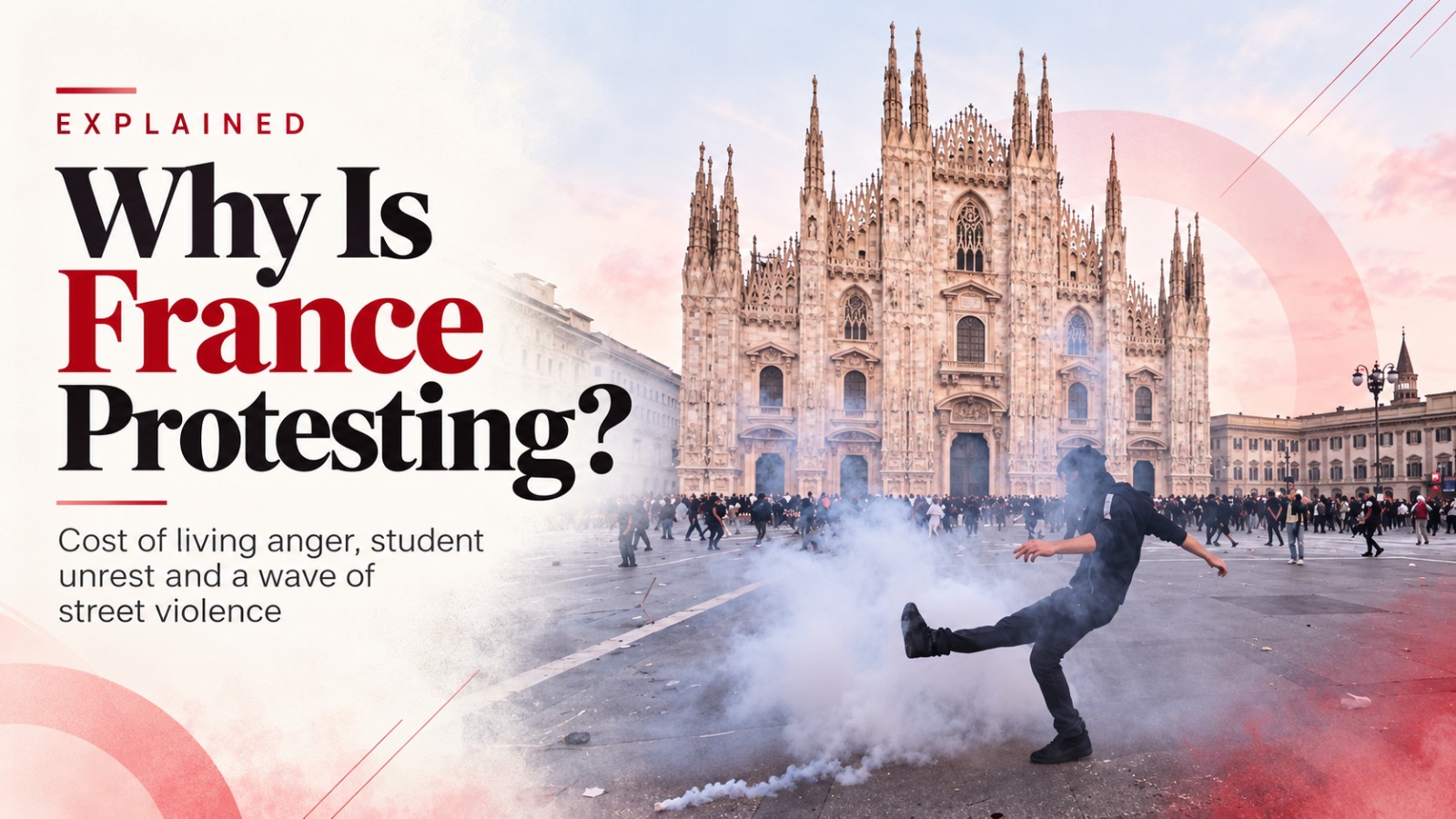
France is witnessing massive protests over rising living costs, problems in schools and dissatisfaction with public services. What began as demonstrations over everyday concerns has now turned violent in several cities, with historic buildings damaged, luxury stores looted and hundreds arrested.
France is back on the streets, and this time the anger goes far beyond one issue.
More than 550,000 people joined demonstrations across the country on Saturday, October 17, according to France’s Interior Ministry. Labour union CGT put the number much higher, at 800,000.
Thousands came out to raise concerns about the rising cost of everyday life, the condition of schools and the quality of public services. But as demonstrations spread, violence broke out in several cities. Shops were looted, vehicles were set on fire, police clashed with masked groups and a historic town hall in Limoges was largely destroyed by flames.
The protests have also drawn attention beyond France, with similar demonstrations taking place in Belgium, Italy and Portugal.
But why exactly are people protesting in France, who is behind the demonstrations, and how did they turn so violent?
Why are people protesting in France?
The simplest answer is that many people are unhappy with how expensive everyday life has become and how public services are functioning.
Food, fuel and energy prices are among the major concerns. Protesters are also raising questions about government spending, education and what opportunities young people will have after completing their studies.
There is no single demand bringing everyone onto the streets. Different groups have joined the demonstrations for different reasons, although many of their complaints overlap.
For working people, the concern is the cost of living. For students, it is the condition of their schools and their future. Labour unions have raised questions about public spending and essential services.
Together, these issues have brought different sections of French society into the same wave of protests.
What do students have to do with the protests?
Students were protesting even before Saturday’s nationwide demonstrations.
High school students in France have been holding protests for more than three weeks over classroom conditions, teacher absences and university admissions.
Their complaints are not just about what happens inside classrooms. There are also concerns about what comes after school, including uncertainty over future opportunities.
The student movement has attracted considerable public support. A Cluster 17 poll published on October 11 found that around 57% of French people supported the students’ protests.
The French government has promised to consider their complaints, although significant increases in education spending remain difficult.
These demonstrations helped build the atmosphere of dissatisfaction that was already present when larger protests took place on Saturday.
Who is organising the protests in France?
One important thing to understand is that the demonstrations are not being led by a single organisation.
Students, labour unions and supporters of the Yellow Vests movement are among those taking part.
The Yellow Vests, also known as Gilets Jaunes, first emerged as a major protest movement in 2018. Their demonstrations were initially driven by opposition to a proposed fuel tax increase under President Emmanuel Macron.
The issue particularly affected rural and working-class people who depended on their vehicles for everyday travel.
Although the movement later lost momentum, it never completely disappeared.
Now, some Yellow Vests activists are trying to revive it amid renewed frustration over living costs.
Interestingly, the call for Saturday’s demonstrations was initially suggested by a TikTok creator without a clear political agenda, according to reporting attributed to Bloomberg. Yellow Vests activists subsequently sought to use the opportunity to mobilise supporters again.
Labour unions, including the CGT, also planned to participate, focusing on living costs and public spending.
This helps explain why the protests have grown so large. People with different concerns have found a common reason to demonstrate.
How did peaceful protests turn into riots?
Not everyone who joined the demonstrations was involved in violence.
Many marches remained peaceful. However, masked groups clashed with police and attacked shops, vehicles and public buildings in several cities.
In Paris, groups smashed shop windows, ransacked supermarkets and jewellery stores, and threw fireworks, paving stones and other objects at police officers.
Police responded with tear gas and water cannon.
The unrest was not limited to the capital.
In Marseille, protesters damaged shops and municipal facilities. In Lyon, a tourist office was set on fire. Government buildings and police facilities were also targeted in other parts of the country.
French Interior Minister Laurent Nunez blamed masked groups he described as radical far-left troublemakers for some of the attacks on public buildings.
The distinction matters because the violence occurred alongside much larger demonstrations involving people protesting over economic and social concerns.
Why was the historic Limoges Town Hall set on fire?
One of the most disturbing incidents took place in Limoges, where a historic town hall was largely destroyed by fire.
The building’s construction began in 1873, and it was inaugurated in 1883. Having survived both World Wars, it had stood for more than 140 years.
According to witness accounts, masked individuals first set a police vehicle on fire outside the town hall before smashing windows and entering the building.
A fire subsequently spread through the historic structure. Firefighters were deployed late on Saturday to bring the blaze under control.
A regional official described the destruction as a “catastrophe for heritage” and condemned it as a deliberate act.
The fire became one of the most widely discussed incidents of the unrest, raising questions about how demonstrations over public concerns had escalated into attacks on historic landmarks.
Why were Louis Vuitton, Rolex and other luxury stores looted?
Alongside government buildings, several well-known retail brands became targets of looting.
Stores associated with Louis Vuitton, Hermès, Rolex and Apple were among the businesses reportedly attacked.
In Bordeaux, looters broke into shops along Rue Sainte-Catherine, a major shopping street, with Apple and Louis Vuitton among the brands affected.
An Apple store in Lille was also looted, while a Hermès boutique and a Rolex store in Marseille were among the reported targets.
The attacks drew attention because they involved some of the world’s most recognisable luxury brands.
However, the available reporting does not establish that these stores were targeted as part of an organised campaign against wealth or luxury goods. They were among a wider range of businesses damaged during the unrest.
How many people have been arrested in France?
The scale of Saturday’s demonstrations was significant.
550,000
Protesters estimated by the Interior Ministry
800,000
Turnout estimated by CGT union
1,200
Arrests reported by the prime minister
150
Police officers reported injured
Figures reported following the October 17 demonstrations. The competing turnout estimates reflect different assessments by authorities and the labour union.
The Interior Ministry said demonstrations took place in 110 marches nationwide.
French Prime Minister Sébastien Lecornu confirmed that 1,200 people had been arrested and 150 police officers injured.
Another serious incident was reported in Saint-Étienne, where a young protester lost a hand during Saturday’s demonstrations.
Authorities opened an investigation into the injury. Interior Minister Laurent Nunez declined to confirm reports suggesting that a police grenade caused it.
The circumstances of that injury therefore remain unresolved in the available reporting.
What has Emmanuel Macron said about the violence?
French President Emmanuel Macron has condemned the attacks on public property, government buildings and businesses.
He warned that those responsible for vandalism, looting and attacks on administrative offices would be prosecuted and punished.
The government faces two separate challenges. It must respond to the concerns that brought hundreds of thousands onto the streets while also dealing with the violence that followed.
The protests come at a politically sensitive moment, with France approaching a presidential election in roughly six months.
Questions over living costs, education and public spending are therefore likely to remain part of the political debate.
Why is JD Vance blaming immigration for France’s unrest?
The protests have also triggered a political response from the United States.
US Vice President JD Vance reacted to footage of the Limoges Town Hall fire by criticising European immigration policies.
In a post on X, Vance accused Western liberals of encouraging mass immigration without adequately addressing questions of assimilation and compatibility.
He also warned Americans that they should pay attention to the violence unfolding in France.
However, Vance’s comments are a political interpretation of the unrest, not an established explanation for why the demonstrations began.
The reported demands of the protesters centre on rising living costs, education, public services and government spending. The available evidence does not establish immigration as the cause of the demonstrations or identify the immigration status of those responsible for the violence.
Is the anger spreading beyond France?
France is not the only European country experiencing demonstrations over economic pressures.
On the same Saturday, protesters also took to the streets in Belgium, Italy and Portugal, although the demonstrations were separate and not part of a single coordinated movement.
In Portugal, tens of thousands demonstrated against rising living costs, low wages and difficulty finding affordable housing.
In Belgium, police used tear gas and water cannon during clashes with demonstrators in Brussels.
In Italy, protests over rising living costs and wars turned violent in Milan, where masked individuals clashed with police and property was damaged.
Alberto Alemanno, a professor of EU law and policy at HEC Paris, described France as the “epicentre” of the current wave of unrest and suggested that similar grievances were emerging elsewhere in Europe.
The protests have different local causes, but they share concerns about economic pressures, education and future opportunities.
What happens next in France?
For now, the larger question is whether the French government can address the frustration driving the demonstrations.
The violence has created an immediate law-and-order challenge, but the issues that brought people onto the streets have not disappeared.
Students continue to have concerns about schools. Workers are questioning the cost of living. Labour unions are pressing the government over public spending and services.
The coming months will show whether these groups can sustain their protests and whether the government can find a response that satisfies them.
At its heart, the unrest is about everyday problems that many people feel have not been adequately addressed.
The fires, looting and clashes have dominated the headlines. But the bigger story is why so many people in France were willing to come out and protest in the first place.
Also Read: Tesla Opens Roadster Bookings in India at ₹50 Lakh, Adds Free Model Y L Boost