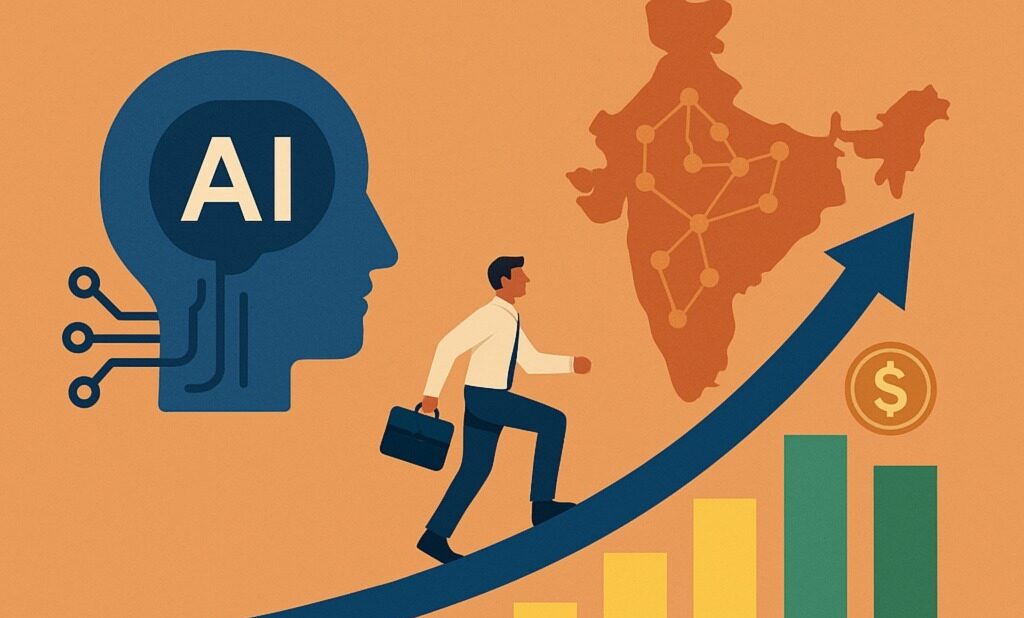
India’s entrepreneurial landscape has undergone a remarkable transformation in less than a decade. From a modest start in 2016, the country has now emerged as the third-largest startup ecosystem in the world, powered by Artificial Intelligence (AI) and digital innovation.
According to the Department for Promotion of Industry and Internal Trade (DPIIT), the number of officially recognized startups in India has soared from around 500 in 2016 to over 1.8 lakh (180,000) by June 2025. This massive leap reflects more than just business growth, it marks the rise of a new mindset where creativity, risk-taking, and technology drive national progress.
From Numbers to Impact
The startup boom is about more than quantity, it’s about transformation. Since the launch of the Startup India initiative, these ventures have:
- Created over 16.6 lakh direct jobs, contributing significantly to youth employment.
- Attracted billions in domestic and foreign investment.
- Paved the way for greater inclusion, with many startups founded in Tier-II and Tier-III cities.
AI has amplified this impact by giving entrepreneurs the ability to solve local challenges through intelligent, data-driven tools, making innovation both accessible and scalable.
The AI Boom: From Code to Catalyst
Artificial Intelligence has evolved from a niche concept into the driving engine of India’s startup renaissance. A NASSCOM report highlights that:
- The number of Generative AI (GenAI) startups grew from 66 in early 2023 to over 240 by mid-2024, a 260% increase in just one year.
- These AI-driven ventures have collectively raised more than USD 750 million in funding.
Startups are using AI as the core enabler across various industries. The examples range from AI-powered healthcare diagnostics and personalized learning platforms to smart agriculture and predictive financial tools.
Artificial intelligence has gone a long way from being a mere buzzword. It is now the main driver of change that is fundamentally altering India’s way of building, learning, and competing on the global stage.
Also Read: Neulife Secures $1 Million to Power Protein Innovation
Democratizing Entrepreneurship
One of the major influences AI has had is its power to equalize opportunities among entrepreneurs. A small team from a small town can now go head to head with big players from all over the world, inventions like these have made it possible:
- Affordable cloud computing and scalable digital infrastructure.
- Open-source AI frameworks that reduce entry barriers.
- AI tools that automate tasks, personalize customer experiences, and optimize operations.
Sectors like healthtech, agritech, and education are seeing rapid innovation, where smart algorithms address real-world challenges unique to India.
The Government’s Invisible Hand
Behind this transformation lies a decade of supportive public policy. The Startup India initiative, launched in 2016, laid the groundwork through:
- Tax exemptions and easier business registration processes.
- Seed-funding schemes to support early-stage ventures.
- Innovation hubs and incubators that mentor startups across the country.
Combined with India’s booming digital infrastructure and affordable internet, these measures have built one of the world’s most dynamic startup ecosystems.
Innovation Spreads Its Wings
Innovation is no longer confined to Bengaluru, Mumbai, or Delhi NCR. Tier-II and Tier-III cities such as Indore, Jaipur, Kochi, and Coimbatore are witnessing a surge in entrepreneurial activity.
This decentralization is crucial, it ensures that India’s innovation story is inclusive, geographically diverse, and culturally rooted, tapping into regional talent and solving local problems with global potential.
From Service Providers to AI Pioneers
For decades, India was known primarily as an IT outsourcing hub. That narrative is changing. Startups today are creating products, not just offering services.
- AI ventures are building solutions in natural language processing for Indian languages.
- Enterprise startups are developing automation platforms that power global clients.
- Deep-tech founders are working on data analytics and robotics innovations aimed at both domestic and international markets.
India is transitioning from being a participant in the global tech race to being a trailblazer shaping the next AI era.
Challenges on the Horizon
The journey, however, is not without hurdles.
- Scalability and sustainability remain issues for early-stage startups.
- India still trails the U.S. and China in patent filings, deep-tech R&D, and AI research output.
- Many startups face funding constraints beyond seed rounds and rely heavily on replication rather than original innovation.
To sustain growth, the ecosystem must focus on research depth, long-term business models, and nurturing advanced AI talent.
From Dreamers to Global Leaders
Despite challenges, India’s momentum is undeniable. If current trends continue, the nation is projected to have over 2.4 lakh startups by 2030, and the number of unicorns could rise from about 120 today to nearly 280.
AI has done more than fuel this transformation, it has redefined India’s global identity. What was once a nation of dreamers has become a community of doers, thinkers, and innovators.
The foundation for a new era of intelligent entrepreneurship is firmly in place. The next step is clear: scale globally, sustain innovation, and lead boldly in the age of AI.
Also Read: This Indian Startup Is Quietly Disrupting the ₹12,000-Crore Protein Industry