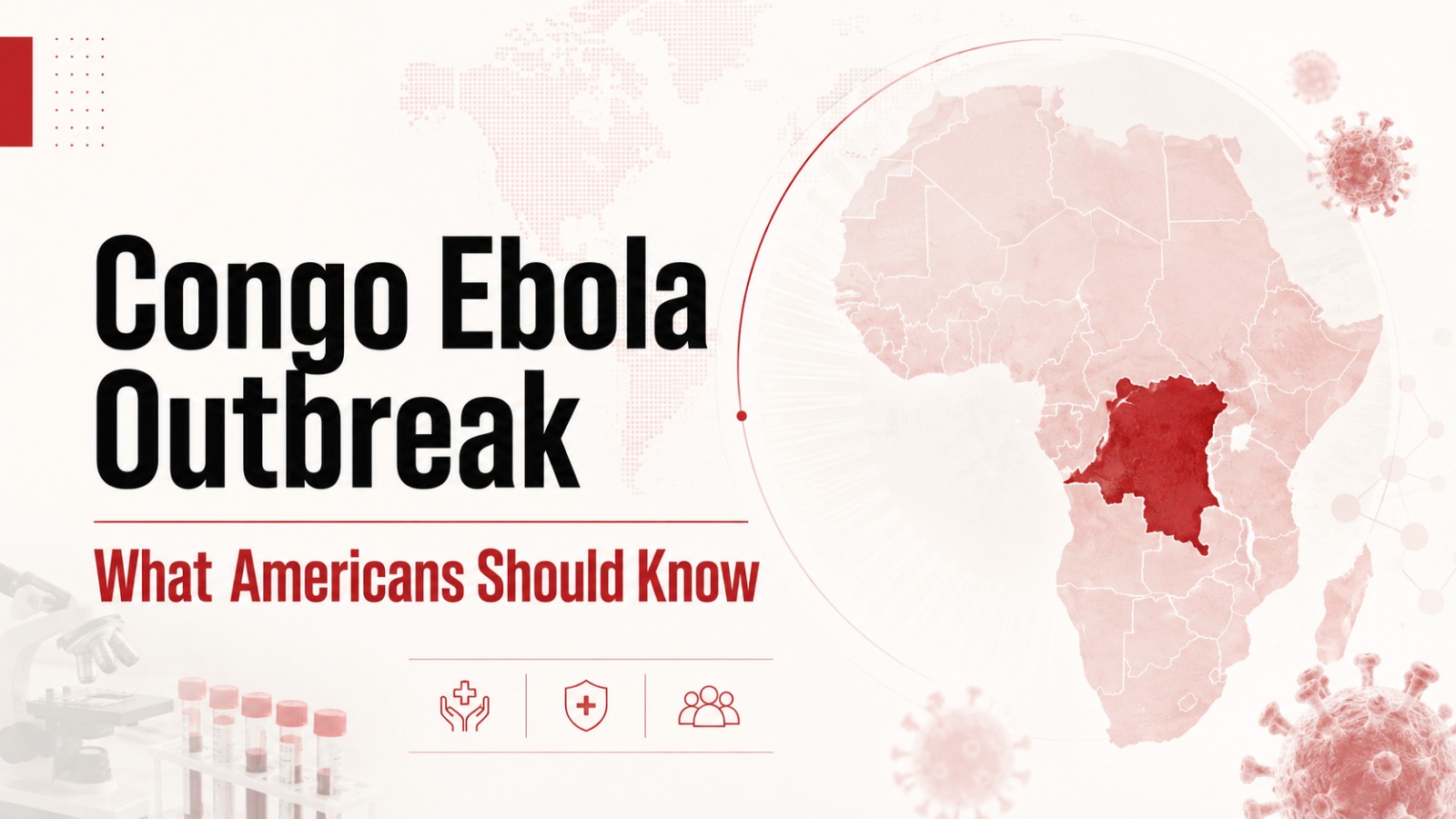
The Ebola outbreak tearing through eastern Democratic Republic of Congo is no longer just another flare-up in a country that has dealt with the virus before.
More than 2,000 people have died. Associated Press reporting puts the number of cases at more than 4,300, while government data cited by Fox News Digital gives a more precise figure of 4,381 confirmed cases.
What makes the situation especially worrying is not only the scale. It is the speed.
The World Health Organization says the outbreak is moving rapidly enough that, if the current pace continues, it could eventually surpass the West African Ebola epidemic of 2014 to 2016, which killed more than 11,000 people among more than 28,000 cases.
There is another detail that helps explain why health teams are struggling to catch up. The outbreak was officially declared on May 15, 2026, but sequencing later showed that it had apparently been spreading since February.
That early, largely unseen period gave the virus valuable time.
Why is this Ebola outbreak different?
The virus behind the current outbreak is Bundibugyo ebolavirus, a comparatively rare form of Ebola that presents a different medical challenge from the Zaire strain associated with the major West African epidemic.
Treatments and vaccines were successfully used against the Zaire strain, but the Bundibugyo virus circulating in Congo is genetically different.
There are currently no approved vaccines or treatments specifically for disease caused by Bundibugyo virus. The effectiveness of previously approved Ebola therapeutics against it has also not been established.
That distinction matters because health authorities are confronting a rapidly expanding outbreak without the same established medical tools available for some previous Ebola responses.
Researchers are evaluating new treatments and vaccine candidates. Emerging approaches, including mRNA technology, are also being explored as possible ways of developing vaccines directed at the Bundibugyo strain.
For now, however, the outbreak is moving faster than the response.
Why has the virus been so difficult to contain?
There is no single explanation.
The outbreak is unfolding in parts of eastern Congo where health workers are operating under several pressures at once.
Conflict in and around affected areas has made access difficult. Poor infrastructure and inadequately equipped health facilities have further complicated the response. Many new infections and deaths are being recorded in communities that health teams struggle to reach.
Some health workers have also gone on strike over unpaid wages.
At the same time, misinformation and suspicion of outsiders have discouraged some people from seeking treatment at clinics.
These problems directly affect the basic work required to contain Ebola. Health teams need to identify infected people, trace their contacts, isolate cases and reach communities quickly. When roads, security conditions, staffing problems or public mistrust interrupt that process, the virus gains more room to spread.
David Wohl, a professor of medicine in the Division of Infectious Diseases at the University of North Carolina at Chapel Hill, described the combination of conditions as a “perfect storm.”
He also pointed to the size of the communities involved. This is not an outbreak confined to a tiny settlement. Cases have been emerging around population centres numbering in the hundreds of thousands.
Has Ebola spread beyond Congo?
The main burden remains in Congo, but the outbreak has already produced an international dimension.
Fox News Digital reported earlier cross-border cases in Uganda. The affected area of eastern Congo is also close to Uganda, Rwanda and South Sudan.
That geography makes effective surveillance especially important. An outbreak does not need to become widespread in neighbouring countries for cross-border movement to complicate tracing and containment.
International agencies, including the WHO and the U.S. Centers for Disease Control and Prevention, are continuing to follow developments in the region.
Could this become the deadliest Ebola outbreak ever?
The WHO believes that is now a possibility if the outbreak continues at its present pace.
WHO Director-General Tedros Adhanom Ghebreyesus said the trajectory could eventually take the outbreak beyond the West African epidemic of 2014 to 2016.
That does not mean such an outcome is inevitable.
It means the current growth pattern is serious enough for the world’s leading international health agency to make the comparison.
The timing of the outbreak has added to the concern. By the time authorities formally declared it in May, sequencing indicated that transmission had already been underway since February.
Tedros has characterised the response as being forced to catch up with an outbreak that had already built a substantial lead.
How long could the outbreak continue?
There is no fixed end date.
Dr. Abdirahman Mahamud, WHO’s director for health emergency alert and response operations, said the agency expects the outbreak to reach its peak in about six months under what he described as the moderate scenario.
He also said there is a scenario in which the outbreak could continue for nine to 12 months.
Those projections underline how much depends on what happens next. Reaching communities, improving surveillance, supporting healthcare workers and developing effective medical countermeasures could all influence the course of the crisis.
What does the outbreak mean for Americans?
Ebola transmission requires close physical contact with bodily fluids from a severely ill or deceased infected person, Wohl explained. He stressed that it does not spread across a room through the air in the way an airborne respiratory infection can.
The experience of the 2014 West African outbreak also provides useful context.
Although more than 28,000 people were infected during that epidemic, four Ebola cases were diagnosed in the United States. Two were imported cases, while two nurses contracted the virus while caring for an infected patient in Dallas, according to the CDC information cited by Fox News Digital.
Other patients who had been diagnosed overseas were medically evacuated to the United States for treatment.
For Americans, the more immediate Ebola-related concern is therefore not widespread domestic transmission. Greater risk may fall on healthcare workers travelling to affected areas to assist with containment and treatment.
Why the coming months matter
The central problem in Congo is a race between the virus and the response.
Health authorities are dealing with an outbreak that appears to have circulated for months before its formal declaration, is occurring in communities that can be difficult to reach and involves an Ebola virus for which there are no approved strain-specific vaccines or treatments.
The numbers are already severe. More than 2,000 deaths have been recorded. The case count has crossed 4,300, with government figures cited separately placing confirmed infections at 4,381.
But the most important number may eventually be the one that shows whether the curve begins to slow.
The WHO’s warning that the outbreak could surpass the catastrophe of 2014 to 2016 is a projection based on its present pace, not a declaration that history has already repeated itself.
What happens next will depend heavily on whether health teams can close the head start the virus gained before the alarm was raised.
Also Read: iPhone 18 Pro Max Rumours: What Else Could Apple Announce at September Event?