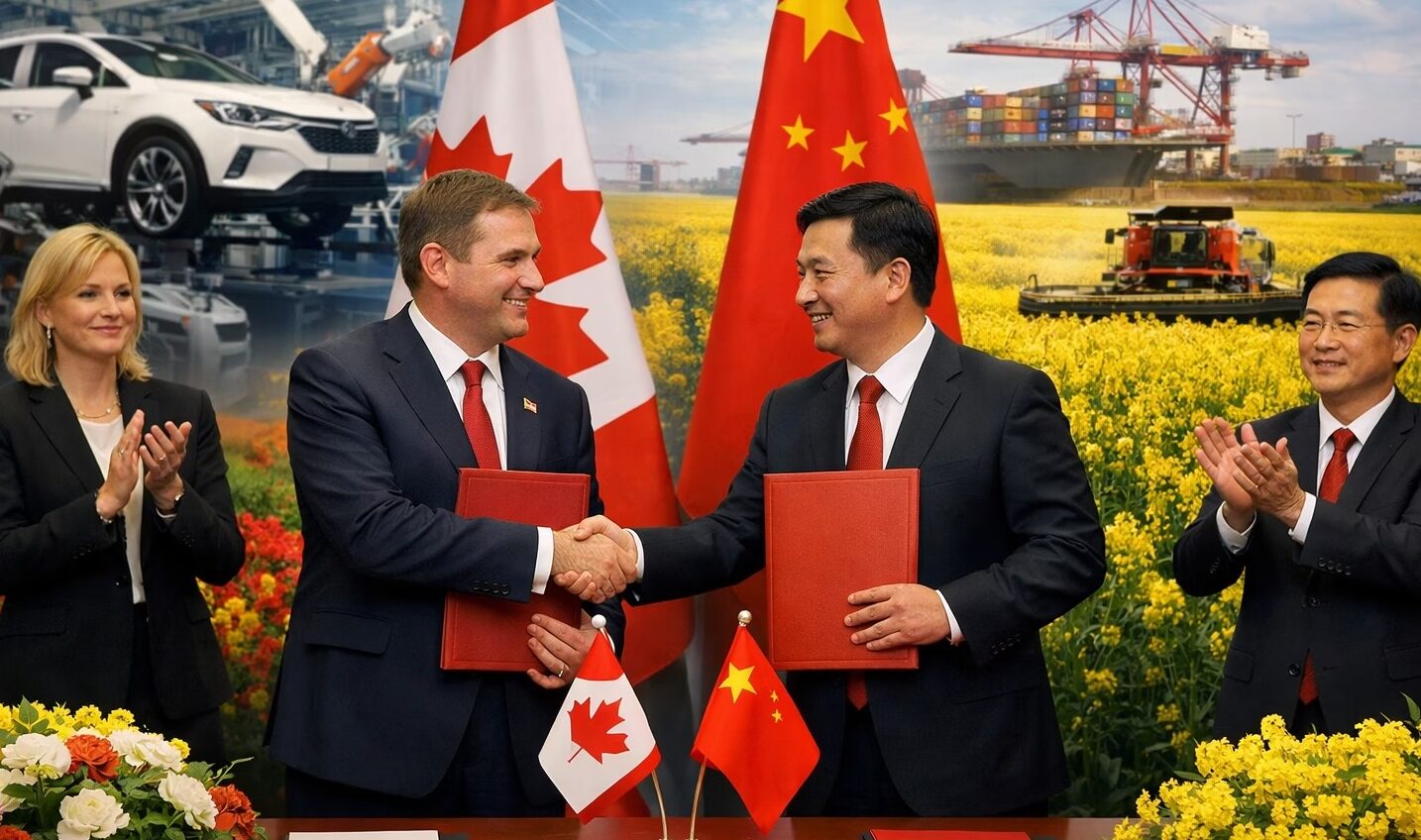
The Canada-China trade reset has emerged as one of the most consequential economic developments of early 2026, as Canada and China agreed to cut tariffs on electric vehicles (EVs) and canola. The decision marks a clear departure from years of strained trade relations and signals a renewed focus on economic pragmatism at a time of mounting global uncertainty.
The Canada-China trade reset comes as governments worldwide confront slowing growth, lingering inflation pressures, and fragile supply chains. By easing tariffs in two strategically important sectors, clean transportation and agriculture, both countries appear to be prioritizing economic stability over prolonged trade confrontation.
Canada-China Trade Reset Revives a High-Value Economic Relationship
Economically, the reset carries considerable weight. Canada-China bilateral trade already exceeds USD 100 billion annually, making China one of Canada’s largest trading partners. However, previous tariff hikes and regulatory restrictions had disrupted trade flows, particularly in agriculture. Canola exports, once valued at USD 4-5 billion per year, were among the worst affected, placing financial strain on Canadian farmers and increasing market volatility.
With the Canada-China trade reset, Ottawa is seeking to restore access to a vital export destination, especially for prairie provinces heavily dependent on canola production. For Beijing, reduced tariffs ensure a stable supply of agricultural commodities that play a crucial role in food processing and price control.
“This agreement reflects a return to economic rationality,” said a senior Asia-Pacific trade economist. “Trade normalization in essential goods reduces inflationary pressure and strengthens supply chain resilience.”
Also Read: EtherealX Secures $20.5 Million to Advance Reusable Launch Vehicle Program
EV Tariff Cuts Highlight Green Transition Priorities
The Canada-China trade reset is equally significant in the electric vehicle sector. China currently accounts for over 60% of global EV production, supported by large-scale manufacturing, advanced battery technology, and competitive pricing. Lower tariffs on Chinese EVs could make electric vehicles more affordable for Canadian consumers, potentially accelerating Canada’s clean-energy transition.
At a time when many advanced economies are struggling to balance climate commitments with consumer affordability, tariff relief on EVs may help reduce costs while boosting adoption rates. Analysts note that increased competition could also stimulate innovation in North America’s EV ecosystem.
“Cheaper EV imports support climate goals while easing cost pressures on households,” said a clean-energy policy analyst based in Toronto. “That makes the Canada–China trade reset particularly timely.”
Global Growth Risks Push Trade De-Escalation
The broader global context further explains the timing of the Canada-China trade reset. Institutions such as the International Monetary Fund and the World Bank have repeatedly warned that deepening trade fragmentation could reduce global GDP by up to two percent in the medium term.
Against this backdrop, the Canada-China agreement reflects a wider trend toward selective trade de-escalation, particularly in sectors linked to food security, inflation management, and climate transition. Rather than dismantling all trade barriers, governments are increasingly reopening economically critical channels while maintaining strategic safeguards elsewhere.
Economic Realism Shapes the Next Phase of Canada-China Ties
For Canada’s agricultural sector, even partial tariff relief could unlock billions of dollars in renewed export revenues, stabilizing farm incomes and reducing vulnerability to global price swings. Market reaction has been cautiously positive, with analysts pointing to improved sentiment across agriculture, EV supply chains, and cross-border manufacturing.
Officials from both sides have indicated that the Canada-China trade reset could pave the way for further discussions on clean technology cooperation, agri-processing, and investment facilitation. While implementation details are still awaited, the direction of policy signals a willingness to rebuild economic trust incrementally.
Ultimately, the Canada-China trade reset represents more than a narrow tariff adjustment. It underscores a growing recognition that, in an era of global volatility, economic realism and selective cooperation may offer a more sustainable path to growth than prolonged trade conflict.
Also Read: Highest Grossing Bollywood Films: The Hindi Box Office Club That Rewrote the Record Books