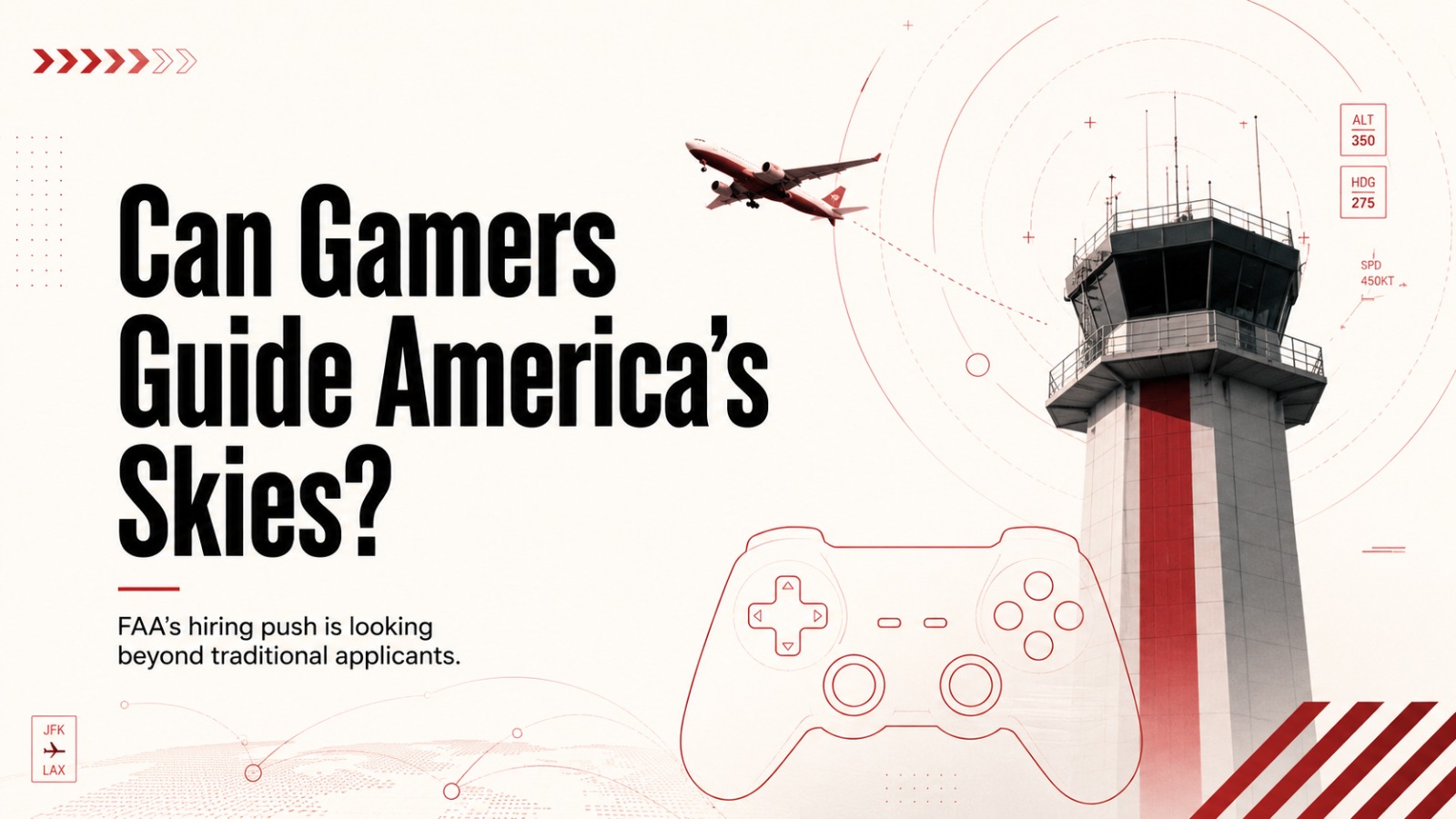
For years, spending hours with a controller in hand was more likely to be treated as a distraction from a career than a route towards one. The Federal Aviation Administration (FAA) is now testing a very different idea.
An FAA recruitment campaign launched in April specifically sought the attention of video gamers as the agency looked for new ways to attract people to air traffic control. The response was substantial. According to US Transportation Secretary Sean Duffy, 12,350 people applied to join the country’s air traffic controller ranks during the mid-April recruitment period.
By August, Duffy said more than 2,000 people had been hired.
That combination has produced an irresistible headline: gamers are becoming air traffic controllers.
The reality is more interesting, and considerably less reckless, than that wording suggests.
The FAA is not allowing people to guide aircraft simply because they are good at video games. Gaming was used as a recruiting hook to reach potential candidates who might possess relevant abilities or who might never previously have considered air traffic control as a career.
Applicants still have to make it through the FAA’s selection and training system before they can become qualified controllers.
In other words, gaming may get someone thinking about the control tower. It does not give them the keys to it.
Why did the FAA go looking for gamers?
Air traffic control demands an unusual mix of concentration, speed and judgement.
Controllers must keep track of aircraft, communicate with pilots and handle multiple pieces of information while conditions around them continue to change. The FAA’s recruitment approach has focused attention on whether some abilities associated with gaming could make certain players worth bringing into the applicant pool.
Among the skills highlighted are rapid information processing, sustained concentration, quick decision-making, spatial awareness and the ability to manage several tasks at once.
Anyone who has played a demanding strategy or multiplayer game will recognise the basic idea. A player may have to monitor different moving elements, react to changes and make decisions without losing sight of the larger situation.
But the comparison ends there.
A bad decision in a game can mean losing a match. Air traffic control is a safety-critical profession involving real aircraft, real crews and real passengers. Gaming experience may offer a reason to recruit someone. It cannot replace professional training or the standards expected of a controller.
That distinction matters because the most sensational interpretation of the FAA campaign is also the least accurate one.
The 2,000 figure needs context
Duffy said more than 2,000 people had been hired following the recruitment push. He also said the FAA had reached 94% of its hiring goal in what he described as the fastest time the agency had reached that target.
There is an important qualification.
The available information does not establish that every one of those hires is a video gamer, nor that gaming was the reason each person was selected. The April campaign targeted gamers, but it formed part of a wider effort to increase the number of people entering the air traffic control pipeline.
So the story is not that the FAA suddenly hired 2,000 people because they play games.
It is that an agency trying to expand its controller workforce deliberately advertised the career to an unconventional audience, drew 12,350 applications during the April window and subsequently reported more than 2,000 hires.
That is a more useful measure of what the experiment is actually trying to accomplish.
A recruitment problem bigger than gaming
The gamer campaign also makes more sense when viewed alongside the FAA’s broader workforce plans.
In May, the agency released an Air Traffic Controller Workforce Plan focused on accelerating hiring, improving controller efficiency and modernising the National Airspace System.
FAA Administrator Bryan Bedford said the agency was changing the way it hires, trains and schedules its controller workforce while providing updated tools for the job.
The recruitment push is therefore not a standalone gaming experiment. It sits inside a larger attempt to rethink how the FAA brings people into air traffic control and prepares them for the work.
That effort has also been accompanied by investment in infrastructure. More than $835 million was committed to modernising air traffic control facilities, including the replacement of eight ageing control towers and upgrades at 41 airports across 24 states.
People and infrastructure are different parts of the same challenge. New technology and modern facilities still require trained professionals capable of operating within the system.
Do air traffic controllers need traditional academic backgrounds?
One of the more revealing details in the recruitment discussion is how little the profession fits the conventional degree-first view of employment.
The FAA has said that only about 25% of controllers hold a traditional college degree.
That helps explain why targeting gamers is not necessarily as unusual as it first sounds.
Air traffic control is specialised work. What matters is whether an applicant has the aptitude to enter the system, complete the required training and eventually perform to the standards demanded by the job.
Seen from that perspective, the gaming campaign is less about turning a hobby into a professional qualification and more about widening the front door.
Someone with strong concentration, spatial awareness or an ability to manage rapidly changing information may never have pictured themselves working in aviation. An advertisement speaking directly to gamers can put the profession in front of precisely that kind of person.
The FAA can then decide through its normal screening and training process whether that applicant is suitable.
Can gaming really prepare someone for air traffic control?
Not by itself.
There is a temptation to turn this story into a debate over whether video games can train someone to manage aircraft. That is not what the recruitment campaign proves.
The FAA has pointed to feedback from departing controllers who said gaming had helped them develop abilities such as thinking quickly, remaining focused and managing complexity.
That is an interesting observation, but it does not establish that gamers automatically make better air traffic controllers.
The meaningful test comes after recruitment.
How many candidates successfully complete training? How many obtain the necessary certifications? How well do they perform once qualified? How many remain in the profession?
Those outcomes will say far more about the value of the campaign than the number of gaming hours on an applicant’s résumé.
From gaming headset to aviation headset?
Perhaps that is the most interesting part of the FAA’s experiment.
Modern careers do not always begin in places that look like training grounds.
Skills can develop through jobs, education, hobbies or environments that were never designed as professional preparation. The FAA’s campaign appears to be asking whether some people who have spent years navigating complex virtual environments could have abilities worth testing in a much more demanding real-world profession.
The agency is not replacing aviation training with gaming.
It is changing where it looks for people who might be capable of completing that training.
For passengers, that difference is important. Nobody earns responsibility for aircraft because they mastered a console or built an impressive gaming record. Candidates still have to prove themselves through the FAA’s process.
The experiment will ultimately be judged not by how many gamers notice the advertisements, but by how many capable controllers emerge from the larger pool of applicants.
With 12,350 people applying during the April recruitment period and more than 2,000 hires later reported, the campaign has already demonstrated one thing: an unconventional message can attract serious attention to a highly specialised career.
Whether it produces the controllers the FAA needs is the question that comes next.
Also Read: Selena Gomez Wondermind Lawsuit: Investors Seek Recovery of Nearly $1.2 Million