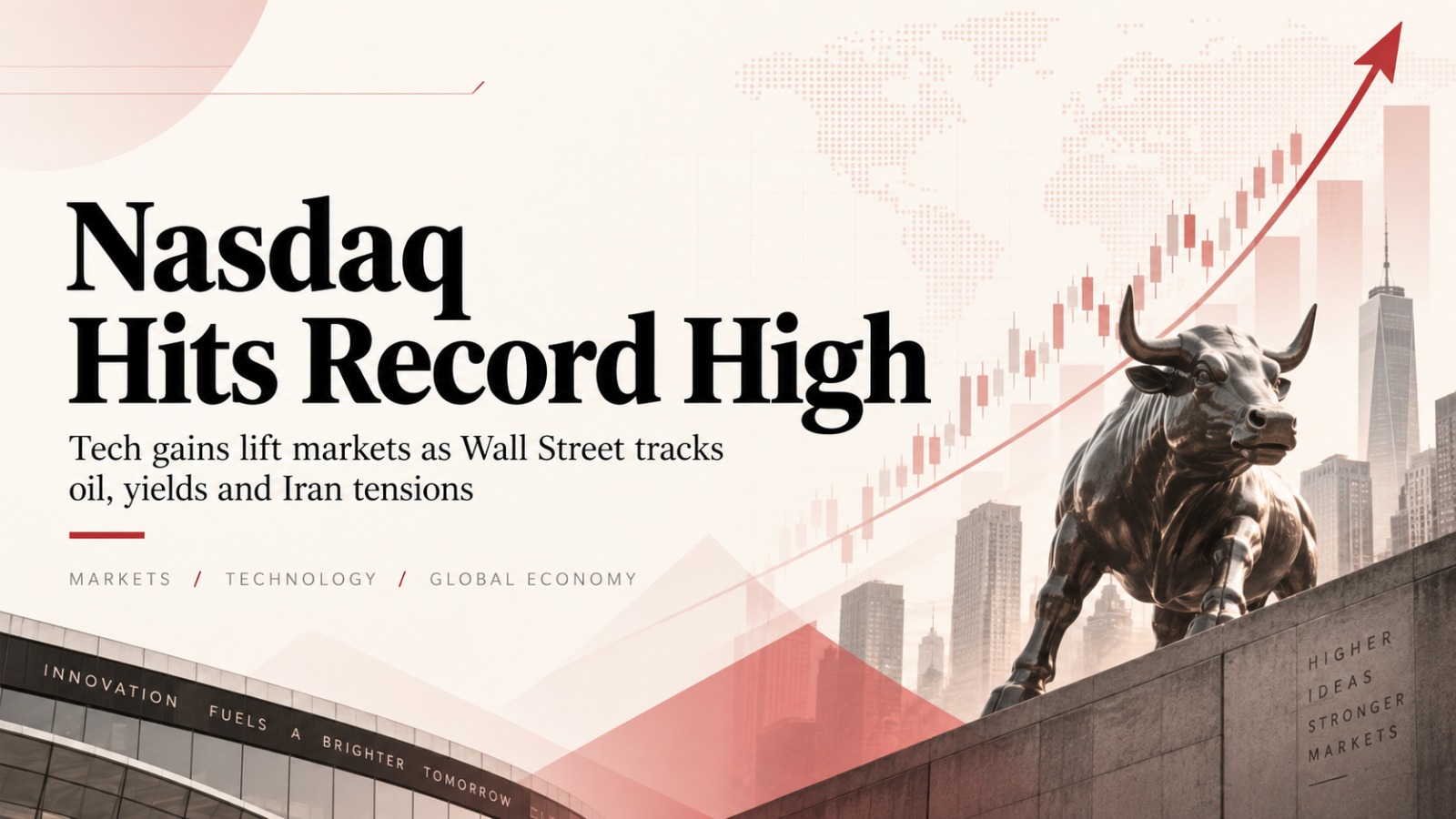
Wall Street turned increasingly uneven on Tuesday as technology shares pushed the Nasdaq Composite to a fresh all-time high, while the S&P 500 struggled for direction and the Dow slipped. Investors were balancing another burst of AI-related optimism against oil prices, elevated Treasury yields and developments involving the United States and Iran.
The Nasdaq Composite climbed to a new intraday record on September 22, rising as high as 27,250.92 during morning trade. It was the index’s first intraday record since June 1 and followed its first record close since June 2 in the previous session.
The technology-heavy Nasdaq was last up about 0.2%, helped in part by a roughly 4% rise in Sandisk. The S&P 500 hovered around the flatline, while the Dow Jones Industrial Average was down around 270 points, or 0.5%, at the time of the update.
That divergence captured the mood of the session: enthusiasm around technology and artificial intelligence remained strong, but investors were far from ignoring the risks building elsewhere.
Sandisk adds fuel to Nasdaq’s record run
Sandisk became one of the notable contributors to Tuesday’s technology strength after Rosenblatt initiated coverage of the data-storage company with a buy rating.
The investment firm put a $2,400 price target on the stock, representing 36% upside from Monday’s close. Analyst Kevin Cassidy argued that new AI computing platforms were making NAND flash memory more important to the wider infrastructure behind artificial intelligence.
The call added another AI-linked name to a market already being heavily influenced by spending on computing infrastructure, chips and data centres.
Alibaba offered another example earlier in the day. Its shares rose around 3% in Hong Kong after the company introduced its Zhenwu V900 AI chip and outlined plans to expand Alibaba Cloud’s global data-centre capacity to more than 20 gigawatts by 2032. Alibaba said the V900 delivers three times the performance of its Zhenwu M890 chip released in May.
Taiwan’s Taiex also touched a record intraday high of 48,601.53, with technology stocks among the main drivers. MediaTek gained 7.88%, Delta Electronics rose 2.67% and TSMC advanced 0.40%.
Oil and Iran remain central to the market
Markets remained sensitive to developments involving the U.S. and Iran, particularly because of their potential impact on energy supplies and inflation.
President Donald Trump, speaking at the United Nations General Assembly on Tuesday, said he had a “big decision” to make over whether to pursue an agreement with Iran or take military action. He also said he believed a deal could come after the U.S. midterm election.
Oil prices showed relatively limited movement following the comments. Brent crude futures were up less than 1% at roughly $100 a barrel, while U.S. crude futures traded below 1% higher at around $96.
Earlier in the day, oil had fallen following reports that Iran had offered to reopen the Strait of Hormuz within seven days if the U.S. moved toward de-escalation. The report had not been independently confirmed by CNBC.
Expectations around the Strait have already been influencing equities, oil and bond markets, making traders highly responsive to any suggestion of a change in regional tensions.
Treasury yields remain close to a key level
The U.S. 10-year Treasury yield was trading at 4.974%, putting it close to the psychologically important 5% level. The move comes after the Federal Reserve raised its key interest rate by a quarter percentage point the previous week, with yields also being pressured by concerns around debt, oil prices and persistent inflation.
RBC Wealth Management senior portfolio strategist Tom Garretson said markets may not have fully accounted for what another rate-hike cycle combined with higher yields could mean. He also pointed to the possibility of the 10-year yield moving above 5% and further Federal Reserve increases extending into early 2027.
That leaves equity investors facing an unusual combination: record levels in parts of the stock market alongside borrowing costs that remain elevated.
Shopify, Viking Therapeutics and Grab among the day’s big movers
Individual stocks produced some of Tuesday’s sharpest moves.
Shopify shares gained nearly 7% after the company announced it would work with Meta’s personal AI agent, Muse, to introduce agentic checkout through Shop Pay. The stock was on course for a two-day rise of more than 15%.
Viking Therapeutics surged 31% after releasing results from a study of its diabetes and obesity drug VK2735. Patients taking the treatment lost between 16% and 19% of their body weight after 21 weeks. The drug targets the same hormone receptors as Eli Lilly’s Zepbound and Mounjaro.
Lennar rose more than 4% after Berkshire Hathaway disclosed a purchase of more than 2.7 million shares. Amgen gained more than 3% following positive Phase 3 results for dazodalibep, while Grab Holdings climbed more than 7% after CEO Anthony Tan disclosed that he had recently bought 10.4 million shares.
Capri Holdings also advanced after a report suggested that potential buyers had examined the company’s financials, although the report indicated that any transaction was unlikely in the near term.
A record high, but not a broad-based rally
One detail beneath the headline numbers gives Tuesday’s record a more complicated backdrop.
During Monday’s rally, more S&P 500 stocks fell to fresh 52-week lows than climbed to 52-week highs, even though the benchmark itself was less than 1% from an all-time high.
According to SentimenTrader founder Jason Goepfert, cited in the supplied market coverage, the previous occasion when the S&P 500 gained at least 1%, finished within 1% of a new 52-week high and still had new lows outnumbering new highs was in December 1999.
That does not determine where stocks go next, but it illustrates how much of the market’s strength has been concentrated in particular names and sectors.
For now, technology remains capable of pushing the Nasdaq into record territory. The broader market, however, is having to digest oil near $100, a 10-year Treasury yield approaching 5%, geopolitical uncertainty and another round of major diplomatic discussions still ahead.
Investors will also be watching the planned Washington meeting between Trump and Chinese leader Xi Jinping, with artificial intelligence, tariffs, rare-earth metals and the Iran conflict expected to feature in the discussions.
Also Read: Samsung Galaxy S27 Ultra May Get a 5,700mAh Battery Without a Bigger Body