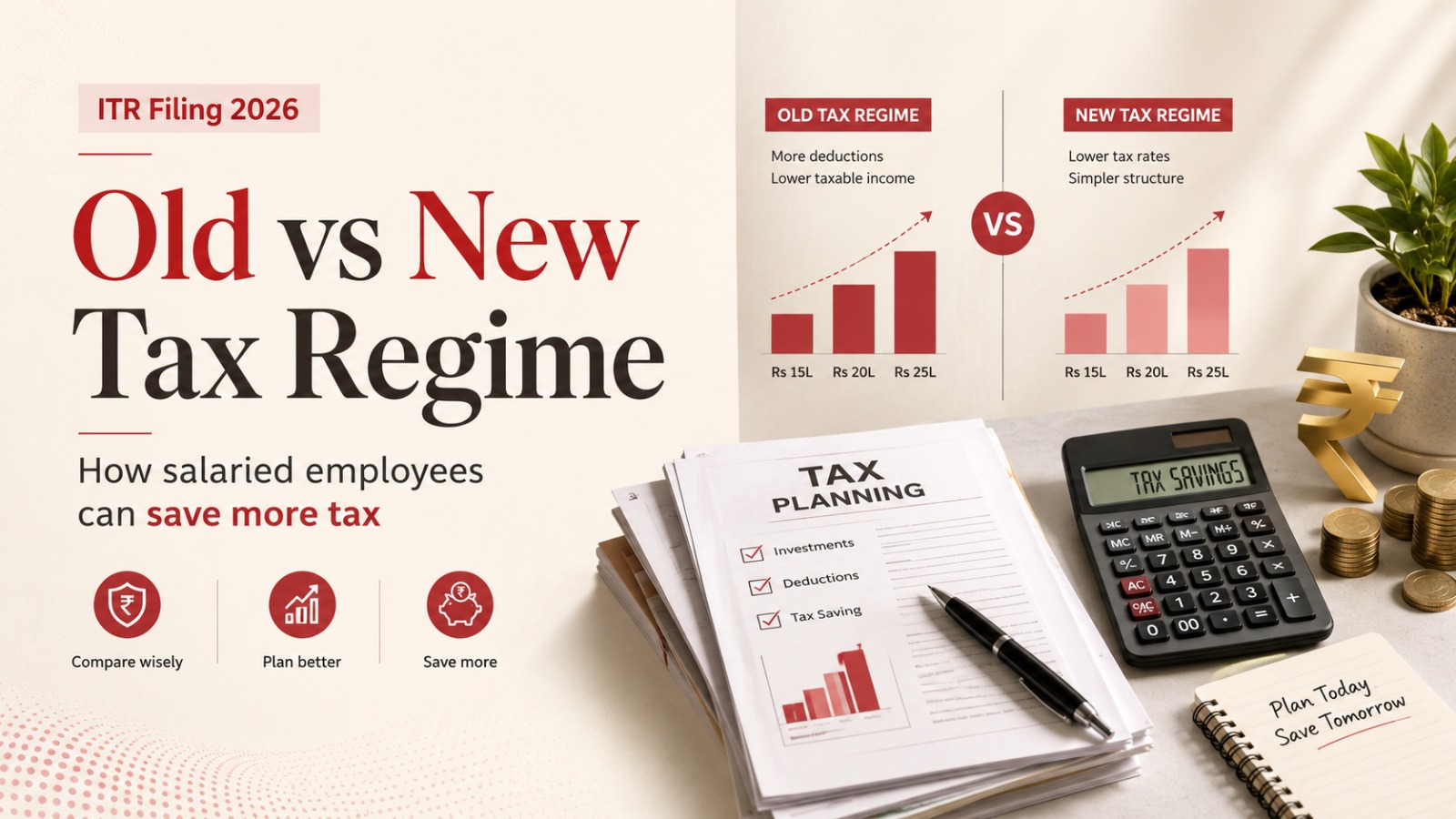
ITR Filing 2026: Illustrative calculations show the new tax regime producing savings of up to Rs 1.17 lakh at a Rs 25 lakh salary. Yet taxpayers with large HRA, home-loan and investment deductions may still find the old regime more rewarding.
ITR FIling 2026: Contest Between Higher Deductions And Lower Tax Rates
For salaried employees filing income tax returns for the financial year 2025-26, choosing between the old and new tax regimes is no longer a straightforward contest between higher deductions and lower tax rates.
The new regime is the default option and offers a higher standard deduction, along with comparatively lower tax liability at several income levels. The old regime, however, continues to reward taxpayers who can combine benefits such as House Rent Allowance, Section 80C investments, health insurance, National Pension System contributions and housing-loan interest.
The right choice depends less on gross salary and more on how that salary is structured.
New regime leads in illustrative salary comparisons
A comparison prepared for employees earning Rs 15 lakh, Rs 20 lakh and Rs 25 lakh considered total deductions and exemptions of Rs 4.75 lakh under the old regime.
These included:
- Rs 50,000 standard deduction
- Rs 1.5 lakh under Section 80C
- Rs 50,000 through an additional NPS contribution under Section 80CCD(1B)
- Rs 25,000 under Section 80D
- Rs 2 lakh as HRA exemption
Under the new tax regime, the calculation considered only the Rs 75,000 standard deduction. Employer contributions to NPS under Section 80CCD(2), which can also reduce taxable income under the new regime, were not included in the illustration.
The results showed a lower tax outgo under the new regime at all three salary levels.
| Annual salary | Tax under old regime | Tax under new regime | Illustrative saving |
|---|---|---|---|
| Rs 15 lakh | Rs 1,24,800 | Rs 97,500 | Rs 27,300 |
| Rs 20 lakh | Rs 2,80,800 | Rs 1,92,400 | Rs 88,400 |
| Rs 25 lakh | Rs 4,36,800 | Rs 3,19,800 | Rs 1,17,000 |
The calculations include a 4 per cent health and education cess. At a salary of Rs 25 lakh, the illustration shows the new regime reducing the tax bill by Rs 1.17 lakh despite the employee claiming Rs 4.75 lakh of deductions and exemptions under the old system.
That does not mean the new regime will be cheaper for every salaried taxpayer. A higher HRA exemption, housing-loan interest or other eligible claims can change the outcome considerably.
The old regime needs a strong deduction base
The old regime becomes competitive when the taxpayer has enough deductions to offset its higher slab rates.
For an employee earning Rs 15 lakh, the old regime may become marginally more tax-efficient when the person can claim around Rs 2 lakh under Chapter VI-A and another Rs 3.5 lakh through benefits such as HRA or eligible donations. That places the combined deduction and exemption requirement at roughly Rs 5.5 lakh in the illustration.
At higher income levels, the deductions required to beat the new regime also rise.
Employees paying substantial rent, servicing a housing loan and making full use of Section 80C, NPS and health-insurance benefits may therefore find the old regime worth retaining. Those with few eligible deductions are more likely to save under the new system.
Tax saving under the new regime has shifted to the employer
The new regime removes several popular individual deductions, but it does not eliminate tax planning. Instead, much of the opportunity now lies in employer-provided contributions, reimbursements and allowances.
One of the biggest available benefits is the employer’s contribution to the National Pension System under Section 80CCD(2). A deduction of up to 14 per cent of basic salary plus dearness allowance is available, over and above the Rs 75,000 standard deduction.
The employee’s personal NPS contribution does not receive a deduction under the new regime. This makes the employer’s role especially important when compensation packages are being designed or revised.
Employer contributions to the Employees’ Provident Fund also retain favourable tax treatment within the prescribed limits. However, when aggregate employer contributions to EPF, NPS and an approved superannuation fund exceed Rs 7.5 lakh in a financial year, the excess amount becomes taxable.
Standard deduction requires no paperwork
Salaried employees and pensioners opting for the new regime can claim a standard deduction of Rs 75,000.
The deduction is automatic. It does not require investments, bills or proof of expenditure, making it the most widely available tax benefit under the new system.
Certain employer benefits remain tax-efficient
A carefully designed salary package can reduce the taxable portion of an employee’s compensation even under the new regime.
Telephone and broadband reimbursements for official use, employer-sponsored mobile or device leasing programmes, and certain health, wellness and financial-wellness benefits may continue to receive favourable treatment, subject to the applicable conditions.
For Tax Year 2026-27, free meals and paid meal vouchers are stated to be exempt up to Rs 200 per meal. Employees should check whether these benefits are part of their company’s compensation policy and whether the required conditions are met.
Official-duty allowances continue to offer relief
Most routine allowances are taxable under the new regime, but some payments linked directly to official responsibilities remain exempt within prescribed conditions.
These include allowances for official travel, transfers, daily expenses, uniforms and transport support for specially-abled employees.
The key distinction is the purpose of the allowance. A payment connected to the performance of official duties may qualify, while a general cash allowance may not.
Let-out property interest can still be claimed, with restrictions
Interest paid on a home loan for a property that has been let out can be considered while calculating income from house property under the new regime.
There is, however, an important limitation. A loss arising under the head “Income from House Property” cannot be adjusted against income from another head under the new regime. The benefit may therefore be less flexible than many property owners expect.
Employer gifts and family pension deductions
Gifts received from an employer are tax-free up to Rs 5,000 during FY 2025-26. The exemption limit is stated to rise to Rs 15,000 from FY 2026-27.
Family pensioners under the new regime can also claim a deduction equal to the lower of one-third of the family pension received or Rs 25,000 a year.
Calculate before selecting a regime
The new regime may appear simpler, but taxpayers should not choose it merely because the slab rates are lower.
Two employees with the same annual salary can face very different tax bills depending on rent payments, housing loans, employer NPS contributions, salary benefits and eligible exemptions. A taxpayer with limited deductions may save substantially under the new regime, while another with a deduction-heavy financial profile may still come out ahead under the old one.
The safest approach is to calculate taxable income under both systems using actual figures rather than assumptions. The final decision should reflect the employee’s real salary structure, investments, insurance payments, housing costs and employer-provided benefits.
Also Read: Abhishek Sharma Net Worth 2026: Inside His ₹14 Crore IPL Earnings