

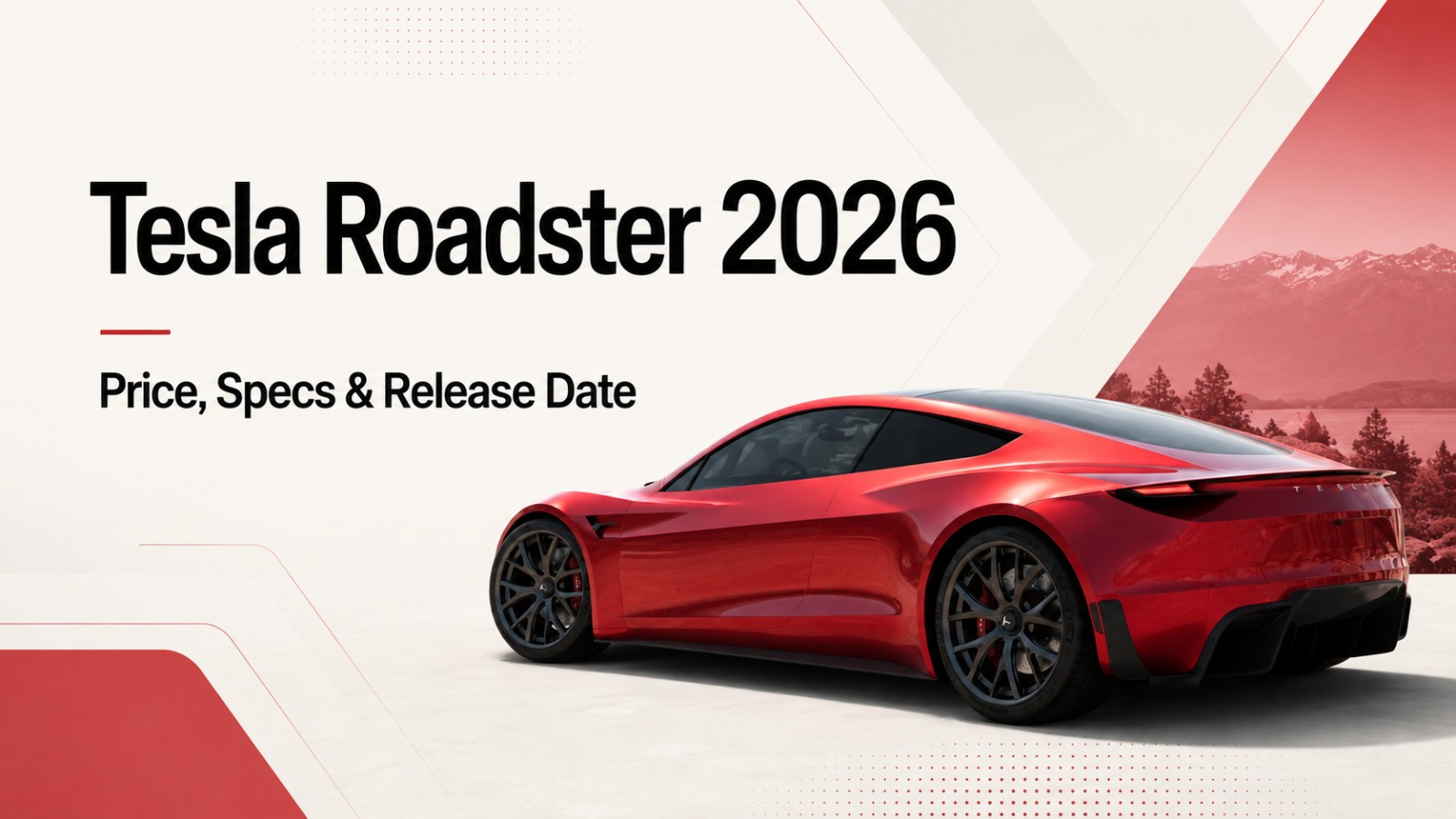
The Tesla Roadster has spent so long in development that the obvious question is no longer simply how fast it will be. It is whether Tesla can actually turn its increasingly ambitious vision into a production car.
First shown in 2017, the second-generation Roadster was originally presented as a battery-electric supercar with extraordinary acceleration, a top speed above 250 mph and enough range to make most performance EVs look short-legged. Nearly nine years later, the story has changed considerably.
Tesla is now trying to blend the Roadster with technology associated with SpaceX, including an optional system of cold-gas thrusters. That decision appears to be central to both the car’s extraordinary performance ambitions and the engineering challenge that has prolonged its development.
Tesla Roadster 2026 release date: when is it actually coming?
There is still no firm customer delivery date in the information currently available.
The clearest timeline points to a Roadster debut or demonstration in the second half of 2026, potentially as early as August. Production, however, is expected to follow in 2027.
That makes “2026 Tesla Roadster” a slightly misleading description if it is interpreted as a normal model-year launch. What Tesla appears closer to delivering in 2026 is the next major public showing of the car, not necessarily customer vehicles.
Tesla was preparing to unveil a version equipped with SpaceX-derived cold-gas thrusters capable of lifting or floating the car for a short period. That would make the event much more than a conventional new-car reveal.
It would also explain why Tesla has continued talking about the Roadster as a product demonstration rather than simply another high-performance EV.
Why has the Tesla Roadster been delayed for so long?
Tesla initially targeted 2020 for the second-generation Roadster, but that timetable slipped repeatedly.
The most useful explanation for the latest delays comes from the engineering problem created by the SpaceX component of the project.
Tesla’s VP of Vehicle Engineering, Lars Moravy, has previously described the SpaceX-related feature as one of the hardest parts of the Roadster programme. Rocket systems can justify carrying considerable propulsion hardware because of the performance they provide. In a road car, every additional component also adds mass, packaging requirements and complexity.
That creates an unusual engineering loop.
The thrusters are supposed to make the Roadster accelerate harder, brake more aggressively and corner faster. But the hardware required to provide that additional thrust also has to be carried by the car. Engineers therefore have to make the system powerful enough to justify its own weight without compromising the rest of the vehicle.
Former Tesla president Jon McNeill has also pointed to major engineering challenges involving the integration of SpaceX cold-gas thrusters. He has suggested that a demonstration might show the Roadster hovering rather than literally flying.
That technical problem is one of the most revealing details in the Roadster story. Tesla is not simply trying to make another very fast electric sports car. It is attempting to add a separate propulsion concept to a vehicle that still has to function as a car.
Will the Tesla Roadster actually fly?
“Flying” needs to be treated carefully.
The available reporting does not establish that the production Roadster will operate like an aircraft or travel through the air for meaningful distances.
What has been described is much narrower: cold-gas thrusters capable of generating enough force to potentially lift or briefly hover the vehicle.
One August report said the SpaceX-equipped Roadster could float for a short period. McNeill separately said he did not know whether the demonstration would involve flying, but believed hovering was possible.
That is a significant distinction.
A brief controlled lift during a product demonstration would be spectacular, but it would not make the Roadster a conventional flying car. Until Tesla demonstrates the technology publicly and explains exactly how the production system works, claims about sustained flight should be treated cautiously.
Tesla Roadster specs: what performance has been claimed?
The Roadster’s performance targets have evolved since the concept first appeared.
When Tesla unveiled the car in November 2017, the headline figures included:
- 0-60 mph in 1.9 seconds
- A top speed of more than 250 mph
- A quarter-mile time of 8.8 seconds
Tesla’s ambitions have since become even more extreme. Musk has said the updated Roadster has a shot at reaching 60 mph in less than one second, while describing that acceleration figure as one of the less interesting aspects of the programme.
Another Roadster overview lists an all-wheel-drive arrangement with one electric motor at the front and two at the rear, along with torque vectoring.
The important caveat is that these are targets and claims surrounding a vehicle that has not yet reached normal series production. They should not be read as independently verified production-car test results.
The same applies to the sub-one-second acceleration figure. Until a finished production-specification Roadster performs the run under independently measurable conditions, it remains an engineering target rather than a settled benchmark.
Tesla Roadster range and battery
One of the longest-standing Roadster claims is also one of its most ambitious: a 200 kWh battery pack paired with a claimed range of up to 620 miles.
If the production car reaches anything close to that figure, it would give the Roadster an unusual combination of long-distance capability and supercar-level performance.
There is an obvious tension, though. A very large battery means additional mass, while the SpaceX system introduces another set of components that also need to earn their place in the car.
That helps explain why the Roadster project is more complicated than simply installing stronger electric motors into a lightweight sports-car body.
The final battery specification, certified driving range and real-world efficiency will only become clear when Tesla reveals production-ready technical details and the vehicle undergoes official testing.
How much will the Tesla Roadster cost?
The familiar Roadster pricing remains $200,000 to $250,000, but buyers should treat those figures as announced or estimated pricing rather than assume they represent a final 2027 transaction price.
The structure previously described for the car is:
Tesla Roadster: around $200,000
Founders Series: around $250,000
Tesla has said the Founders Series would be limited to 1,000 cars.
Given how much the Roadster programme has changed since its 2017 debut, the final specification and pricing will matter more than the numbers attached to the original concept. The safest conclusion today is that the supplied coverage consistently places the car in the $200,000 to $250,000 bracket, while final production pricing has yet to be established in the material available here.
What will the Tesla Roadster interior be like?
For all the attention given to rocket thrusters and acceleration, the Roadster is still intended to retain a surprising amount of everyday-car functionality.
The concept has been shown with four seats, although the rear pair are considerably smaller than the front seats. A removable glass roof panel can be stored in the trunk, giving the car an open-top configuration without requiring a conventional folding-roof mechanism.
Another description of the cabin points to a minimalist Tesla-style layout with a large portrait-oriented touchscreen, a compact steering control and a slim centre console.
Those details make the Roadster unusual among vehicles targeting supercar performance. Tesla has not presented it purely as a two-seat track machine. The original concept attempted to combine extreme performance with at least a degree of practicality.
The SpaceX connection is bigger than a marketing exercise
SpaceX has been part of the Roadster story in more than one way.
In 2018, Elon Musk’s personal first-generation Tesla Roadster was sent into space during a SpaceX mission. Musk said in August 2026 that the car was chosen because the probability of failure was considered very high and the team did not want to risk something valuable.
The old Roadster therefore became an unconventional test payload.
Years later, the relationship has effectively reversed. Instead of a Tesla being carried by a SpaceX rocket, Tesla is now attempting to bring a form of SpaceX-derived propulsion technology back into the Roadster.
That circular connection helps explain why the second-generation car has become something more experimental than the vehicle shown in 2017.
What has changed since the 2017 Tesla Roadster?
The Roadster unveiled in 2017 already had specifications that seemed extreme. The current programme appears to be aiming considerably further.
The original proposition was straightforward by comparison: build an electric supercar with exceptional acceleration, more than 250 mph of claimed top speed and unusually long range.
The newer vision adds another layer. Tesla now wants the car to use aerospace-derived technology, potentially generate enough thrust to hover briefly and reach acceleration figures that would put it beyond almost every conventional road car.
That ambition is also the Roadster’s biggest risk.
Every new objective adds engineering work. A thruster system needs hardware, packaging, controls and safety provisions. Extra hardware adds weight. Additional performance creates greater demands on tyres, brakes, chassis systems and vehicle control.
The Roadster’s development story therefore makes more sense when viewed not as one long unexplained delay, but as a project whose target has repeatedly become more difficult.
So, is the Tesla Roadster finally close?
Closer, perhaps. Finished, not yet.
The strongest sign of progress is that several strands of reporting now point towards another Roadster demonstration, with the SpaceX thruster system potentially taking centre stage.
But the larger lesson from the past nine years is that an unveiling date should not be confused with a production date.
If Tesla demonstrates a Roadster that can genuinely lift itself using cold-gas thrusters, the spectacle will attract plenty of attention. The more consequential question will come afterwards: can Tesla package that technology into a repeatable, safe and manufacturable vehicle without sacrificing the performance that made the Roadster so ambitious in the first place?
That is the question likely to determine whether the next Tesla Roadster becomes a production supercar or remains one of the automotive industry’s most extraordinary long-running promises.
Also Read: Mitsubishi Pajero SUV to Make a Global Comeback on September 2
















