Commerce and Industry Minister Piyush Goyal has urged India’s corporate leaders and billionaires to step up and create a dedicated pool of domestic capital for startups, warning that many young entrepreneurs are being forced to surrender large chunks of their companies at “abysmally low” valuations to foreign investors.
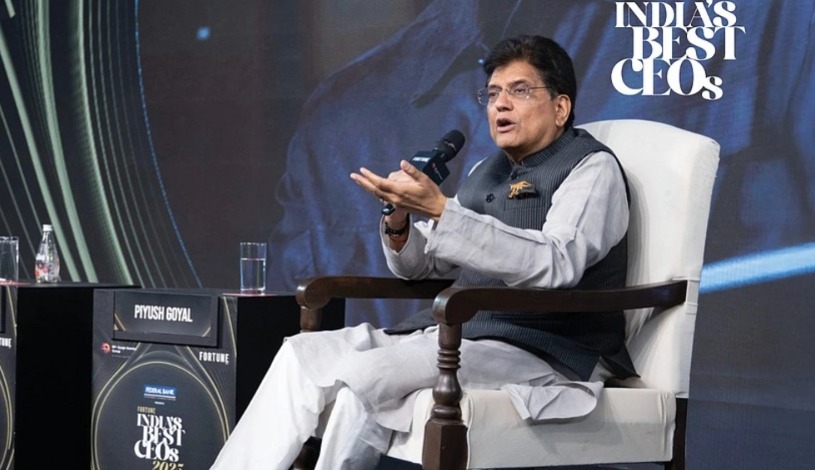
Speaking at an event in Mumbai on Monday, Goyal made an unusually sharp appeal to Indian big business, accusing sections of the country’s wealthy elite of not doing enough to back homegrown innovation at the earliest stages.
“I have a complaint about many of the billionaires that Indian domestic capital is not coming sufficiently to support the Indian startups,” he said. “So I do wish to see Indian companies, Swadeshi capital coming in a big way to promote the startups because there’s tremendous potential.”
‘Sharks’ Killing Startup Ideas Early: Piyush Goyal
The minister painted a stark picture of the funding landscape for early-stage ventures, saying that founders desperate for their first cheques often end up parting with outsized ownership stakes on unfavourable terms.
“Sadly, a startup sellout, a large part of their equity ownership, at abysmally low price, very low price when they need that first seed capital or early stage funding,” Goyal said.
Without naming specific investors, he used strong language to describe predatory funding behaviour in the ecosystem.
He said there are “sharks” who “just tend to kill the ideas of Indian startups or buy them out very cheaply,” suggesting that the lack of adequate domestic capital leaves many entrepreneurs vulnerable at a critical stage of their journey.
Call for a Domestic Capital Pool
Goyal’s central message to India Inc. was clear: step in before foreign investors snap up promising Indian startups on the cheap.
“I want to appeal to all of you, let’s look at a more domestic pool of capital supporting startups,” he told the gathering.
His comments point to a broader push for a more “Swadeshi” or domestically anchored funding architecture, where Indian savings and corporate surpluses are channelled into building Indian-owned technology, platforms and brands, rather than ceding control early in their lifecycle.
Goyal suggested that domestic capital should not be seen as a substitute for public funds, but as a powerful complement.
There is a need, he said, for “domestic capital [to] supplement the money that the government puts up for startups”, framing the state as an enabler and the private sector as a crucial co-investor in India’s innovation story.
Quality, Innovation and Sustainability as Growth Drivers
Beyond funding, the minister also used the platform to remind Indian businesses of the need to compete on the strength of their products and processes, not just on cost or scale.
He urged domestic firms to focus on quality, innovation and sustainability as the core levers to push the country’s economic growth.
By clubbing these three priorities together, Goyal signalled that India’s growth ambitions, in his view, hinge on much more than capital availability alone.
The message to industry was that capital, when combined with better quality standards, original ideas and sustainable practices, can help Indian companies compete more confidently in global markets.
A Subtle Reframing of Responsibility
While the government has frequently showcased its various support schemes for startups, Goyal’s remarks in Mumbai placed the moral and strategic responsibility squarely on the shoulders of India’s wealthiest corporates.
Rather than celebrating unicorn valuations or headline-grabbing deals, his speech turned the spotlight on the uncomfortable reality of ownership — who ultimately controls India’s most promising companies, and at what price that control changes hands.
By describing early-stage investors who extract large stakes at low valuations as “sharks”, and by directly “complaining” about billionaires not doing enough, Goyal moved away from polite, generic appeals and chose sharper, more candid language.
A Moment of Reckoning for India Inc.?
The minister’s intervention effectively poses a pointed question to corporate boardrooms:
If Indian entrepreneurs are building high-potential companies, why should their first lifeline come predominantly from outside India and at terms that dilute their ownership disproportionately?
His call for a domestic startup capital pool, backed by “Swadeshi” money, suggests a vision in which Indian corporates are not just buyers of mature startups or users of their technology, but early believers willing to share risk when ideas are still fragile.
For founders, Goyal’s comments acknowledge a reality they often face quietly: that the price of survival in the early years can be a permanent loss of control.
For India’s big business houses, the message is equally clear, the government expects them to be more than spectators in the startup boom.
Goyal’s speech in Mumbai, framed around capital, quality, innovation and sustainability, underlines a simple but powerful proposition: if India wants to retain long-term ownership of its ideas and innovation, Indian money will have to show up earlier, in larger pools, and on fairer terms.
Also Read: Hoopr Raises ₹4 Crore to Strengthen Its Music Licensing Platform