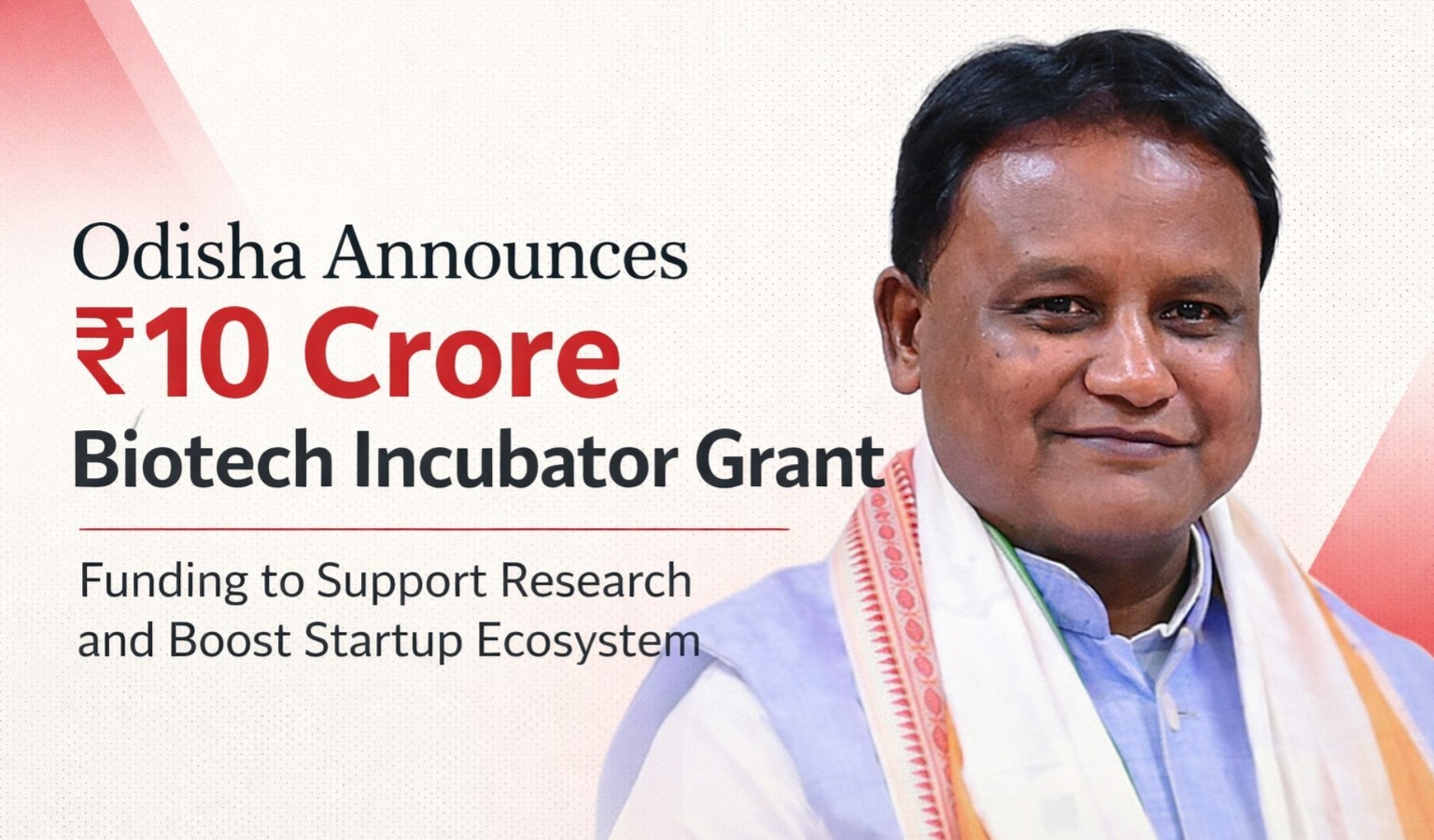
Odisha has announced a new funding push for the biotechnology sector, with Chief Minister Mohan Charan Majhi sanctioning a Rs 10 crore grant framework to support the creation and expansion of bio-incubators in the state through Odisha biotech Incubator Grant,. The move is positioned as part of the broader “Viksit Odisha” mission and is aimed at strengthening the link between laboratory research and market-ready enterprise.
At its core, the initiative is an attempt to solve a familiar problem in India’s innovation economy: promising scientific work often remains trapped within institutions, unable to travel the last mile into commercial application. By backing bio-incubators, the state is betting on infrastructure that can support translational research, early-stage entrepreneurship, and a more durable biotech startup ecosystem.
The support has been divided into two funding tracks.
The first category is meant for new biotech incubators. Under this window, eligible institutions can receive up to Rs 10 crore over a period of five years to establish new incubation capacity. The second category is designed for existing centres that need expansion or upgradation support. These institutions can receive up to Rs 5 crore over three years, with an extension possible if performance benchmarks are met.
That structure matters. It shows the state is not treating all incubators as the same. New institutions need patient capital and time to build from the ground up, while established centres often require funds to scale infrastructure, improve services, or widen their research and startup support capabilities. The two-track design reflects that difference.
Among the institutions expected to benefit under the expansion category are KIIT-Technology Business Incubator, the Institute of Life Sciences, and NIT Rourkela. Their inclusion points to the state’s intention to build on existing scientific and academic strength rather than start entirely from scratch. If implemented effectively, this could give Odisha a stronger base in advanced biological research and entrepreneurship support.
The government has also laid out clear eligibility conditions, suggesting that the scheme is being framed as a performance-linked institutional support system rather than a broad subsidy announcement.
To qualify, an applicant must be a legally registered organisation. That could include an academic institution, a research organisation, or a private biotech company. The host institution must have been operating in Odisha for at least five years. It must also provide a minimum of 5,000 square feet of built-up space and appoint a full-time chief executive officer for the incubator. The expectation is that the incubator should move towards self-sustainability within five years.
These conditions are important because they set a fairly serious threshold for entry. The state is not merely funding an idea on paper; it is asking for institutional credibility, physical infrastructure and leadership capacity. In the startup ecosystem, incubators often succeed or fail not on intent, but on execution. Dedicated leadership and long-term viability are therefore central to the model being proposed.
The selection process, too, appears to be layered. Applications will first go through an initial screening, followed by review by the Project Evaluation and Review Committee, or PERC. The committee is expected to include experts drawn from government, academia and industry. According to the report, Science and Technology Minister Nityananda Gond said the funding will be released in phases, linked to performance, and backed by annual audits.
That last detail may turn out to be one of the most significant elements of the policy. Incubation support, particularly in research-heavy sectors like biotech, requires more than headline allocation. It requires accountability, measurable outcomes and institutional discipline. By tying disbursement to performance and annual audits, the government appears to be signalling that this will be monitored as an outcome-driven programme.
The broader promise of the scheme lies in what incubators can actually offer. The government’s stated goal is to support entrepreneurs with shared lab facilities, equipment and legal advisory services. For biotech startups, these are not small benefits. Unlike many digital ventures, biotech founders cannot build and test products with only laptops and rented desks. They need expensive equipment, controlled facilities, regulatory understanding and research support systems. In that sense, incubation in biotechnology is not just mentorship-led; it is infrastructure-led.
That is why this announcement deserves attention beyond its funding number. The Rs 10 crore headline is important, but the bigger story is that Odisha is trying to build the enabling architecture of a bio-economy. It is making a policy choice to support institutions that can nurture scientific enterprise over time.
Whether this turns into a true biotech growth story will depend on implementation. The quality of institutions selected, the rigour of the review process, the pace of fund release, and the ability of incubators to generate viable ventures will all determine whether the programme creates lasting value. But as a policy signal, the direction is clear: Odisha wants research, entrepreneurship and public support to work in tandem.
For a state looking to deepen its innovation footprint, that is a serious statement of intent.
Also Read: What Was Harshad Mehta Worth at the Height of His Rise?