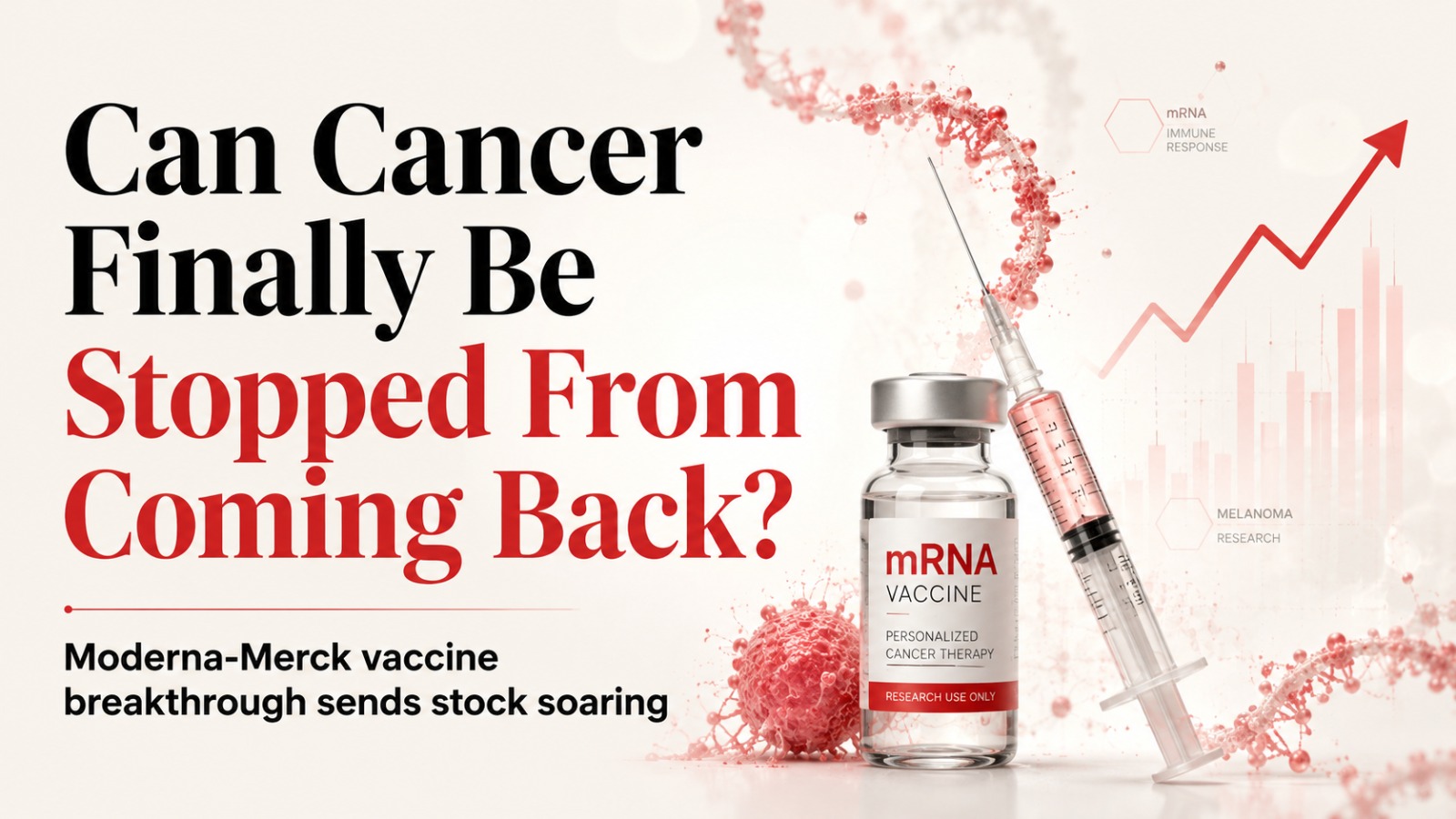
Moderna and Merck’s personalized mRNA cancer vaccine, combined with Keytruda, met key goals in a pivotal melanoma study. The clinical result sent Moderna shares sharply higher and gave investors their strongest late-stage evidence yet that personalized mRNA treatment can work against cancer.
A cancer vaccine tailored to mutations found in an individual patient’s tumor has delivered the kind of result Moderna and Merck have spent years trying to reach.
The companies reported positive initial results from a Phase 3 study testing their personalized mRNA cancer vaccine alongside Merck’s immunotherapy Keytruda in patients with higher-risk or advanced melanoma. More than 1,100 participants had already undergone surgery to completely remove detectable cancer, making the central question of the trial particularly important: could the combination keep the disease from returning for longer than Keytruda alone?
The initial answer was positive.
The combination significantly extended the period patients lived without their melanoma returning compared with Keytruda alone. It also reduced the risk of the cancer spreading to distant parts of the body, meeting the study’s key goals.
For Moderna, the clinical readout quickly became a stock-market event. Its shares surged dramatically as investors digested what the result could mean not only for melanoma, but also for the company’s broader personalized cancer vaccine program.
What exactly did the Phase 3 trial show?
The study tested an mRNA-based personalized cancer vaccine in combination with Keytruda against Keytruda alone.
Unlike a standardized treatment given in exactly the same form to every patient, the vaccine is designed around mutations found in an individual patient’s tumor. The aim is to teach the immune system to recognize those specific cancer markers. Keytruda is then used alongside that response to help the body attack the cancer more effectively.
That personalized approach is central to why this trial has attracted so much attention.
The Phase 3 study involved more than 1,100 people with higher-risk or advanced melanoma whose detectable tumors had been completely removed through surgery. The combination met the study’s main goal by significantly extending recurrence-free survival, meaning patients went longer without their melanoma coming back. It also produced a benefit in preventing the disease from spreading to distant parts of the body.
The findings also build on positive Phase 2 results previously reported for the same combination.
There is another reason the result stands out. The late-stage success was described as the first successful final-stage study for an mRNA-based cancer therapy, giving the platform a milestone far beyond Moderna’s experience with infectious-disease vaccines.
Why did Moderna stock surge so much?
The market reaction was immediate, but the exact percentage varied because different reports captured the stock at different moments during an unusually volatile session.
The stock had climbed around 100% earlier in the morning.
Merck’s shares also rose, climbing more than 8% in premarket trading in one report, but Moderna’s move was far larger. One factor helping explain that difference is company size. Merck entered the session with a market value of around $333 billion, compared with roughly $25 billion for Moderna. A major new program can therefore have a much larger proportional effect on how investors value the smaller company.
The importance investors placed on the readout was evident even before the results arrived. A Leerink Partners analyst had characterized the Phase 3 outcome as a “make-or-break” event for Moderna’s stock.
The rally, in other words, was not simply a reaction to another encouraging research update. Investors were responding to evidence from a pivotal late-stage trial that Moderna’s personalized cancer vaccine platform could clear one of its most consequential clinical tests.
What makes this cancer vaccine different?
The word “vaccine” can create the wrong impression if it is viewed only through the lens of preventing an infectious disease.
Here, the treatment is being developed for people who have already been diagnosed with melanoma and undergone surgery to remove detectable cancer.
Tumors can carry different mutations even among people with the same type of cancer. The personalized vaccine is designed to target mutations specific to an individual patient’s tumor rather than relying on a single identical treatment for everyone.
The goal is to direct the immune system toward those unique cancer markers and then combine that targeted response with Keytruda.
That makes the Phase 3 result important on two levels. It provides evidence for the melanoma program itself, while also offering support for the larger idea of using personalized mRNA technology as part of cancer treatment.
Does this mean the vaccine is ready for approval?
Not yet.
The positive topline result moves Moderna and Merck closer to seeking regulatory approval, but important work remains.
The Phase 3 trial is continuing to evaluate additional outcomes, including whether the treatment ultimately improves overall survival. The companies also plan to present the data at an international medical meeting. The material available so far does not establish when they will file an application for U.S. approval.
That distinction matters. The trial has met important efficacy goals, but the initial announcement is not the same as a regulatory approval or a complete final dataset.
Safety will also remain part of the evaluation. Merck’s Dr. Jane Healy described the therapy as well tolerated and said its side effects were similar to those seen with vaccines commonly given for other diseases.
For patients and investors alike, the next major pieces of information will therefore include the fuller clinical presentation, continued follow-up and the companies’ eventual regulatory plans.
Why the result could matter beyond melanoma
The commercial and scientific stakes extend beyond a single skin cancer study.
Moderna and Merck are already studying the personalized vaccine approach in other tumor types, including non-small cell lung cancer, bladder cancer and renal cell carcinoma.
Success in melanoma does not prove that the treatment will work in those cancers. Each program has to produce its own evidence.
What the melanoma result does provide is late-stage validation for the underlying personalized treatment strategy. That is significant because every additional cancer indication would test whether the approach can travel beyond the disease in which it has now produced its strongest clinical result.
This is also why the stock reaction has to be understood as more than a bet on one melanoma product. Part of Moderna’s valuation has been tied to expectations that personalized cancer vaccines could eventually have applications across multiple tumor types. The Phase 3 result gives those expectations new clinical evidence, but future trials will determine how far that potential actually extends.
The bigger picture for Moderna
For Moderna, the readout arrives as a major test of whether its mRNA platform can establish a meaningful role beyond the applications that originally made the company widely known.
That question is not completely answered by one trial. But the Phase 3 melanoma result represents a substantial step because it came from a large late-stage study, involved more than 1,100 patients and demonstrated an improvement over Keytruda alone on important measures of cancer recurrence and spread.
The extraordinary stock reaction reflects that distinction.
Investors were not handed a finished commercial story on Wednesday. Overall survival is still being followed, detailed data remain to be presented, the timing of an approval filing is uncertain and success in other cancers remains to be demonstrated.
What they did receive was something more concrete than another early clinical signal: evidence that a personalized mRNA cancer vaccine could succeed in a pivotal Phase 3 setting.
For Moderna and Merck, that makes the melanoma trial both a treatment milestone and a platform test. For Moderna’s stock, it was enough to trigger one of the most dramatic repricings in the company’s recent trading history.
Also Read: Avengers: Doomsday Presales Race Ahead of Spider-Man: Brand New Day