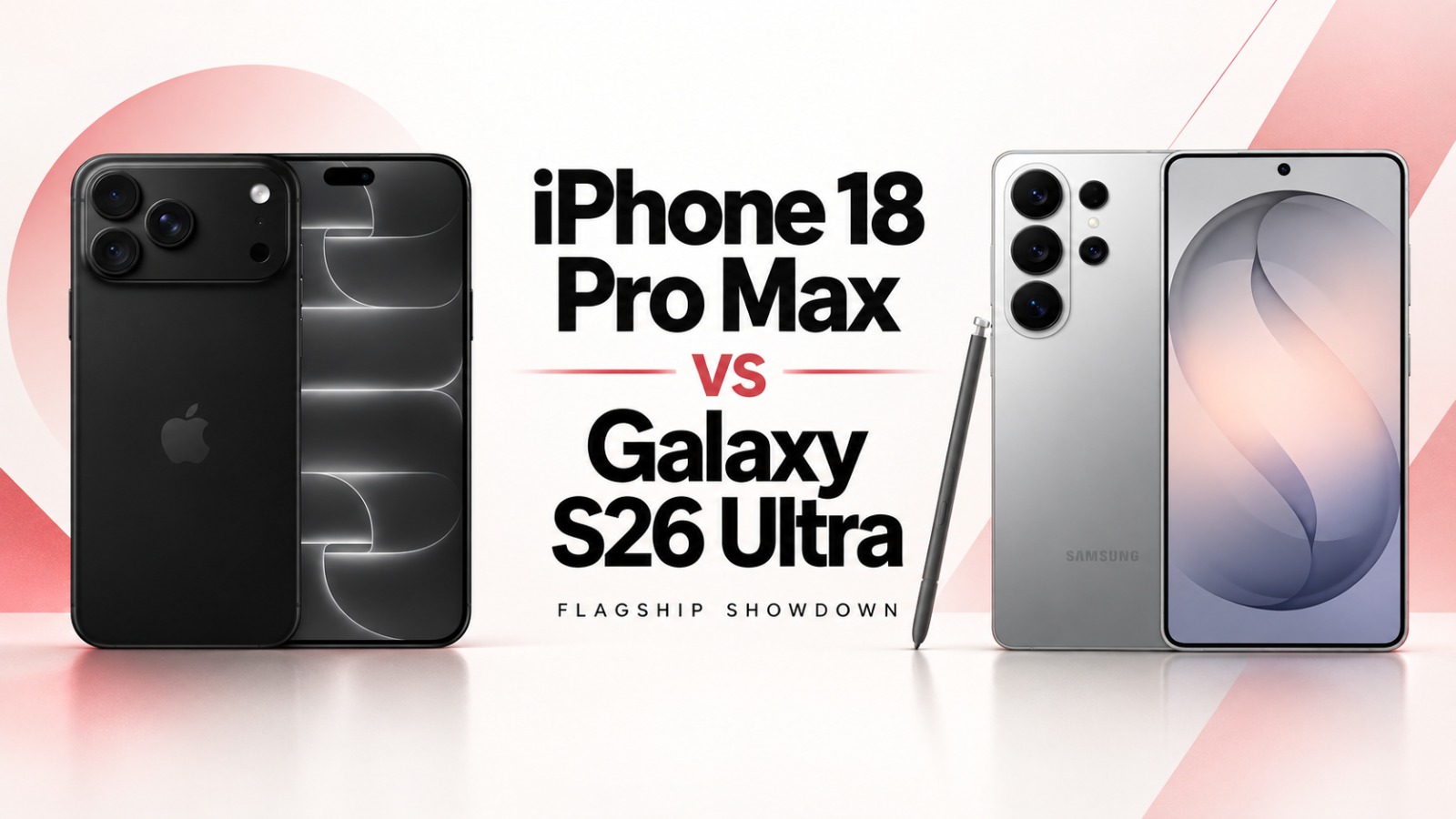
Apple’s iPhone 18 Pro Max and Samsung’s Galaxy S26 Ultra may be chasing the same premium smartphone buyer, but their approach to getting there is noticeably different. Both phones bring large displays, powerful processors, advanced camera systems and extensive AI capabilities, yet the features each company chooses to emphasise tell two different stories.
The iPhone 18 Pro Max puts Apple’s hardware and software integration at the centre of the experience, backed by the new A20 Pro chip and an emphasis on video. Samsung, meanwhile, pushes the Galaxy S26 Ultra in another direction, with a higher-resolution display, versatile zoom cameras, the S Pen and faster wired charging.
That difference may matter more than any single specification.
iPhone 18 Pro Max and Galaxy S26 Ultra start from surprisingly similar displays
One of the more interesting details in the iPhone 18 Pro Max vs Galaxy S26 Ultra comparison is how similar the basic display formula is.
Both smartphones feature large 6.9-inch screens and support a 120Hz refresh rate. That gives Apple and Samsung a common starting point for activities such as gaming, streaming and everyday scrolling.
The similarity ends when the display technologies come into focus.
Apple uses its OLED display technology on the iPhone 18 Pro Max, while Samsung equips the Galaxy S26 Ultra with a Dynamic AMOLED 2X panel. The Galaxy S26 Ultra also holds the resolution advantage in the comparison.
For buyers looking at the two phones side by side, then, screen size and refresh rate are unlikely to be the main differentiators. Both deliver the same 6.9-inch, 120Hz headline figures. Samsung’s pitch goes further on resolution, while Apple’s broader proposition is built around how its display, processor and software work together.
Apple puts the A20 Pro chip at the heart of its flagship
The iPhone 18 Pro Max is powered by Apple’s new A20 Pro chip, with the phone’s positioning leaning heavily on the company’s familiar hardware-software integration.
That matters because Apple’s approach here is not presented simply as a contest over an isolated specification. The A20 Pro sits alongside the iPhone 18 Pro Max’s video capabilities as part of a tightly integrated flagship package.
The Galaxy S26 Ultra takes a different route. It is also described as having a powerful processor, but the comparison places greater emphasis on the wider collection of features surrounding it rather than making the processor the sole focus.
Both phones, importantly, are positioned as high-performance devices rather than models built around compromises. The distinction lies in what Apple and Samsung want buyers to notice first.
Cameras highlight another split between Apple and Samsung
The camera comparison follows much the same pattern.
Apple’s iPhone 18 Pro Max places particular emphasis on video capabilities. Samsung’s Galaxy S26 Ultra, in contrast, is highlighted for its versatile zoom cameras.
That creates a useful distinction without turning the comparison into a simple winner-and-loser exercise. Both smartphones are described as offering advanced camera systems, but the strengths being highlighted are not identical.
The available information does not provide detailed camera sensor figures or zoom ranges, so attaching additional megapixel counts, focal lengths or performance claims would go beyond what has been established here.
What can be said is that Apple’s flagship leans toward its video proposition, while Samsung is making camera versatility, particularly zoom, one of the Galaxy S26 Ultra’s prominent advantages.
Galaxy S26 Ultra adds the S Pen and faster wired charging
Samsung also has two features that more clearly separate the Galaxy S26 Ultra from its Apple rival: the S Pen and faster wired charging.
The S Pen gives Samsung another element in its flagship proposition beyond the usual display, processor and camera contest. Apple’s iPhone 18 Pro Max comparison, meanwhile, centres much more strongly on integration, processing and video.
Charging is another area where the Galaxy S26 Ultra is identified as having an advantage, with faster wired charging highlighted among its strengths. No charging wattages are stated in the information available, so the comparison here is directional rather than numerical.
That distinction is important. It establishes Samsung’s faster wired charging as a differentiator without inventing a specification that has not been confirmed in the supplied material.
AI is part of both phones, but not the deciding factor here
AI capabilities are also part of the package on both smartphones.
The iPhone 18 Pro Max and Galaxy S26 Ultra are described as offering extensive AI capabilities, although individual AI features are not detailed in the available comparison.
That leaves AI as a shared part of the premium experience rather than the clearest dividing line between these two devices, at least on the information currently established.
Instead, the sharper differences emerge elsewhere: Apple with the A20 Pro chip, hardware-software integration and video focus; Samsung with display resolution, zoom-camera versatility, the S Pen and faster wired charging.
iPhone 18 Pro Max vs Galaxy S26 Ultra: the bigger difference is philosophy
On paper, the two phones have plenty in common. They occupy the top end of their respective line-ups, share the same 6.9-inch display size and 120Hz refresh rate, and both arrive with powerful processing, sophisticated camera systems and AI capabilities.
Yet their similarities make the areas of disagreement more interesting.
The iPhone 18 Pro Max appears built around Apple’s preference for making its hardware, software and processor work as one tightly connected proposition, with the A20 Pro chip and video capabilities playing prominent roles.
Samsung’s Galaxy S26 Ultra spreads its appeal across a broader set of visible differentiators. A higher-resolution display, versatile zoom cameras, the S Pen and faster wired charging give buyers several specific reasons to consider Samsung’s flagship.
There is no universal winner in that equation based solely on the verified details available. Instead, the comparison points to a choice between two flagship philosophies.
For someone deciding between the iPhone 18 Pro Max and Galaxy S26 Ultra, the most revealing detail may therefore not be that both phones have 6.9-inch 120Hz displays. It is what Apple and Samsung chose to build around those nearly identical headline screen specifications.
Also Read: iPhone Duo Price in US, UAE, India, Hong Kong, Canada & More: Where Is It Cheapest?