

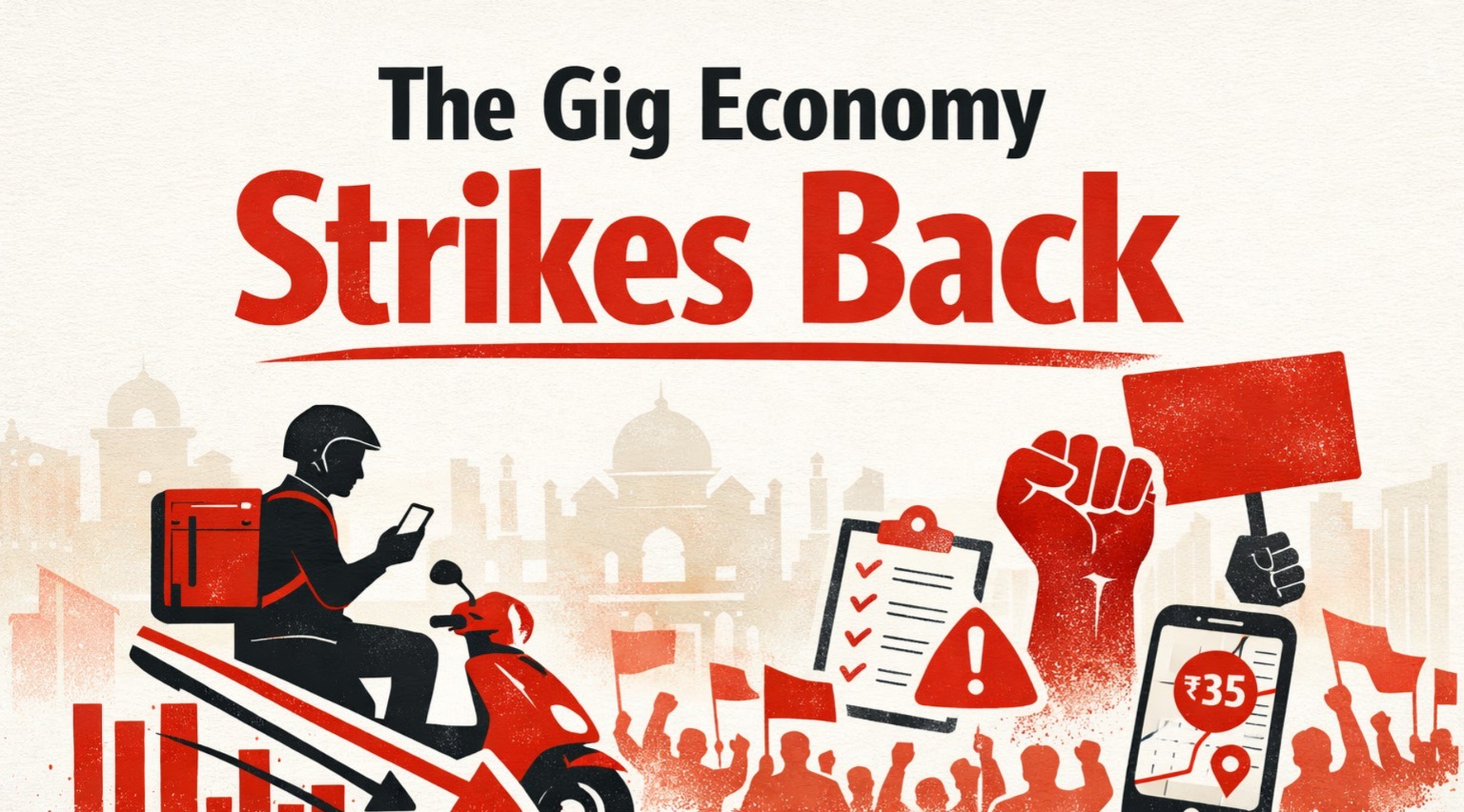
For so long, the Indian gig economy was hailed as a badge of contemporary employment and a marker of speed and efficiency in its own right. However, towards the end of December, things began to fall apart.
Two nationwide strikes, one on December 25 and another on December 31, turned the spotlight away from convenience and toward the uncomfortable mechanics of how India’s platform economy actually functions.
The strikes were not isolated incidents. They were the most visible expression of a deeper unease that has been building inside India’s app-based labour system. Around forty thousand delivery workers participated in the December 25 shutdown, disrupting an estimated half of all deliveries in several major cities.
The timing of the second strike, on New Year’s Eve, was deliberate. It targeted one of the most profitable nights of the year, forcing platforms, consumers, and policymakers to confront a reality that is usually hidden behind push notifications and discount banners.
What triggered the shutdowns was not a single decision or pay cut, but an accumulation of pressures that workers say have made the work increasingly unpredictable. The delivery partners talk of declining earnings per order, constantly changing incentive schemes, penalties for no reason, and deactivating accounts without notice that could suddenly nullify their only source of income.
The sense that the rules keep changing, without consultation or recourse, has become as important as the money itself.
Yet the strikes also exposed a contradiction at the heart of gig work. On New Year’s Eve, many workers still logged in. The reason was not loyalty to platforms, but necessity. One delivery worker summed up the dilemma in plain terms: “Normally 30-40 rupaye milte hain. Aaj almost triple mil raha hai. Strike karein ya kaam?” In a labour market where income volatility is constant, peak-day incentives act as both relief and restraint.
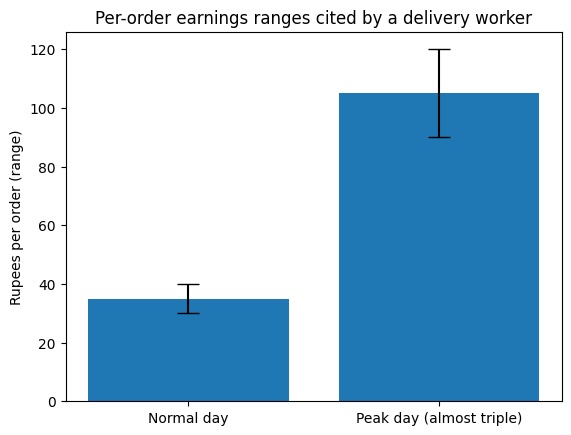
They offer short-term gain while making collective protest economically risky for those who live day to day.
At the centre of worker frustration is not just pay, but control. In the gig economy, authority does not wear a uniform or sit in an office. It lives inside the app. Workers repeatedly describe the same experience: orders, earnings, penalties, and even termination are governed by automated systems that cannot be questioned. “App sab decide karta hai, order, paisa, penalty,” one worker said, adding that when something goes wrong, there is no real system to be heard.
The absence of a meaningful grievance mechanism has turned algorithmic efficiency into a source of anger. When decisions feel arbitrary and irreversible, trust collapses.
For platforms, this breakdown of trust creates a business risk that is rarely acknowledged in public statements. This lack of workforce stability has been known to affect deliverability. The December 25 workforce went on strike, thereby hampering deliveries. The workforce on December 31 put into question whether it is possible to rely on mere incentives. When it is organized, it becomes questionable whether the concept of an unlimited workforce is feasible.
The conflict escalated further after a remark attributed to Zomato’s CEO, who referred to striking workers as “miscreants.” The choice of word triggered political backlash. AAP MP Raghav Chadha publicly criticised the remark, arguing that workers demanding fair treatment could not be dismissed as troublemakers. With that intervention, the gig economy dispute crossed into political territory. What had been framed as an internal platform issue became a question of dignity, rights, and the limits of corporate power.
But alongside the street battle, another battle is brewing on the internet. And the gig economy has suddenly become the battleground on which the ideological war is fought. “Capitalism is not perfect, but it is the only engine we have seen that creates value. Create first, and distribute second,” says Deepinder Goyal.
Reverse the order, and we distribute scarcity.” This was echoed in the words of Kunal Shah, for in his view capitalism was the only method that has been proven to be able to extract people from poverty. Chander Bhatia applied the concept to state capacity, suggesting governments do not have the means to fund the welfare states without the taxes created by capitalism.
Pushing back against this binary framing, Dhruv Rathee argued that no economy operates on pure ideology. “Even the most capitalist country has elements of socialism, and the most socialist country has elements of capitalism,” he said, warning against blindly trusting theoretical models. What this debate revealed was less about economic doctrine and more about discomfort. The gig economy has grown large enough to force uncomfortable questions about who bears risk and who benefits from scale.
One of the least discussed aspects of the current model is how speed reshapes risk. Ultra-fast delivery promises shift pressure downward. Workers report being pushed to meet unrealistic timelines regardless of traffic, weather, or pollution. On days of hazardous air quality or severe congestion, expectations do not change, but penalties remain. The cost of convenience is absorbed by the worker’s body and time, while consumers experience frictionless service.
There has been movement on the legal front. The Code on Social Security, 2020 formally recognises gig and platform workers and provides a framework for welfare boards and social security funds funded by aggregators. On paper, this marks a significant shift.
What happens is that the employees still lack clarity on the implementation process, eligibility, and timelines. More importantly, the social security system does not provide solutions to the real-life concerns underlying the strikes related to income unpredictability, unclear fines, as well as the unilateral deactivation mechanism.
The December strike is not a culmination point. It is a signal. It indicates that the gig economy of India has matured beyond a point when merely having growth is a sufficient reason for having a structure with holes in it.
Platforms have grown faster than the systems to manage them. Algorithms have substituted supervisors without substituting accountability. Flexibility is no longer separable from insecurity.
The future of the gig economy has nothing to do with ideology or bonus payments. The future of the gig economy has to do with whether the platforms are willing to abide by transparent rules, whether the rules on minimum standards are enforced, whether there is truly a voice for the workforce in the systems that do not currently operate on appeal. If these issues are left in the dark, strikes won’t be the exception to the rule. They’ll be the rule.
India’s gig economy is still growing. But it is no longer just a story about innovation. It is a story about power and whether that power will be exercised with restraint, or challenged in the streets again.
Also Read: What Is Deepinder Goyal’s $25 Million ‘Continue Research’?















